

Introduction To Concept Of Social Enterprise Startups Powerpoint Presentation Slides





Try Before you Buy Download Free Sample Product
 Impress Your
Audience
 100%
Editable
 Save Hours
of Time


Embark on your social enterprise startup journey with our comprehensive Introduction to Concept of Social Enterprise Startups PowerPoint Presentation. This step by step guide is designed to assist entrepreneurs in establishing a for profit social business startup that addresses the needs of people and the community. The Social Enterprise Startup PPT deck provides a thorough overview of social startups, including their types, objectives, and key statistics relevant to social business startups. It outlines the essential steps involved in setting up a social startup, such as identifying a viable idea, defining a business model, establishing a mission, developing a robust business plan, setting a budget, securing financing, and assembling the right team. Furthermore, the Social Enterprise PPT module covers the fundamentals of social startup marketing, including conducting market research, staking claims to your business territory, and developing an effective marketing plan. Lastly, it also addresses the challenges entrepreneurs commonly face when launching a social business startup. Download our 100 percentage editable and customizable template, compatible with Google Slides, and embark on your journey to create a successful social enterprise startup.
People who downloaded this PowerPoint presentation also viewed the following :
Content of this Powerpoint Presentation
Slide 1: This slide introduces Introduction to Concept of Social Enterprise Startups. State your company name and begin.
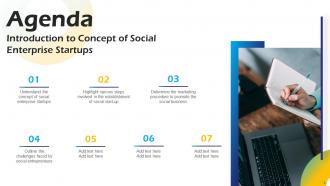
Slide 2: This is an Agenda slide. State your agendas here.
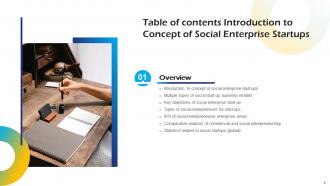
Slide 3: This slide shows Table of Content for the presentation.
Slide 4: This slide continues showing Table of Content for the presentation.
Slide 5: This slide shows title for topics that are to be covered next in the template.
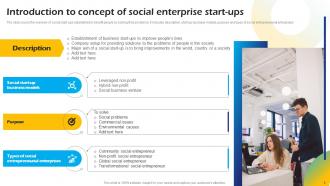
Slide 6: This slide covers the overview of social start-ups established to benefit people by solving their problems.
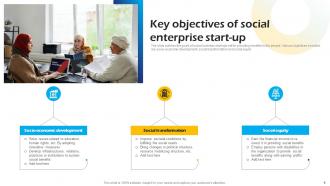
Slide 7: This slide outlines the goals of social business start-ups set for providing benefits to the people.
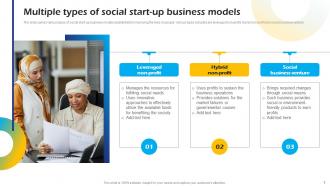
Slide 8: This slide presents various types of social start-up business models established for improving the lives of people.
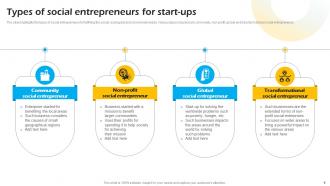
Slide 9: This slide highlights types of social entrepreneurs for fulfilling the social, ecological and commercial needs.
Slide 10: This slide presents various areas to be determined for establishing a social business start-up.
Slide 11: This slide displays the comparison between social and commercial entrepreneurship to understand the key difference.
Slide 12: This slide contains the stats summarizing the current status of social entrepreneurial start-ups worldwide.
Slide 13: This slide shows title for topics that are to be covered next in the template.
Slide 14: This slide illustrates the survey results highlighting the common challenges faced by social entrepreneurs in establishing their business start-ups.
Slide 15: This slide presents common start-up challenges faced by entrepreneurs in establishing and growing a social business.
Slide 16: This slide shows title for topics that are to be covered next in the template.
Slide 17: This slide highlights the process of establishing a social business start-up to help the people by solving their problems.
Slide 18: This slide shows title for topics that are to be covered next in the template.
Slide 19: This slide presents an introduction to the ideas for starting up a social enterprise for benefitting the people.
Slide 20: This slide displays a process of selecting the idea for setting a social entrepreneurial start-up.
Slide 21: This slide highlights various business startup ideas for establishing a social entrepreneurships.
Slide 22: This slide exhibits the assessment of market demand for selecting an appropriate idea for starting a social enterprise.
Slide 23: This slide presents the business idea evaluation for selecting an appropriate idea to establish a social startup.
Slide 24: This slide shows title for topics that are to be covered next in the template.
Slide 25: This slide outlines the introduction of business models used by social start-ups to solve the social issues.
Slide 26: This slide presents various steps for selecting an appropriate business model for establishing a social startup.
Slide 27: This slide describes various types of business models used by social enterprise startups for serving the people.
Slide 28: This slide shows title for topics that are to be covered next in the template.
Slide 29: This slide presents the introduction to the company’s mission statement used for building and launching the business.
Slide 30: This slide highlights the steps of designing and building a mission statement for getting differentiated from the business competitors.
Slide 31: This slide presents various tips for writing mission statements for the social start-up to effectively communicate the business operations.
Slide 32: This slide shows title for topics that are to be covered next in the template.
Slide 33: This slide exhibits the overview of business plan to effectively start a social enterprise to solve the people’s problems.
Slide 34: This slide illustrates a business plan outlining the executive summary, company structure, market analysis, competitive analysis etc.
Slide 35: This slide displays various practices for the development of business plan to ensure defining the tasks, operations and strategies.
Slide 36: This slide illustrates a business plan in the form of a canvas to represent problems, solutions, unique value proposition etc.
Slide 37: This slide shows title for topics that are to be covered next in the template.
Slide 38: This slide involves the overview of setting up a budget for the social business start-up to plan and arrange the required funds.
Slide 39: This slide presents various steps of setting up the budget for start-up to estimate the capital required in establishing a social business.
Slide 40: This slide displays a program-based budget plan for the social enterprise startup to effectively manage the finances.
Slide 41: This slide demonstrates an annual budget for highlighting the estimated funds required for the business and its operations.
Slide 42: This slide shows title for topics that are to be covered next in the template.
Slide 43: This slide presents an overview of selecting an appropriate source of finance for funding the social business start-up.
Slide 44: This slide displays various sources of finance available for providing funds to the social business start-up.
Slide 45: This slide shows title for topics that are to be covered next in the template.
Slide 46: This slide outlines the selection of the right people for the social startup team to achieve the business objectives.
Slide 47: This slide highlights various steps of selecting the right people for social business start-ups to get an effective team.
Slide 48: This slide presents various job roles available for recruiting the people to create an effective social start up team.
Slide 49: This slide shows title for topics that are to be covered next in the template.
Slide 50: This slide outlines the overview of social start-up marketing to communicate the brand’s message to the different stakeholders.
Slide 51: This slide presents various strategies used by social entrepreneurs to increase brand awareness.
Slide 52: This slide shows title for topics that are to be covered next in the template.
Slide 53: This slide illustrates various steps of planning and implementing marketing strategies to promote social start-ups and for raising funds.
Slide 54: This slide presents various steps and best practices for conducting marketing research to understand the needs of target group.
Slide 55: This slide highlights various steps and practices for acquiring the business territory to create a market presence.
Slide 56: This slide illustrates various steps of developing an effective action plan for the social enterprise marketing along with the best practices.
Slide 57: This slide displays the process of branding the social enterprise to increase the attract the potential customers towards the business.
Slide 58: This slide exhibits the process of testing customer acquisition strategies in the target market to increase conversion rates.
Slide 59: This slide outlines the process of selecting and making an effective investment in marketing strategies to enhance brand perception.
Slide 60: This slide shows all the icons included in the presentation.
Slide 61: This slide is titled as Additional Slides for moving forward.
Slide 62: This is Our Vision, Mission & Goal slide.
Slide 63: This slide shows Post It Notes for reminders and deadlines. Post your important notes here.
Slide 64: This is About Us slide to show company specifications etc.
Slide 65: This slide describes Line chart with two products comparison.
Slide 66: This slide depicts Venn diagram with text boxes.
Slide 67: This is an Idea Generation slide to state a new idea or highlight information, specifications etc.
Slide 68: This slide presents Roadmap with additional textboxes.
Slide 69: This is a Thank You slide with address, contact numbers and email address.
Introduction To Concept Of Social Enterprise Startups Powerpoint Presentation Slides with all 72 slides:
Use our Introduction To Concept Of Social Enterprise Startups Powerpoint Presentation Slides to effectively help you save your valuable time. They are readymade to fit into any presentation structure.












FAQs for Introduction To Concept Of Social Enterprise Startups
So social enterprise startups put solving problems first - like environmental stuff or helping disadvantaged communities get jobs. Profit comes second, which is honestly pretty refreshing. They measure success differently too, tracking things like waste reduced or people helped instead of just shareholder returns. Most profits get pumped back into the mission rather than lining pockets. The whole business model revolves around the cause from day one, not some afterthought CSR thing. If you're thinking about this route, you'll need both a clear social impact story and a way to actually make money. Both matter.
Start with specific goals that actually mean something - "cut food waste by 30%" beats "save the planet" any day. Track the obvious stuff like how many people you're helping and money saved, but also grab some real feedback through quick surveys. Honestly? Most startups way overthink this and never actually start measuring anything. Just use Google Forms or look into SROI frameworks - nothing fancy needed. The trick is collecting data from day one, even if your system's kinda messy at first. You'll figure out the perfect method later, but you can't go back and recreate data you never collected.
Honestly, you're in a pretty good spot funding-wise. Impact investors are huge right now - they want businesses that actually solve problems AND make money. Grants are everywhere too if you dig around foundations and government stuff. Crowdfunding crushes it for social enterprises because people get excited about causes. I'd probably start by finding foundations that match your thing. Oh, and check out revenue-based financing or social impact bonds depending on what you're doing. Kiva Microfunds has good connections, though their website's kinda clunky. Way more options than regular startups get.
Don't think of social impact as something separate from making money - make it your main selling point. Look at TOMS or Grameen Bank. They built their entire revenue around their mission. TOMS sells shoes to fund donations, Grameen makes microloans work through volume and community pressure. Honestly? It's way trickier than regular businesses since you're juggling two goals. But here's the thing - your customers need to see the social good as the main reason they're paying you, not just some bonus feature. Map out how your impact could actually drive sales growth. That's where the magic happens.
Dude, tech is huge for social enterprises. You can reach thousands instead of dozens, plus automate all that boring admin stuff that eats your budget. Apps have completely changed microfinance and food waste - it's wild. Here's the thing though: don't go crazy trying to tech-ify everything at once. Start small. Figure out what manual tasks are killing your team's time first. Then find simple solutions for those. The goal is freeing up resources so you're doing actual mission work, not drowning in spreadsheets. Real-time impact tracking is pretty sweet too.
Look for orgs that actually align with your mission - not just the flashy, well-funded ones everyone wants to partner with. Those forced partnerships never last anyway. Don't pitch them with some generic "let's collaborate" nonsense. Come with real ideas: co-developing programs, resource sharing, whatever makes sense for both of you. Be honest about what you offer and what you need. Here's the thing though - build those relationships way before you actually need anything from them. Go to their events, comment on their posts, learn their pain points. When opportunities pop up later, you'll already have that trust built up instead of cold-calling them.
Honestly, the hardest part is that profit vs purpose balance - some days you'll feel completely drained by it. Finding the right investors is tricky too since most VCs just don't get the whole dual mission thing. You'll have way better luck with impact investors and social venture funds instead. Oh, and set up your impact KPIs from day one - like how many lives you're actually affecting or whatever metrics make sense for your thing. Here's what I learned the hard way though: don't spread yourself thin trying to solve everything. Pick one problem, crush it, then grow from there. Also start networking with other social entrepreneurs now - they're honestly the best source of real advice.
Honestly, just show don't tell. Real customer stories hit way harder than any fancy marketing copy. Drop some behind-the-scenes stuff too - people love that transparency, especially with social enterprises since everyone's watching for greenwashing. Focus on where your audience actually scrolls (Instagram for younger folks, LinkedIn if you're going B2B). The tricky part is staying consistent everywhere without sounding robotic. Oh, and don't be afraid to share the messy stuff alongside your wins. People respect honesty more than perfection these days. Quick test: look at your current messaging and ask if you'd actually buy into it yourself.
Track the stuff that actually shows your impact - like how many people you're helping, what changes you're seeing, environmental improvements, whatever fits your mission. Get feedback from the people you serve too, because honestly, their opinion matters most. Don't forget the money side though. Cost per person and diversifying your funding sources - boring but necessary if you want to stay afloat. Pick maybe 3-5 metrics that really connect to your goals and stick with measuring those consistently. Oh, and start simple! You can always add more complicated tracking later once you get the hang of it.
Honestly, your customers are gonna dictate pretty much everything about how you set up your social enterprise. Young people today - especially millennials and Gen Z - they're not messing around. They want real transparency and will actually dig into your supply chain if something feels off. So you've got to bake impact reporting right into your operations from the start, which yeah, costs more money. But here's the thing: people will pay extra if they trust you're legit. Your whole business model should be built around proving your impact, not just creating it. These conscious consumers have zero patience for greenwashing.
TOMS Shoes totally nailed this with their "one for one" thing - buy shoes, they donate a pair. Warby Parker copied the model with glasses. Both hit billion-dollar status while actually helping people, which is pretty cool. Oh, and Grameen Bank basically created microfinance from scratch. They won a Nobel Prize for getting people out of poverty with tiny loans! The crazy part? These companies show you don't need to pick between making money and doing good. Your social mission can actually fuel business growth if you set it up right.
Dude, social media is perfect for you guys! Your mission basically writes the content for you. Share real stories from people you've helped - that stuff hits different than corporate posts. Pick one platform first (don't spread yourself thin). LinkedIn's good for finding partners and funding, but honestly Instagram and TikTok are where the magic happens with younger people. I've seen orgs blow up just posting their regular work day. Keep it real instead of super polished - people can smell fake from a mile away. Post regularly for like a month and actually talk to people, don't just shout into the void.
Honestly, it's way different from regular startups. You need the usual stuff - financial planning, fundraising, team building. But stakeholder management becomes this weird juggling act between investors, the people you're helping, and community partners. Impact measurement is probably the biggest thing though - like, you actually have to prove your social outcomes with real data, not just feel-good stories. Fundraising works totally differently too. Storytelling becomes everything since you're basically selling a mission. I'd definitely connect with other social entrepreneurs first, maybe grab a course on impact measurement if you can find a decent one.
Honestly, you can't just swoop in and expect people to trust you right away. Ask them what they actually need instead of assuming you know best. Town halls work great, or maybe start an advisory board with actual community members. I know social media feels easier, but showing up in person consistently beats posting any day. Partner with local groups who already have that trust built up - saves you tons of time. Your team should look like the community you're serving too. Prove you're sticking around long-term, not just doing some feel-good project and bouncing. Start small with one real relationship.
Dude, social enterprises are honestly genius at this stuff. They don't just fake caring about purpose - it's actually built into how they operate day-to-day. What's cool is they juggle everyone's needs, not just investors. Employees, customers, communities... the whole thing. They're also weirdly good at doing more with less money (probably because they have to be). I think the biggest thing you can steal from them? Start building real social impact into your actual business decisions. Sounds cheesy but customers notice authenticity, and it sparks way more innovation than you'd think. Long-term thinking becomes natural when your mission actually matters.
-
The website is jam-packed with fantastic and creative templates for a variety of business concepts. They are easy to use and customize.
-
Topic best represented with attractive design.