


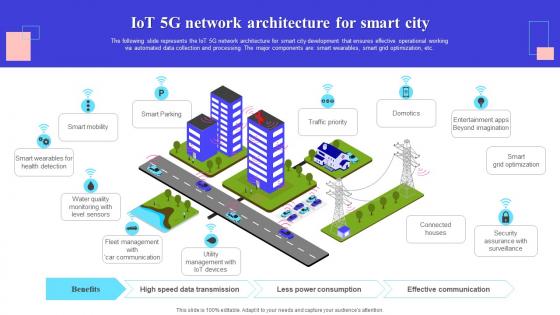
IoT 5G Network Architecture For Smart City




Try Before you Buy Download Free Sample Product
 Impress Your
 Audience
 100%
100% Editable
 Save Hours
 of Time


The following slide represents the IoT 5G network architecture for smart city development that ensures effective operational working via automated data collection and processing. The major components are smart wearables, smart grid optimization, etc.
People who downloaded this PowerPoint presentation also viewed the following :
IoT 5G Network Architecture For Smart City with all 9 slides:
Use our IoT 5G Network Architecture For Smart City to effectively help you save your valuable time. They are readymade to fit into any presentation structure.









FAQs for IoT 5G Network Architecture
So basically you've got three main pieces - the RAN (radio access network) handles connecting all your devices through base stations. Then there's the core network doing all the routing and authentication stuff. Edge computing is where things get interesting though - it processes data right near your devices instead of sending everything back to some distant server. Way faster that way. 5G also does this cool network slicing thing where you can create separate virtual networks for different use cases. Oh and it's all built on service-based architecture. Honestly, I'd sketch out what each layer does for your specific setup first - saves tons of confusion down the road.
Okay so 5G is actually a game-changer for IoT stuff. Latency drops from like 50ms to just 1ms - which is crazy fast. You can now connect a million devices per square kilometer (sounds nuts but think smart cities). For anything real-time like autonomous cars or factory automation, that speed difference matters big time. Oh and there's this thing called network slicing where you basically get dedicated virtual networks for different use cases. Honestly if you're doing any serious IoT project, you'd be missing out not considering 5G from day one.
So edge computing puts your processing power right next to your IoT devices instead of way off in some cloud datacenter. Cuts latency down to milliseconds, which is honestly pretty sweet. Your data gets processed locally - analytics, decisions, all that stuff happens right there. No more sending everything back and forth to the cloud constantly, so you save on bandwidth costs too. The trick is figuring out what processing can actually happen at the edge vs what you'll still need cloud resources for. Makes way more sense than the old setup if you ask me.
So network slicing basically lets you split your 5G network into separate virtual chunks, each one tuned for different IoT stuff. Picture highway lanes - your industrial sensors get the fast, reliable lane while smart meters use a more energy-efficient one with different bandwidth needs. Pretty cool concept, honestly. Each slice runs on its own with guaranteed performance levels, so critical apps don't have to fight with random devices for resources. Oh, and definitely map out your IoT use cases first - you'll need to know what each one actually requires before designing your slices.
So the biggest pain points are gonna be the huge attack surface - like, millions of devices everywhere - plus crappy authentication and data getting intercepted. Network slicing in 5G is actually pretty sweet for this because you can separate IoT traffic from your important stuff. Zero-trust architecture is your friend here, strong end-to-end encryption obviously, and you'll need AI for threat detection since there's no way you're monitoring all that manually. Oh, and check your device auth methods first - any hardcoded credentials need to go immediately.
So basically, 5G's crazy low latency (like under 5ms) works by connecting your IoT stuff directly to edge computing nodes instead of sending everything to some far-away server. Pretty cool for things where timing matters - think self-driving cars, factory equipment, even remote surgery if that's not terrifying to think about. You can also set up network slicing to give your most important devices their own dedicated bandwidth slice. Honestly, I'd start by figuring out which devices actually need instant responses, then talk to your network provider about getting those priority slices set up for the critical stuff.
So mMTC is wild - you're cramming up to a million IoT devices into one square kilometer. Traditional signaling just dies under that load, so networks have to completely rethink connection management. Grant-free access becomes huge, plus they simplify protocols because the usual smartphone handshake stuff doesn't work anymore. Edge computing gets baked in too since centralized processing turns into chaos with all those endpoints. Oh, and plan for ultra-dense from the start - I've seen teams try to retrofit later and it's absolutely brutal.
So basically AI and ML work like traffic controllers for your 5G IoT setup. They'll automatically juggle bandwidth and predict congestion before things get messy. The cool part? ML algorithms figure out which devices need priority access and adjust resources ahead of time. Your latency drops because the system learns usage patterns - no more bottlenecks during busy periods. Oh, and start with AI-driven network slicing if you want quick wins. That's probably your best bet for immediate performance improvements in IoT stuff.
So there are basically three ways to do this. Public networks are the standard telecom stuff - Verizon, AT&T, whatever. You're sharing with everyone else but it's cheaper. Private networks give you your own dedicated setup, which is obviously way better for security and performance but costs more. Most companies I've seen actually go hybrid though - mixing both depending on what they need. Like, you'd use private for your critical sensors that can't have downtime, but public works fine for basic temperature monitors or whatever. Honestly, just map out what your IoT stuff actually does first. That'll tell you whether you need the fancy private setup or if sharing infrastructure is totally fine.
So basically 5G lets you slice up one network into different virtual ones - each optimized for whatever you need. Your self-driving cars get the ultra-fast, low-latency slice while those farm sensors get the battery-saving version since they don't need crazy speed. Manufacturing gets reliable bandwidth for real-time stuff, healthcare gets the secure setup. It's actually pretty clever how each slice has different performance based on what you're doing. I'd figure out your specific IoT needs first, then work backwards from there to pick the right slice type.
Dude, here's the thing - when you've got a million different IoT devices trying to talk to your 5G network, everything gets complicated fast. Smart cars need crazy bandwidth while tiny sensors barely use any data at all. The network has to be like... I don't know, a really good DJ mixing different songs at once? You'll need network slicing so each device type gets its own dedicated connection. Edge computing helps too since it processes stuff locally instead of sending everything to the cloud. Honestly, just map out what devices you're dealing with first, then build your network around those needs.
Dude, so much more bandwidth means your IoT devices can actually send data in real-time without choking your network. No more waiting around for batch processing - you get instant analytics the moment sensors pick up something. Edge computing gets crazy powerful too since it can process huge datasets immediately. Think real-time video from security cams or maintenance alerts that pop up right when equipment starts acting weird. Oh and you'll need to rebuild your data pipelines from scratch basically, but that's worth it. Just adding more devices to your old setup won't cut it anymore.
Honestly, these partnerships are like innovation accelerators. Telecoms bring the heavy infrastructure while IoT companies have the specialized know-how and can move fast. Verizon teams up with AWS or Microsoft to build edge computing that actually works - not just in labs but real world stuff. They cover each other's weak spots pretty well. Telecoms handle the tricky network slicing and keeping latency low. Meanwhile, IoT companies focus on building apps that can really use what 5G offers. Pro tip: always check what partnerships are behind any 5G solution you're considering. That's usually what separates the flashy demos from things that'll actually scale up.
So QoS basically makes sure your IoT stuff gets the network performance it actually needs. Like, autonomous cars need crazy low latency while soil sensors just send occasional updates - totally different requirements. With 5G you can slice up the network and give each application its own bandwidth and reliability levels. Otherwise your critical IoT systems are fighting with people's Netflix binges for network resources, which is... not great when safety's involved. Honestly, the trick is figuring out what QoS parameters you need for each use case first. Then you can set up those network slices properly instead of just crossing your fingers.
So edge computing is getting way more spread out - stuff processes right next to your IoT devices instead of bouncing everything to the cloud. 5G network slicing is getting crazy granular too, where you can basically slice up networks for specific IoT needs. AI optimization is handling bandwidth and latency adjustments automatically now, which honestly feels like magic sometimes. Satellite integration is finally happening for remote spots. Oh and if you're working on anything latency-sensitive, you should probably start thinking about how this affects your projects sooner rather than later.
-
Exclusive and extensive collection of templates. Really helped me create a professional presentation in just no time.
-
Nice and innovative design.