


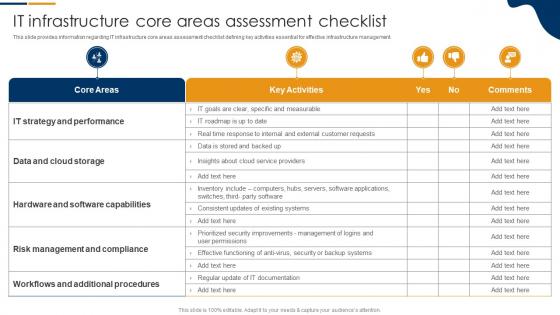
IT Infrastructure Core Areas Assessment Checklist Information Technology Infrastructure Library




Try Before you Buy Download Free Sample Product
 Impress Your
 Audience
 100%
100% Editable
 Save Hours
 of Time


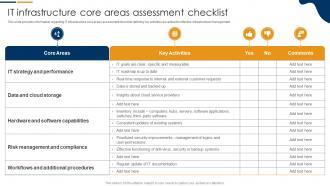
This slide provides information regarding IT infrastructure core areas assessment checklist defining key activities essential for effective infrastructure management.
People who downloaded this PowerPoint presentation also viewed the following :
IT Infrastructure Core Areas Assessment Checklist Information Technology Infrastructure Library with all 6 slides:
Use our IT Infrastructure Core Areas Assessment Checklist Information Technology Infrastructure Library to effectively help you save your valuable time. They are readymade to fit into any presentation structure.





FAQs for IT Infrastructure Core Areas Assessment Checklist Information
So ITIL breaks down into five stages that are pretty straightforward once you get them. You've got Service Strategy for planning what to offer, then Service Design to figure out the how. Service Transition handles rolling stuff out, while Service Operation keeps everything running smoothly day-to-day. Finally there's Continual Service Improvement - basically making things better over time. The names are kind of corporate-y but it's really just plan, build, launch, run, improve. I'd start by seeing which stage your current projects fit into, then dig into those specific processes. Way less intimidating than it sounds initially.
So ITIL is basically about organizing your IT stuff to actually deliver value instead of just putting out fires all day. Most teams are still stuck in reactive mode, which is exhausting. It covers your whole service lifecycle - strategy, design, transition, operations, and improvements. You're treating services like actual products rather than just "things that break." First step? Map out what services you're really providing to the business. That's where everyone should start, but honestly half the teams I know skip this part and wonder why they're always scrambling.
Honestly, ITIL's biggest win is that your systems just break less often. When stuff does go wrong, you'll fix it way faster because everyone knows the drill. No more scrambling around wondering who does what. Your IT team gets actual visibility into what's happening instead of flying blind. Short punchy processes beat chaos every time. Plus you're not just firefighting anymore - you can actually focus on things the business cares about. Start with incident management if you're on the fence about it. That's where most places see results pretty quick, and it's not overwhelming to roll out.
Honestly, you need to measure both the technical stuff and business impact. Start with the obvious ones - how fast you're fixing incidents, whether changes actually work, uptime percentages. But don't stop there. Customer satisfaction scores matter way more than most IT teams think they do. Cost per incident, reduced downtime - that's what leadership cares about. Here's what everyone screws up though: get your baseline numbers BEFORE you change anything. Otherwise you're just guessing if things improved. Also check if people are even using your new processes. Regular stakeholder reviews help too, keeps you focused on the original goals instead of just ticking boxes.
CSI is ITIL's way of making sure you don't just coast - it's all about continuous improvement rather than "good enough." Basically, you're always measuring how things are performing and spotting where stuff falls short. Then you actually do something about it across your whole service lifecycle. It's like having quality control that never takes a break (which honestly, it probably shouldn't). The framework helps you figure out what's worth fixing first based on business impact and what's realistic. My advice? Pick one service that's driving users crazy and try the CSI approach. Quick wins there will get people excited about doing more.
So ITIL is basically about making your IT stuff actually help the business instead of just being cool tech for tech's sake. You start by figuring out what the business actually needs, then build services around that. The whole lifecycle follows this - strategy maps IT to business goals, and you measure success based on real business value, not just "hey our servers are running fast!" Honestly way better than the old days when IT teams would build random stuff because they could. Oh and you've got to keep business people involved in the design process, plus regularly check if your IT spending is actually moving the business forward.
Honestly, resistance to change is gonna be your biggest headache - people absolutely hate switching up their workflows. Getting leadership on board is tough too. Oh, and don't try implementing everything at once because ITIL processes are crazy complex. You'll burn yourself out trying to balance the official framework with what actually works for your company. Training gets pricey fast, and proving ROI? That takes forever. Start with just one or two processes first. Get some wins, then slowly add more. Trust me on this one.
Yeah, totally doable for smaller teams! Just don't try to implement everything at once - that's where people mess up. Pick like 2-3 processes that'll actually help you day-to-day. Incident management is usually a good starting point, plus basic change management. Honestly, half the ITIL framework is just enterprise bloat anyway. Keep your documentation super simple and work with whatever tools you've already got. Once you get those processes running smoothly, then you can think about adding more stuff. I've watched teams burn out trying to do too much too fast - it's not worth it.
So the SVS is basically ITIL 4's centerpiece - connects all your guiding principles, governance, practices, and that service value chain into one framework. Way more holistic than the old lifecycle stuff we used to deal with (thank god). Everything revolves around creating actual value for customers now. Short sentences work here. Instead of just following processes, you're constantly thinking about outcomes people actually want. Honestly, it's like having an operating system that makes all the pieces talk to each other properly. I'd start by figuring out how your current setup maps to the SVS model - makes the transition way smoother.
Okay so incident management is like "oh crap, fix this NOW" - you're just trying to get things working again fast. Problem management? That's the detective stuff where you actually figure out WHY it broke in the first place. Like when your email server dies - incident team restarts it or whatever gets it back up. Then problem management digs into what caused the crash so it doesn't happen again next week. Honestly, most places are way better at the first part than the second. Different timelines, different goals, but they should work together. Quick question when stuff breaks: are you fixing or preventing?
Honestly, ITIL 4 ditched those rigid processes for flexible practices - way better. The Service Value System replaced v3's lifecycle phases, and now you've got four dimensions plus seven guiding principles that don't make you want to bang your head against a wall. DevOps and Agile integration was long overdue since v3 felt super waterfall-ish. Teams can actually adapt it to how they work instead of cramming themselves into process boxes. Oh, and it's much more value-focused now. If you're stuck with v3 stuff, seriously consider moving toward ITIL 4's approach.
Yeah totally doable! Most people overthink this tbh. ITIL's principles work great for governance stuff while Agile handles your dev cycles. Make the ITIL processes way lighter though - ditch those massive change boards for continuous improvement instead. DevOps can actually automate a bunch of the ITIL workflows if you set it up right. They're not competing against each other at all. Map out what you're doing now and see what can be streamlined. The automation piece is honestly where the magic happens - saves so much time.
So ITIL's got this straightforward cert path - you start with the Foundation level, then branch into either Managing Professional or Strategic Leader depending on what you want to do. Training-wise, there's everything from online courses to boot camps to self-study (though honestly, self-study is brutal unless you're super disciplined). AXELOS and PeopleCert are the big names, plus tons of accredited training orgs. The exams are proctored and you'll need continuing ed credits to keep your certs current. I'd just start with Foundation first - it's pretty manageable and helps you figure out which direction makes sense for your career.
So ITIL basically gives IT and business teams the same vocabulary to work with - no more confusing tech jargon that makes everyone's eyes glaze over. The service catalog is probably the most useful part tbh, since it actually shows business people what IT does in terms they get. You'll have better communication through SLAs and regular check-ins too. Here's the thing though - you gotta actively translate your technical stuff into business impact language. Like instead of saying "we patched the servers," say "we improved system reliability." Takes practice but it works.
So I'd start with mapping out your current ITIL processes first - that's honestly the most important step. ServiceNow and Remedy are solid for bigger companies, but they're overkill if you've got a smaller team. Jira Service Management is pretty decent middle ground. You definitely need a good CMDB to track all your assets and how they connect (boring but necessary). Oh, and monitoring tools like Nagios will save your butt since they automatically feed into incident management. Freshservice works great for smaller setups - we used it at my last job and loved it. Really though, pick whatever fits how your team actually works, not what sounds impressive.
-
Awesome presentation, really professional and easy to edit.
-
I want to thank SlideTeam for the work that they do, especially their customer service.