


Key Account Strategies Matrix For Client Management Key Account Management Assessment




Try Before you Buy Download Free Sample Product
 Impress Your
 Audience
 100%
100% Editable
 Save Hours
 of Time


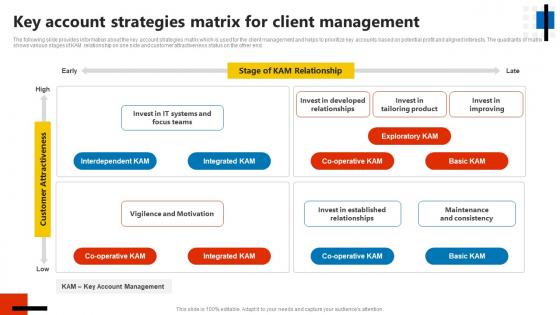
The following slide provides information about the key account strategies matrix which is used for the client management and helps to prioritize key accounts based on potential profit and aligned interests. The quadrants of matrix shows various stages of KAM relationship on one side and customer attractiveness status on the other end.
People who downloaded this PowerPoint presentation also viewed the following :
Key Account Strategies Matrix For Client Management Key Account Management Assessment with all 6 slides:
Use our Key Account Strategies Matrix For Client Management Key Account Management Assessment to effectively help you save your valuable time. They are readymade to fit into any presentation structure.





FAQs for Key Account Strategies Matrix For Client Management Key
Start with strategic account planning and mapping out all your relationships - yeah, it takes forever but trust me on this one. Figure out who the key players are in different departments and what keeps them up at night. Then build custom value props for each account. Set up regular check-ins and quarterly business reviews to track how things are going. Oh, and definitely measure everything with clear KPIs. Honestly? Don't go crazy trying to do this with every account right away. Pick one or two to test it out first.
Focus on three things: revenue impact, growth potential, and strategic value. Your top 20% probably drive most results, so start there. Growth matters too though - which accounts could realistically scale up or expand into new product lines? Don't forget the strategic angle. Some smaller accounts might be in key markets or could become killer case studies later. If they need specialized support or have tons of stakeholders, that's usually a sign they deserve key status. Honestly, I'd just create a simple scoring system and review it every quarter since priorities change.
Honestly, relationships are what make or break you in KAM. Don't just buddy up with your main contact though - you gotta connect with people across the whole organization. These are your biggest accounts, so when stuff inevitably goes sideways, those relationships are what save you. Plus you'll hear about problems way earlier. Map out who actually matters in each account first. Then set up regular check-ins that aren't always about pushing product - maybe grab coffee or whatever. Trust me, the KAMs who nail this part are the ones crushing their numbers while everyone else is scrambling.
Honestly, data analytics is like having a heads up on your biggest accounts before stuff happens. You can see churn coming from a mile away and catch upsell chances your competition totally misses. Those expensive client dinners? Yeah, the data will probably show they don't actually do much lol. Real-time account health tracking is where it's at - way better than just going with your gut. Plus you'll know exactly where to focus your energy instead of spreading yourself thin. My advice? Pick 3-4 solid metrics per account first, then expand. Don't build some crazy dashboard you'll ignore.
Honestly, resource conflicts are gonna be your biggest headache - everyone wants their project prioritized. Misaligned expectations come in close second, plus managing relationships with like 10 different stakeholders who all think they're the most important one. And ugh, when your main contact quits without warning? Nightmare fuel. Set super clear success metrics from day one. Regular check-ins with decision-makers help tons. Build relationships with multiple people, not just one person - learned that the hard way. Keep crazy detailed notes on every conversation and what people prefer. Being proactive beats scrambling later. Map out your stakeholder web now and spot the red flags early.
Dude, key accounts are honestly a whole different beast. They want you to basically be their business bestie - constant check-ins, custom solutions, the works. Regular customers? They're cool with standard service and just getting what they paid for. But these big clients expect you to know their industry better than they do sometimes (which is wild but whatever). They'll want face time with your executives, input on what you're building next, quarterly reviews - the full VIP treatment. Think of it like this: regular accounts buy from you, but key accounts want to partner with you.
Track both the money side and relationship health - you need both to really know what's going on. Revenue growth per account, how much of their total spend you're getting, and renewal rates are your bread and butter metrics. Then look at satisfaction scores and NPS because honestly, pissed off clients don't renew no matter how good your numbers look. Don't forget engagement stuff like how often you're talking and cross-sell wins. Oh, and map out all your contacts at each account - single points of contact are dangerous. Pick maybe 3-4 that actually matter for your accounts and stick with tracking those consistently.
Honestly, CRM systems are game-changers for key account management. They dump all your customer data in one place - interaction history, buying patterns, contact info, the whole nine yards. Your team can actually see what's happening instead of playing guesswork. The automation stuff saves your sanity too (nobody has time for manual follow-ups). But here's what's really cool: the analytics help you catch things you'd miss otherwise. Upsell opportunities, account health red flags, weird trends. My advice? Figure out what metrics actually matter for your key accounts first, then set up your CRM to track those automatically.
Honestly, relationship building is everything in KAM - that's where you make or break it. Communication and negotiation skills are huge too since you're constantly putting out fires and managing expectations. Being able to think strategically matters more than people realize. You need to see the big picture, not just what clients want right now. Oh, and listening beats talking every time - I can't stress that enough. Basic financial knowledge helps you actually understand their business instead of just nodding along. For training, hit up consultative selling courses and get familiar with CRM systems. Shadow someone experienced if you can swing it.
Honestly, it's like comparing apples to oranges. B2B deals take forever - you're dealing with committees, long sales cycles, maybe even years-long partnerships. Think big software contracts or manufacturing stuff. B2C moves way faster but you're managing huge retail chains and distributors instead. The whole relationship thing is different too. B2B clients want strategic planning sessions and those quarterly business reviews (ugh, so many meetings). B2C is more about promotions and making sure stuff gets to shelves efficiently. You've gotta adapt your style completely. B2B means being their go-to advisor, while B2C is all about pushing volume and grabbing market share.
Honestly, most people mess this up by being too reactive. Start with quarterly business reviews - sounds boring but it actually keeps you aligned with what they need. Map out all their stakeholders so you know who matters. The big thing is anticipating problems before they blow up, not just putting out fires. Oh, and audit how often you're actually talking to your key accounts... you might be shocked. Give them dedicated resources so they feel special. Three main areas: build relationships consistently, deliver value upfront, and plan strategically. Trust me, skip the quarterly reviews and you'll be wondering why clients ghost you later.
Dude, cross-functional stuff is seriously a game-changer for KAM. You don't have to be the hero handling everything solo anymore. Pull in product people, finance, ops - whoever makes sense for the situation. Clients actually get better solutions faster because the right brains are on it from day one. Plus you'll build solid relationships internally, which honestly helps you look good too. I'd start by figuring out which teams already touch your accounts (there's probably more than you think) and set up regular check-ins with them. Way better than scrambling last minute.
Look, segmentation basically tells you where to put your energy. Your biggest strategic accounts? They get the works - dedicated teams, direct access to executives, custom everything. Mid-tier clients might just get one account manager checking in monthly. Everyone else gets shuffled to inside sales or partners, which honestly makes sense. You segment based on revenue potential and growth opportunities, then match your effort to what each tier's actually worth. Can't give the VIP treatment to everyone - you'd go broke. Short sentences work. But the key is figuring out who deserves your A-team versus who gets standard service.
Honestly, the best thing you can do is actually listen to what they're telling you - and then act on it. Set up quarterly check-ins with your top accounts where you dig into how things are going. What's working? What sucks? How can you help them hit their goals better? Here's the thing though - don't just nod and forget about it. Track what multiple customers are saying because those patterns usually point to bigger problems you can fix. Always circle back to show them their feedback mattered. I'd start with your top 3 accounts and get something scheduled this month.
Make your goals SMART - you know the drill. But here's what actually works: get your key accounts to help create these goals with you. The buy-in is insane when they're part of the process. Don't go crazy with like 10 objectives though - stick to 3-5 max or you'll be all over the place. Monthly check-ins keep things on track, and honestly? Be ready to change course if the market shifts. Your CRM becomes your best friend for keeping everyone aligned. Oh, and this is crucial - tie everything back to THEIR wins, not just your quota.
-
The presentations are very helpful. I am always able to get appropriate templates for the different topics related to my profession.
-
The best collection of PPT templates!! Totally worth the money.