


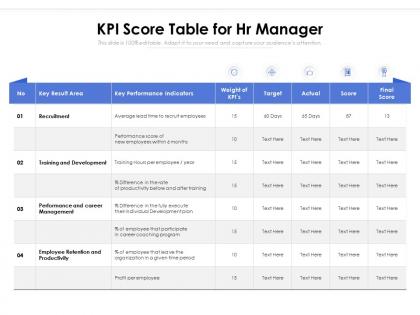
Kpi score table for hr manager




Try Before you Buy Download Free Sample Product
 Impress Your
 Audience
 100%
100% Editable
 Save Hours
 of Time


Track pre-defined organizational goals of human resources management with the help of KPI Score Table For HR Manager slideshow. By using this investment performance PPT theme, you can demonstrate how effectively a company is achieving its key objectives. Discuss the important financial KPIs for a business strategy with the help of portfolio management PPT slide design. This PPT visual will help to showcase the key performance indicators of HR. Evaluate your investment portfolio by using these financial dashboard PPT layouts. Meet your strategic goals by showcasing the report that includes a detailed listing of projects with their status, alignment, risk, budget cost, planned cost, and variance with this project portfolio PPT graphics. Display key performance indicators pertaining to a specific project portfolio with the help of asset management PPT templates. Gain insight into how the PMO is performing compared to past performance using portfolio metrics PPT slideshow. Track how the value of your investments is responding to changes in the market by downloading our ready to use investment management PPT Presentation.
People who downloaded this PowerPoint presentation also viewed the following :
Kpi score table for hr manager with all 2 slides:
Use our KPI Score Table For HR Manager to effectively help you save your valuable time. They are readymade to fit into any presentation structure.
FAQs for Kpi score table
Here's what's worked for me - keep it to like 5-7 metrics max that actually matter for your main goals. Don't go crazy tracking every little thing (I learned that one the hard way). Make sure you've got clear targets so you know if you're winning or not. The visual stuff is huge - those red/green indicators or little arrows let you see problems instantly. Oh, and always add a quick note explaining why numbers moved up or down. Trust me, you'll forget the context later. When it's done right, you should be able to look at it and know exactly where to jump in.
Honestly, just work backwards from what you're actually trying to achieve. Don't get caught up tracking stuff that looks cool on dashboards but doesn't move your business forward. Chat with people from different teams - finance cares about costs, sales wants conversion numbers, and you need both perspectives. They'll tell you what really matters. Keep it tight though. Maybe 5-7 metrics tops or you'll get overwhelmed trying to track everything. Mix some predictive stuff (leading indicators) with results you can already see (lagging ones). Oh, and definitely refine as you learn what's working. Nothing's set in stone.
Yeah, you absolutely need your KPIs tied to business strategy - otherwise you're just tracking random stuff that makes you feel productive but doesn't actually matter. I learned this the hard way at my last job lol. What works is mapping each metric back to your actual strategic goals. So like, start with your top 3-5 business priorities, then figure out which numbers really show you're making progress on those. Skip the vanity metrics that look impressive but don't move the needle. Trust me, your scorecard should tell a story about what's driving real results, not just pretty charts that nobody acts on.
Honestly, the biggest thing is getting everyone on the same page about what each metric actually means. I've watched so many scorecards become total disasters because different people were measuring things differently - it's painful to see. Get your data collection process nailed down: who owns what, when stuff gets updated, zero wiggle room there. Automate whatever you can to avoid human screw-ups, but still have someone double-check before anything goes public. Oh and write down your process! New people will thank you later. Make it dummy-proof basically.
Use those red/yellow/green colors so people instantly get what's happening. Dashboard tiles are perfect for this. I've sat through way too many meetings where someone pulls up what looks like an Excel nightmare - nobody even bothers reading that stuff. Group similar metrics together and put your most critical ones right at the top. Trend arrows help show if things are moving in the right direction. Clear labels are obviously important, but honestly? The real test is whether someone can figure out the status in under 10 seconds. If they can't, you're doing it wrong.
Oh man, don't panic and start changing everything at once - I've watched that blow up in people's faces way too many times. First thing? Figure out if it's actually a performance problem or just bad data/unrealistic goals. Look at the bigger picture over a few months, not just one crappy quarter. If performance really is the issue, break that KPI down into pieces so you can see exactly what's broken. Then get your team together and make some concrete plans with real deadlines. Way better to tackle it head-on than cross your fingers and hope next quarter magically fixes itself.
Honestly, Excel or Google Sheets are perfect starting points - you probably already have access to one of them anyway. They're flexible enough for most basic scorecards. Power BI and Tableau are where things get interesting if you want interactive dashboards with live data feeds. I've personally seen some pretty slick setups using both. There are also dedicated tools like Klipfolio, Geckoboard, and Sisense that come with solid templates right out of the box. My advice? Start with whatever you've got, then see if you actually need the fancier features. No point in overcomplicating things from day one.
Monthly reviews are probably your sweet spot, but quarterly deep dives work great too. Catching problems early is way easier with monthly check-ins. Plus you can pivot faster. Quarterly gives you better data though - more time to see actual patterns instead of random blips. Some teams go crazy doing weekly reviews but honestly? Total overkill unless you're launching something or in crisis mode. Whatever schedule you pick, just stick with it. Random, whenever-we-feel-like-it reviews are basically pointless. Oh and don't overthink it - consistency beats perfection here.
So basically, lagging KPIs are stuff that already happened - your revenue, customer satisfaction, whatever. Leading ones predict what's coming, like your sales pipeline or web traffic. It's kinda like driving honestly - lagging metrics are your rearview mirror, leading ones are your headlights. You need both though. Lagging tells you if what you did actually worked. But leading KPIs? That's where you can fix things before they go sideways. Most teams I've seen just track the backwards-looking stuff, then act all surprised when they miss targets. Throw both types in your dashboard so you're not just playing reporter after everything's already done.
Honestly, bring people in right from the start - don't wait until you've built something and then ask for input. Run workshops where different teams can actually say what matters to them. Sales cares about totally different stuff than customer service, right? Ask what KPIs they'd genuinely use to make real decisions, not just what looks impressive. Set up regular check-ins so they can watch it develop and give feedback as you go. They need to feel like they're helping create it, not just getting handed the final product. Oh, and schedule those stakeholder conversations this week before you forget!
Honestly, most people cram way too many metrics onto one dashboard - like 15+ KPIs that nobody actually reads. Pick 5-7 max that actually matter to your goals. Don't make everything the same size either; use bigger fonts or colors so people know what to look at first. I've seen scorecards that take someone 3 hours to update manually... nightmare. Automate that stuff if you can. Also remember your audience is key - what a CEO needs is totally different from what team leads want to see. Test it with real users before you go live. Trust me on this one.
So basically, KPI scorecards show you what's actually working in your business and what isn't. You can catch problems early instead of scrambling later. It's like having a dashboard - super helpful for staying on track. The best part? When you connect team goals to these numbers and talk about them in regular meetings, people actually care about hitting targets. I'd start with maybe 5-6 metrics that really matter to your bottom line (don't go crazy with too many). Once everyone knows what they're aiming for, things just click better.
Honestly, the balanced scorecard is pretty genius because it stops you from tunnel vision on just money stuff. Four angles: financial, customer, internal processes, and learning/growth. So you won't accidentally wreck your customer service while chasing profits, you know? Think of it like your car dashboard - you need more than just the speedometer to actually drive safely. It helps you catch issues before they blow up and shows your team how their daily work connects to the big picture. Oh, and definitely start with just 2-3 metrics per section or you'll drown in data.
So the trick is basically turning fuzzy stuff into numbers. Like customer satisfaction becomes a 1-10 survey score, or employee engagement turns into those quarterly pulse surveys. You can also do simple yes/no checkboxes - did they finish training? Got certified? That kind of thing. Color coding works great too. Red/yellow/green is super clear for status updates. I mean, it sounds backwards to quantify qualitative stuff but honestly it's the only way to track it properly. Just don't go crazy measuring random things that won't actually move the needle for your business goals.
Make someone own each KPI - no shared responsibility BS because that never works. Do weekly check-ins where people walk through their numbers and explain what happened. Honestly, public praise hits different than private feedback, but save the tough conversations for one-on-ones. Don't just pick random targets either. Connect metrics to stuff your team actually gives a damn about. When numbers tank, jump into problem-solving mode together instead of pointing fingers. The whole thing should feel like teamwork, not punishment. Oh, and celebrating small wins keeps morale up way better than I expected.
No Reviews