


Human Resources Performance Management Metrics Powerpoint Presentation Slides





Try Before you Buy Download Free Sample Product
 Impress Your
 Audience
 100%
100% Editable
 Save Hours
 of Time


Looking to take up your HR performance metrics PowerPoint show to next level? Just check out our readymade deck Human Resources Performance Management Metrics PowerPoint Presentation Slides with 61 slides precisely showcase the data. Our Human Resources Performance Management Metrics PPT presentation supports to underline the important aspects related to HR performance metrics like performance review the role of HR, metrics model, most common HR metrics, employee turnover, profit per employee, revenue per employee, revenue-cost per employee comparison, workforce diversity by gender, staff with professional qualification, competency rating and many more such designs examples. With help of our PowerPoint presentation deck HR teams and managers can easily present the content and reports to the target management. Furthermore, using this visually impactful PPT slide sample, you can brief employees about employee absence schedule, employee absenteeism, employee attendance tracker, performance review scoring, training hours per employee etc. Above all, exclusive presentation slides like employee satisfaction, staff engagement model, David Zinger or Aon Hewitt employee engagement, HR Dashboard etc. are included to touch all aspects of a brilliant human resources PPT presentation. So, what’s holding you back? Click and download our readymade Human Resources Performance Management Metrics Presentation sample and show your PowerPoint skills. Enlighten folks on baseless intolerance with our Human Resources Performance Management Metrics Powerpoint Presentation Slides. Condemn any acts of bigotry.
People who downloaded this PowerPoint presentation also viewed the following :
Content of this Powerpoint Presentation
Slide 1: This slide introduces Human Resource Perfromance Management Metrics. State Your Company Name and begin.
Slide 2: This is an Agenda slide. Present your agendas here.
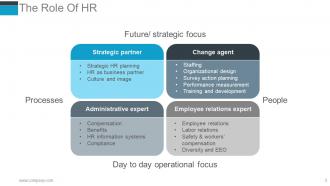
Slide 3: This slide presents The Role of HR as Future/ strategic focus being- Strategic partner: Strategic HR planning, HR as business partner, Culture and image. Change agent: Staffing, Organizational design, Survey action planning, Performance measurement, Training and development. Administrative expert: Compensation, Benefits, HR information systems, Compliance. Employee relations expert: Employee relations Labor relations, Safety & workers’ compensation, Diversity and EEO, Processes, People, Day to day operational focus.
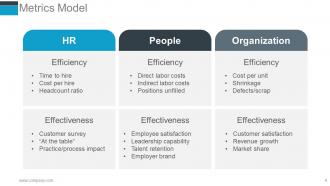
Slide 4: This slide presents Metrics Model divided into- HR: Efficiency:: Time to hire, Cost per hire, Headcount ratio. Effectiveness:: Customer survey, “At the table” Practice/process impact. People: Efficiency:: Direct labor costs, Indirect labor costs, Positions unfilled. Effectiveness:: Employee satisfaction, Leadership capability, Talent retention, Employer brand. Organization: Efficiency:: Cost per unit, Shrinkage, Defects/scrap. Effectiveness:: Customer satisfaction, Revenue growth, Market share.
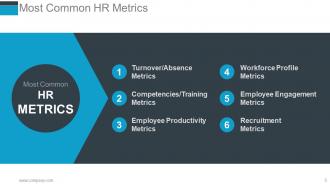
Slide 5: This slide presents Most Common HR METRICS such as- Turnover/absence metrics, Competencies/training metrics, Employee productivity metrics, Workforce profile metrics, Employee engagement metrics, Recruitment metrics.
Slide 6: This slide is titled Turnover/Absence Metrics
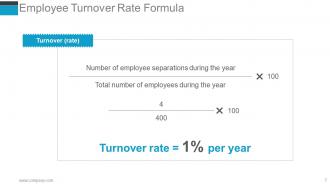
Slide 7: This slide showcases Employee Turnover Rate Formula.
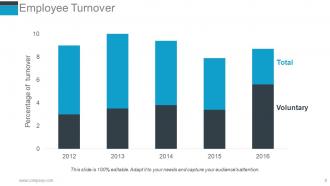
Slide 8: This is an Employee Turnover slide in graph form.
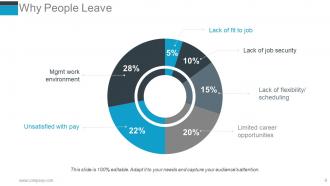
Slide 9: This slide showcases Why People Leave listed into- Lack of job security, Lack of fit to job, Unsatisfied with pay and benefits, Management general work environment, Limited career advancement/promotional opportunity, Lack of flexibility/ scheduling.
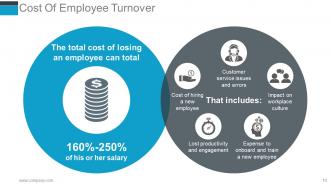
Slide 10: This slide presents Cost Of Employee Turnover. The total cost or losing an employee can total- Cost of hiring A new employee, Impact on workplace culture, Customer service issue and errors, Lost productivity and engagement, Expense to onboard and train new employee.
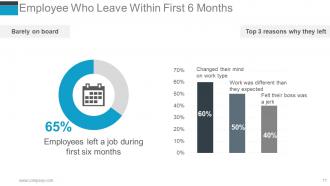
Slide 11: This slide presets Employee Who Leave Within First 6 Months showcasing- Barely on board, Top 3 reasons why they left.
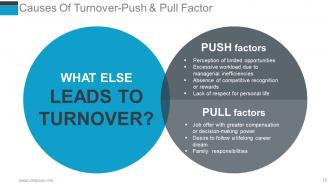
Slide 12: This slide shows Causes Of Turnover-push & Pull Factor.
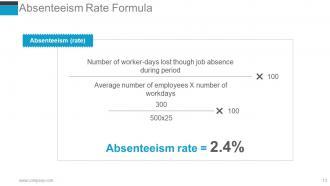
Slide 13: This slide presents Absenteeism Rate Formula to calculate the rate of absenteeism.
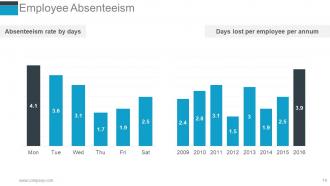
Slide 14: This slide showcases Employee Absenteeism in graph form displaying- Absenteeism rate by days, Days lost per employee per annum.
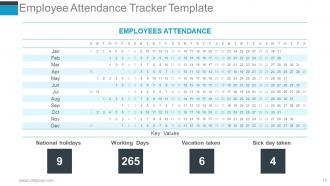
Slide 15: This is an Employee Attendance Tracker Template slide.
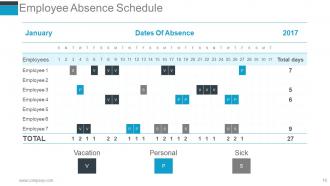
Slide 16: This slide showcases Employee Absence Schedule.
Slide 17: This slide is titled Competencies/training METRICS.
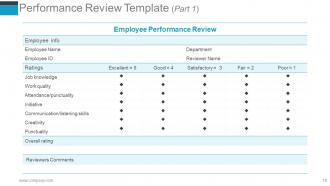
Slide 18: This slide showcases a Performance Review Template.
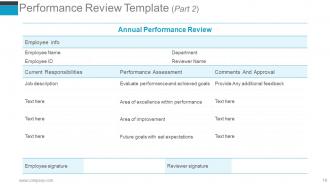
Slide 19: This slide also showcases a Performance Review Template.
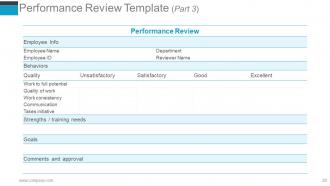
Slide 20: This slide also presents a Performance Review Template.
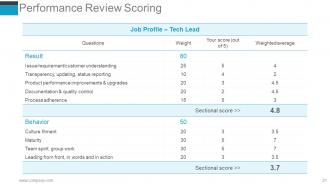
Slide 21: This slide showcases Performance Review Scoring.
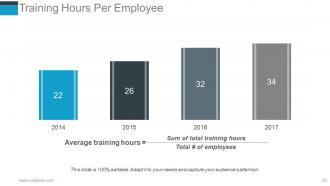
Slide 22: This slide presents Training Hours Per Employee to be calculated.
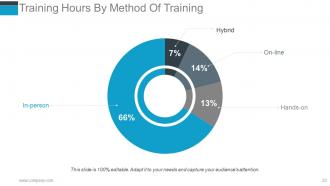
Slide 23: This slide displays Training Hours By Method Of Training showing- Training By Method: Hybrid, On-line, Hands -On, In-person.
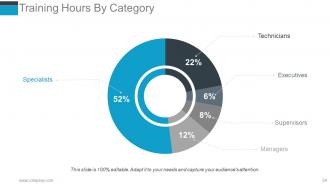
Slide 24: This slide displays Training Hours By Category.
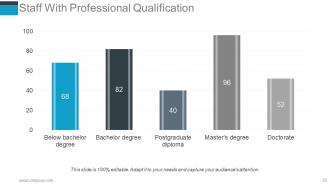
Slide 25: This slide showcases Staff With Professional Qualification in graph form.
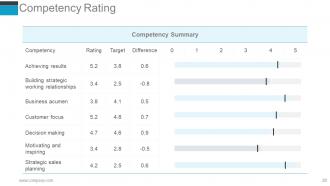
Slide 26: This slide showcases Competency Rating in tabular form.
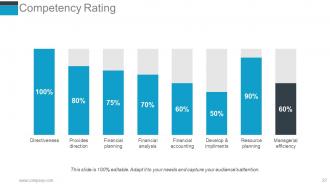
Slide 27: This slide showcases Competency Rating in graph form.
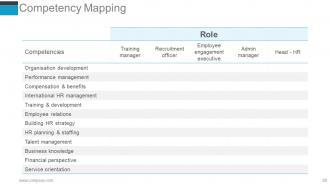
Slide 28: This slide displays Competency Mapping in tabular form.
Slide 29: This slide is titled Employee Productivity METRICS.
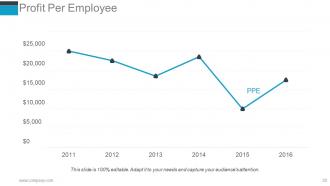
Slide 30: This slide showcases Profit Per Employee in line graph form.
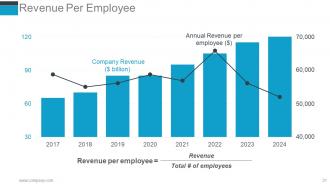
Slide 31: This slide shows Revenue Per Employee in combo chart form.
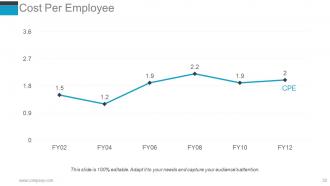
Slide 32: This slide presents Cost Per Employee in line graph form.
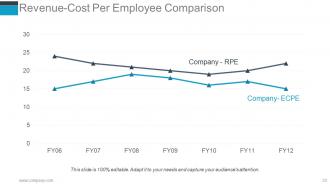
Slide 33: This slide shows Revenue-Cost Per Employee Comparison displaying- Company - RPE, Company- ECPE.
Slide 34: This slide is titled Workforce Profile METRICS.
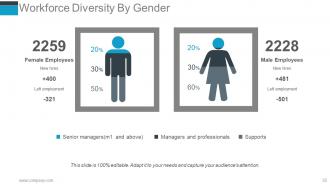
Slide 35: This slide presents Workforce Diversity By Gender.
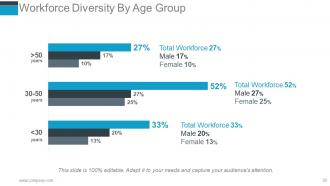
Slide 36: This slide presents Workforce Diversity By Age Group.
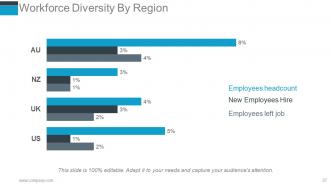
Slide 37: This slide presents Workforce Diversity By Region.
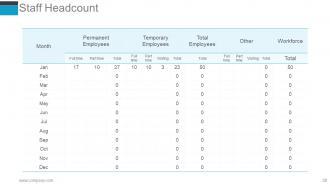
Slide 38: This slide presents Staff Headcount with Staff Count Sheet table.
Slide 39: This slide is titled Employee Engagement METRICS.
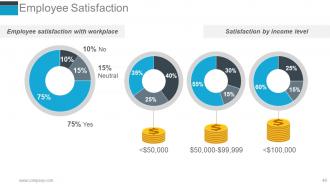
Slide 40: This slide shows Employee Satisfaction with- Employee satisfaction with workforce, Satisfaction By Income Level.
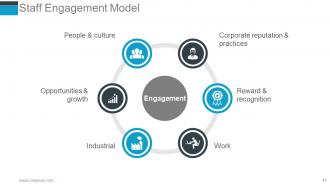
Slide 41: This is a Staff Engagement Model slide showing- People & culture, Work, Corporate reputation & practices, Reward & recognition, Industrial.
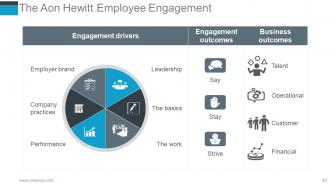
Slide 42: This slide displays The Aon Hewitt Employee Engagement Model displaying- Business outcomes, Engagement outcomes, Engagement drivers.
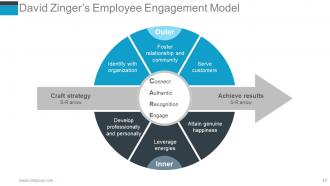
Slide 43: This slide shows a David Zinger’s Employee Engagement Model displaying- Outer, Inner, Foster relationship and community, Identify with organization, Serve customers, Attain genuine happiness, Develop professionally and personally, Leverage energies, Enliven work roles, Excel at performances, Achieve results, S-R arrow, Craft strategy, S-R arrow, Connect Authentic Recognition Engage.
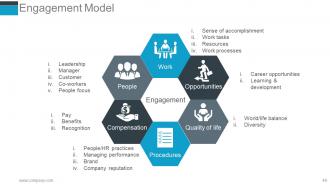
Slide 44: This slide presents an Engagement Model showcasing- Leadership, Manager, Customer, Co-workers, People focus, Pay, Benefits, Recognition, People/HR practices, Managing performance, Brand, Company reputation, Sense of accomplishment, Work tasks, Resources, Work processes, Career opportunities, Learning & development, World/life balance, Diversity, People, Work, Opportunities, Quality of life, Compensation, Procedures.
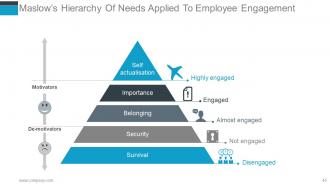
Slide 45: This slide displays Maslow‘s Hierarchy Of Needs Applied To Employee Engagement.
Slide 46: This slide is titled RECRUITMENT METRICS.
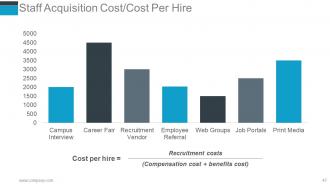
Slide 47: This slide shows Staff Acquisition Cost/Cost Per Hire in graph form.
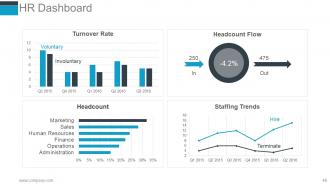
Slide 48: This slide presents an HR Dashboard showing- Span of control, Direct compensation change, Flow through rate, Headcount flow, Key health metrics, Previous 4 quarters, Change, Manager instability rate, Registration rate, Top 3 potential areas of concern, For SMB services, For products, For human resources, Top talent turnover rate, Turnover rate.
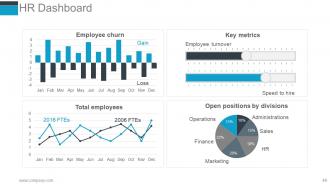
Slide 49: This slide also showcases HR Dashboard displaying- Total employees, Open positions by divisions, Administrations, Key metrics, Employee turnover.
Slide 50: This slide is titled Additional Slides to proceed forward. You can change the slide content as per need.
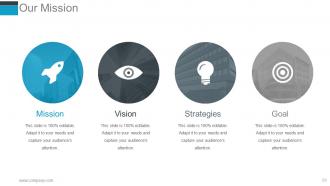
Slide 51: This is Our Mission slide with Vision, Goal and Strategy slide with icons. State all these aspects here.
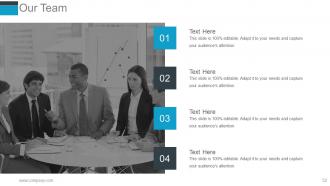
Slide 52: This slide showcases Our Team specifications with name, designation and image boxes.
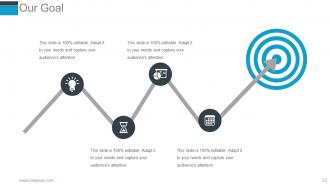
Slide 53: This is an Our Goal slide. State goals etc. here.
Slide 54: This is a Comparison slide for comparing entities/products etc. here.
Slide 55: This is a Financial score slide. State financial aspects etc. here.
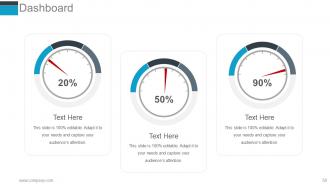
Slide 56: This is a Dashboard slide to state metrics, kpis etc.
Slide 57: This is a Timeline slide to show evolution, journey, growth, milestones etc.
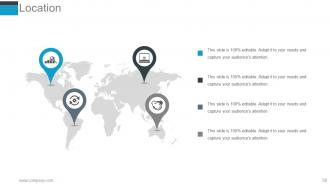
Slide 58: This is a Location slide of world map image to show global presence, growth etc.
Slide 59: This slide showcases Lego imagery. Present information, specifications etc. here.
Slide 60: This slide shows a Magnifying glass image with text boxes. State information, specifications etc. here.
Slide 61: This is a Thank You slide with Address# street number, city, state, Contact Numbers, Email Address.
Human Resources Performance Management Metrics Powerpoint Presentation Slides with all 61 slides:
Even disbelievers begin to come around due to our Human Resources Performance Management Metrics Powerpoint Presentation Slides. It has an impelling impact.



FAQs for Human Resources Performance Management Metrics
You want SMART metrics - specific, measurable, achievable, relevant, time-bound. But don't overthink it! Mix leading indicators (stuff that predicts success) with lagging ones (results after the fact). So like, track both your sales numbers AND customer feedback or how well the team's working together. Some metrics you'll check daily, others maybe quarterly - depends what makes sense. Oh and start small! Pick 3-5 core things instead of measuring absolutely everything. I've seen teams go crazy trying to track 20 different things and it's just chaos.
Look, every industry cares about completely different stuff. Retail shops obsess over sales per square foot and how many browsers actually buy something. Manufacturing? They're all about how fast they can pump out products without breaking things. Tech companies live and die by user engagement - honestly, they probably check those numbers more than their own pulse. Meanwhile healthcare tracks patient outcomes and whether people end up back in the hospital. Finance focuses on risk ratios and staying compliant with regulations. You've got to figure out what actually matters in your specific field, then build your whole measurement system around those things instead of just copying generic business metrics.
Honestly, you NEED your team's input on performance metrics - otherwise you're just guessing at what actually matters. I've watched companies get obsessed with numbers that look impressive but totally miss the mark on real performance. Your employees know which metrics actually drive good work and which ones just create weird, counterproductive behavior. Survey your team about the current metrics you're using. Ask them what success looks like from where they're sitting - you might be surprised. Without their feedback, you'll end up tracking vanity metrics that sound great in meetings but don't mean much day-to-day.
Honestly, just trace each metric back to your actual goals - if you can't connect the dots, toss it. Way too many people get caught up tracking stuff that looks cool on dashboards but doesn't really matter. Make sure everything flows from your big picture down to team and individual targets. I'd check these quarterly since strategies shift more than we think they will. The whole point is driving the right behaviors - if your metrics aren't pushing people toward what you're trying to achieve, they're basically useless noise. Better to have three solid metrics than fifteen mediocre ones.
Honestly, BambooHR and Workday are solid choices - they handle goal setting and progress tracking without making you live in Excel hell. 15Five's pretty good too. If you're working with a smaller team though, you could probably get away with customizing Asana or Monday.com templates for performance stuff. The real trick is picking something your managers will actually stick with. I've seen too many companies buy expensive software that just collects digital dust. Start with free trials of maybe 2-3 options and let your team leads test drive them. They'll know pretty quickly which one clicks with how they work.
Look, the numbers only tell you half the story. Like if Sarah's sales dropped 15%, that's concerning but doesn't tell you *why*. Maybe she's burnt out, maybe the new CRM is confusing her, maybe her biggest client just left - you won't know without asking around. I've seen too many managers make terrible decisions based on spreadsheets alone. Try adding quick manager check-ins or short employee feedback forms to whatever system you're using now. The qualitative stuff - conversations, observations, even complaints - that's where you'll find the real solutions. Numbers are great for spotting problems. Stories help you actually fix them.
Honestly, the hardest part is getting clean data and buy-in from your team. People get weird about being measured, you know? Plus everyone's got their own random systems, so collecting consistent data becomes this whole headache. Your metrics are only gonna be as solid as whatever's feeding into them. Oh, and don't make the mistake of measuring stuff just because it's easy - pick things that'll actually change how people behave. My advice? Start with maybe 2-3 metrics your team already gives a damn about. Get those running smooth first, then build from there.
Oh man, this is such a real thing! Your team's background totally changes how they read performance data. Like, pushing individual metrics in a culture that's all about group wins? Recipe for disaster. Some places see direct feedback as pretty harsh too, which honestly I get - nobody wants to feel attacked over numbers. I'd switch up both what you're measuring and how you share it. Maybe focus more on team achievements or just change up how you deliver the feedback. It really depends on who you're working with and what feels right to them.
Look, benchmarking basically stops you from guessing whether your numbers are actually good or trash. Like you might think 85% customer satisfaction is solid, but what if everyone else is hitting 92%? That's a wake-up call right there. First thing - pick maybe 3-5 metrics that actually move the needle for your business. Then hunt down industry data or scope out similar companies to compare against. Honestly, finding good benchmark data that matches your exact situation is annoying as hell, but it's worth it. You'll finally know if you're crushing it or need to step up your game.
Honestly, just make the whole thing feel like you're all on the same team instead of being watched. Get your people involved in setting their own targets - they'll actually care way more when they help pick the numbers. I'd share all the performance data openly and use it to highlight wins, not just call out problems. The thing is, most employees don't even think the metrics connect to stuff they actually care about. Ask them what would motivate them first - that alone changes everything. Turn those numbers into real conversations about growth and celebrating people, not just judging them.
So for team stuff, look at completion rates, productivity, customer happiness - basically how they crush shared goals together. Individual metrics are different though - personal goal hitting, skill growth, peer reviews, quality of their actual work. Here's the thing that's kinda annoying: some people are total team rockstars but look meh individually, and some solo performers can't collaborate to save their lives. You need both angles or you're missing half the story. Just figure out what behaviors you actually want first, then find metrics that track those instead of random stuff.
Check your metrics monthly if you can, quarterly at bare minimum. Honestly, most companies that do well review them way more often during crunch time. Things move so fast now that what mattered six months ago might be totally pointless today. I'd do a big annual deep-dive where you question everything, but those regular monthly check-ins catch problems early. Quick test - look at what you're tracking right now and ask if it actually moves the needle. If it doesn't feel relevant anymore, it probably isn't. Don't get stuck measuring outdated stuff just because you always have.
So performance metrics basically tell you where to put your training budget instead of just throwing money at random programs. Look for patterns - like if everyone's bombing leadership scores or there's consistent tech skill gaps. That's your starting point right there. You can track if your training actually works by comparing before/after data (honestly, most companies skip this step and wonder why nothing improves). For your star performers, use their individual data to create custom development plans. I'd start with your biggest 3 gaps and build targeted programs around those. Way more effective than the spray-and-pray approach.
Don't let your metrics backfire on you! I've seen teams rush through calls just to hit volume targets, then customer satisfaction goes down the drain. Ask yourself - would I want to be judged this way? Make sure you're transparent about how things get calculated and avoid using metrics to punish people. Some stuff honestly doesn't need tracking at all. The whole point is driving the right behavior, not just collecting data. Oh, and watch out for bias - metrics can accidentally screw over certain groups. It's about finding that sweet spot between keeping people accountable and actually trusting them.
Honestly, metrics are like having a GPS for your team's performance - you can actually see where you're going wrong instead of just wandering around blind. When people have real data in front of them, they stop making wild guesses and start fixing actual problems. The trick is picking the right stuff to measure (don't track everything, you'll go crazy). Share the numbers openly with everyone and set up regular meetings where you all dig into what's happening. That's when people get creative with solutions. It's pretty cool how transparent data just naturally makes teams want to do better.
-
Top Quality presentations that are easily editable.
-
Easily Understandable slides.