


Employee Performance Management Powerpoint Presentation Slides




Try Before you Buy Download Free Sample Product
 Impress Your
 Audience
 100%
100% Editable
 Save Hours
 of Time


Our expert designers have come up with this ready-made Employee Performance Management PowerPoint Presentation Slides. So that you can showcase and audit the performance of the staff in your company. This 26 slides data visualization PowerPoint sample deck will aid you to present the right performance parameters as there are slides like employee assessment criteria table, employee skill assessment template, employee assessment form, employee assessment review chart, employee performance assessment chart, assessment scorecard, employee assessment evaluation form, employee self-assessment form, cross-training employee assessment chart, employee competency assessment table etc. Moreover, you can also employ our staff performance assessment PowerPoint slideshow to encourage actions and boost the performance of your various teams. This staff appraisal management PPT sample presentation is 100% adaptable and you can make changes as per your needs. For example, you can change the color, text, shapes etc. Inform your onlookers about the dynamics involved in employee assessment. So quickly download our employee accomplishment management PowerPoint presentation slides now and present. Prepare for the deafening applause. Our Employee Performance Management Powerpoint Presentation Slides are great cheerleaders.
People who downloaded this PowerPoint presentation also viewed the following :
Content of this Powerpoint Presentation
Slide 1: This slide introduces Employee Performance Management. State Your Company Name and begin.
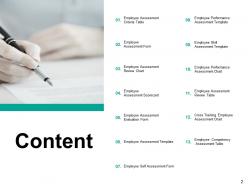
Slide 2: This slide shows Content of the presentation.
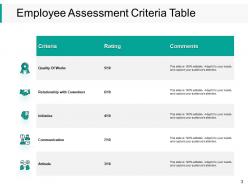
Slide 3: This slide presents Employee Assessment Criteria Table describing quality of works, relationship with coworkers, initiative, communication and attitude.
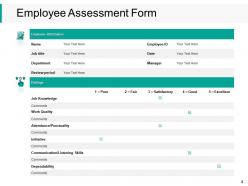
Slide 4: This slide displays Employee Assessment Form with employee information and ratings.
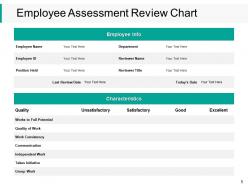
Slide 5: This slide represents Employee Assessment Review Chart with employee information and characteristics.
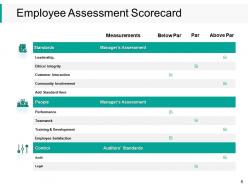
Slide 6: This slide showcases Employee Assessment Scorecard in a tabular form with categories as measurements, below par, par and above par.
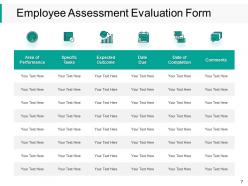
Slide 7: This slide shows Employee Assessment Evaluation Form with categories as- area of performance, specific tasks, expected outcome, date due, date of completion and comments.
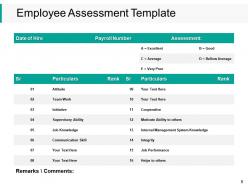
Slide 8: This slide presents Employee Assessment Template with date of hire, payroll number and assessment.
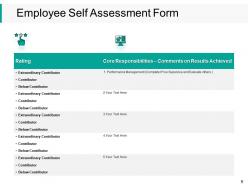
Slide 9: This slide displays Employee Self Assessment Form describing ratings.
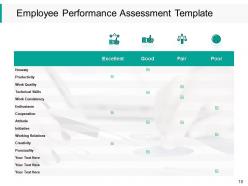
Slide 10: This slide represents Employee Performance Assessment Template.
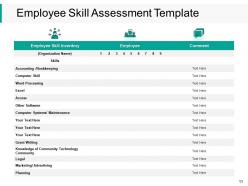
Slide 11: This slide showcases Employee Skill Assessment Template with categories as employee skill inventory, employee and comments.
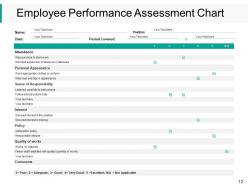
Slide 12: This slide shows Employee Performance Assessment Chart with attendance, personal appearance, sense of responsibility, interest, policy, quality of works and comments.
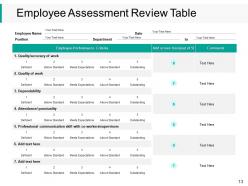
Slide 13: This slide presents Employee Assessment Review Table. You can add or edit data as per requirements.
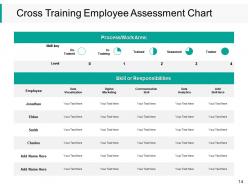
Slide 14: This slide displays Cross Training Employee Assessment Chart with process/work area and skills/responsibilities.
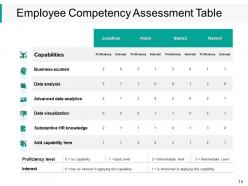
Slide 15: This slide represents Employee Competency Assessment Table with categories as- capabilities, business acumen, data analysis, advanced data analysis, data visualization and substantive Hr knowledge.
Slide 16: This slide displays Employee Performance Management Icons.
Slide 17: This slide is titled as Additional Slide for moving forward.
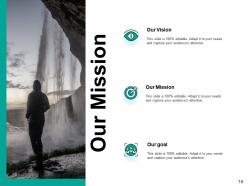
Slide 18: This is Our Mission slide with related imagery and text boxes.
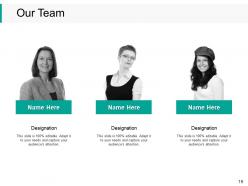
Slide 19: This is Our Team slide with names and designation.
Slide 20: This slide is titled as Post It. Post your important notes here.
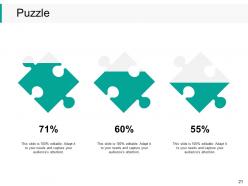
Slide 21: This is a Puzzle slide with text boxes to show information.
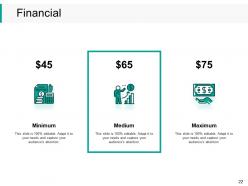
Slide 22: This is a Financial slide. Show your finance related stuff here.
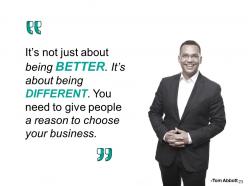
Slide 23: This is a Quotes slide to convey message, beliefs etc.
Slide 24: This is a Timeline slide to show information related with time period.
Slide 25: This is Our Target slide. State your targets here.
Slide 26: This is a Thank You slide with address, contact numbers and email address.
Employee Performance Management Powerpoint Presentation Slides with all 26 slides:
Helping hands come forward with our Employee Performance Management Powerpoint Presentation Slides. Folks agree to make effective contributions.
FAQs for Employee Performance Management
Honestly, I'd stick to the basics - did they actually hit their targets? Quality of work matters too, obviously. Productivity and how well they work with the team are huge. Sales people get judged on revenue, customer service folks on satisfaction scores - you know the drill. Soft skills like communication and problem-solving are worth tracking, but don't get crazy with it. Three to five metrics max or you'll lose your mind in spreadsheets. Oh, and definitely hash this out with each person beforehand. Nobody likes getting blindsided during reviews.
Honestly, just make feedback feel normal instead of this big scary thing. Train your managers to give quick, specific comments all the time - not save everything for those awful annual reviews. Weekly one-on-ones are gold for discussing wins and what needs tweaking in real-time. Don't forget peer feedback too, it hits different than just boss feedback. Focus on specific behaviors, not personality stuff, and connect it back to their goals. Oh and start simple with your team - even asking "what's going well and what could we improve?" makes a huge difference. I swear it works.
Dude, engaged employees are like the secret sauce for performance management. They actually want feedback instead of dreading it. Makes your job so much easier when people see performance talks as growth opportunities rather than torture sessions. Regular coaching beats those awful annual reviews every time - nobody wants to sit through those anyway. Clear goals help too. Recognition matters more than you'd think. Honestly, once you get people engaged, they'll start hitting targets because they actually care. It's pretty wild how different motivated employees are compared to people just collecting paychecks.
Here's what's worked for me: document stuff all year long, not just during review season - seriously saves so much headache later. Get multiple people involved in the process when you can to cut down on bias. Your employees should know upfront what they're being measured on, like actual specific goals they can track. I always try to give feedback regularly so nobody's blindsided come review time. Oh and definitely train managers on unconscious bias - that's huge. The whole thing should feel predictable rather than just going with your gut, you know? Regular check-ins make everything smoother.
Have a private chat first to figure out what's actually going wrong - could be they're swamped, confused about what you want, or dealing with personal drama. Focus on specific behaviors, not their personality (learned that one the hard way). Weekly check-ins work better than monthly ones initially. Make sure they have what they need - training, clearer instructions, whatever. Document stuff but don't make it feel like you're building a case against them. Honestly, most people want to do well if you give them the right support. Follow up within a week so they know you're serious about helping.
Dude, get a performance management platform - it'll save your sanity. No more spreadsheet hell or endless email threads about goals. Your team can actually update their own stuff instead of you chasing everyone down constantly. The automatic review reminders are clutch too (I always forget those dates). Having everything in one place when review season hits? Life-changing. Honestly, I'd start with something basic that just handles goal-setting first. You can always add more bells and whistles later once you get the hang of it.
Hey! So 360 feedback is pretty solid because you get perspectives from everyone - your boss, coworkers, people below you. Way more complete than just your manager's take, you know? It catches blind spots you'd never see otherwise. But real talk - it can blow up in your face if people don't know what they're doing or decide to air grievances. Keeping things anonymous gets tricky, plus it's honestly a time suck. Oh and some people give garbage feedback that's just mean instead of helpful. I'd test it with a small group first and actually train people how to give decent feedback before rolling it out.
Take your big company goals and break them down team by team. Then get specific with each person - like if you need 15% more revenue, maybe Sarah's gotta hit 20 new leads monthly. Everything should connect, kind of like Lego blocks but way more boring. Each employee needs to see how their daily grind actually matters for the bigger picture. Honestly, this part's crucial or people just check out mentally. Review these connections every quarter because priorities will definitely change - and I mean *will*, not might. Adjust as you go.
Dude, just do regular check-ins instead of waiting for those dreaded annual reviews. When you wait a whole year, you're basically trying to remember what happened in March when it's December - good luck with that! Monthly or quarterly works way better because you catch problems while they're still fixable. Plus your people actually get helpful feedback instead of one massive info dump that stresses everyone out. I swear, annual reviews are like performance archaeology. Just do 15-30 minute check-ins. Way less painful for everyone involved.
Honestly, most performance problems come down to fuzzy expectations - like, people literally don't know what "good" looks like. So get super specific about what you want first. Schedule regular check-ins instead of waiting for formal reviews to drop bombs on them. When stuff goes wrong, ask questions before you point fingers. There's usually some roadblock you don't know about. Oh, and document everything because consistency matters if things go south. Hook them up with training or maybe pair them with someone who gets it. Don't forget to actually acknowledge when they improve - even small stuff keeps people from giving up.
Honestly, the best approach is connecting training directly to whatever gaps pop up in performance reviews. Mix it up - formal programs, mentoring, stretch projects that actually match what people want career-wise and what the business needs. Generic workshops are such a waste (trust me on this one). Focus on stuff that fixes current issues but also preps them for what's next. Oh, and definitely track if it's actually working - otherwise you're just going through the motions. Be super clear about expectations for using those new skills afterward.
Honestly, D&I stuff can totally change how performance reviews work. You'll get way less biased evaluations when different perspectives are involved in the process. More fair development opportunities too. Having diverse voices gives you the real story on what each person actually contributes - not just what one manager thinks. It helps spot those weird systemic roadblocks that keep certain people from moving up. Oh, and retention gets so much better when people feel seen. Train your managers on unconscious bias though. Make sure your performance metrics actually match what success looks like in your roles, not some random outdated expectations from 2005.
Honestly, I'd focus on the basics first - engagement scores and retention rates will tell you a lot. Goal completion is huge too since it shows whether managers are being realistic or just setting people up to fail. Check if people are actually getting promoted internally - that's a dead giveaway about development. Performance ratings should connect to real business results, otherwise what's the point? Oh, and definitely survey people about the feedback process itself. I've seen too many companies with fancy systems that employees think are total garbage. Start with maybe 3 metrics max - you can always add more later once you figure out what actually matters for your team.
Stop counting hours and start looking at what people actually deliver. Those yearly reviews are pretty much useless now - do quick check-ins instead. Train your managers to have real conversations about work, not just "how's it going?" Your metrics probably suck too, so audit them first. Does sitting at a desk for 8 hours really mean good work? Nah. Use tools that show project progress and focus reviews on quality, not face time. Communication has to be way more intentional since you can't just wander over anymore.
Honestly, you'll probably lose some dead weight but keep your best people. High performers love it because they actually get recognized and can move up. The slackers either quit or get pushed out pretty quick. Yeah, turnover might spike initially - not gonna lie, it can get messy for a bit. But you end up with way better people who actually care. Just make sure you're being fair with how you measure performance and give decent feedback. Oh, and try coaching the struggling ones first before they bail. Way better team in the long run though.
No Reviews