

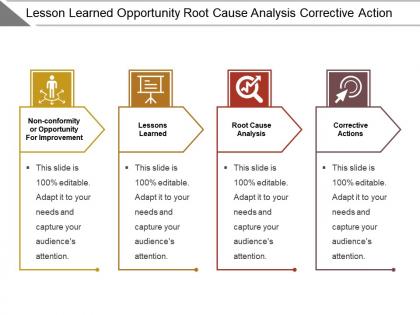
Lesson learned opportunity root cause analysis corrective action





Try Before you Buy Download Free Sample Product
 Impress Your
 Audience
 100%
100% Editable
 Save Hours
 of Time


Explore every avenue with our Lesson Learned Opportunity Root Cause Analysis Corrective Action. You will make a fabulous discovery.
People who downloaded this PowerPoint presentation also viewed the following :
Lesson learned opportunity root cause analysis corrective action with all 5 slides:
Demonstrate authority with our Lesson Learned Opportunity Root Cause Analysis Corrective Action. The audience will get behind you.




FAQs for Lesson learned opportunity root cause
Honestly, just don't blame people - look at the broken systems instead. Keep asking "why" until you get to the actual problem, not just what's obvious on the surface. Data beats guessing every time. You'll want the people who really know the process in the room, and they need to feel comfortable telling you what actually went wrong (not the sanitized version). Also document everything or you'll just end up with temporary fixes that fall apart later. It's basically detective work but for boring workplace stuff lol.
The core process stays the same everywhere - spot the problem, collect data, dig for root causes, fix it. Healthcare teams might tackle medication mix-ups or patient falls with failure mode analysis. Manufacturing? They're usually dealing with broken equipment or quality issues using fishbone diagrams or 5 Whys. Tools work across the board, but your expertise and what you measure changes everything. Patient outcomes matter in hospitals, while factories obsess over throughput and quality stats. Honestly, I'd just pick whatever RCA method clicks with your team first - you can always switch later.
Honestly, just start with the 5 Whys - keep asking "why" until you find the real issue underneath. That'll handle most of your problems right there. Fishbone diagrams are great when you need to map out all the possible causes (we used these constantly at my last job). For trickier stuff, fault tree analysis works well. Oh, and Pareto charts are clutch because they show you what's actually worth fixing versus just background noise. If you're stuck in Six Sigma world, DMAIC's your friend. Otherwise timeline analysis keeps things simple. Don't overthink it though - seriously, the 5 Whys will get you surprisingly far.
So troubleshooting just fixes what's broken right now - like slapping a band-aid on it. RCA is different though. It's asking "okay but WHY did this break?" and trying to stop it from happening again. Think of it this way: your car keeps overheating. You could just add coolant every time, or you could figure out there's actually a leak somewhere. Fault tree analysis fits into RCA sometimes, but it's more about mapping out how things fail. Honestly, most people skip the "why" part because it takes longer. But next time something breaks, try asking yourself if you're actually solving the problem or just making it go away temporarily.
Team dynamics basically make or break your whole RCA process. People won't speak up about screwups if they don't feel safe - they'll either blame someone else or just stay quiet. You want different viewpoints in the room, from the people actually doing the work up to management. Honestly, the "no blame" thing is huge. Focus on fixing systems, not pointing fingers at individuals. I'd start by laying out some basic ground rules about keeping discussions respectful and everyone owning the problem together. Otherwise you're just wasting time.
Honestly, data analytics is a game-changer for RCA - no more shooting in the dark with hunches. You'll catch patterns across incidents that would totally fly under the radar otherwise. Regression analysis and decision trees help test if your suspected causes actually hold water. The visualization stuff is clutch too since stakeholders eat up a good chart (way better than explaining correlations verbally, trust me). Just make sure you're collecting detailed data on incidents first. Otherwise you're just running fancy analysis on garbage. Start tracking more granular info now so you have solid material to work with later.
Honestly, the worst mistake is jumping straight to fixes before you actually know what went wrong. Teams get antsy and grab onto whatever seems obvious first. People also get super defensive - suddenly it's about who screwed up instead of what broke in the system. Oh, and stopping way too early! You find one thing that contributed and boom, case closed. But there's usually more layers if you keep digging. Documentation is another killer - without it you can't spot patterns later. My take? Start by telling everyone this isn't about blame, it's about fixing broken processes. Then ask "why" like five times minimum before you even think about solutions.
Make people feel safe bringing up problems instead of scared they'll get blamed. Celebrate when someone catches an issue early - that's gold. Train everyone on RCA basics, not just the engineers or whoever. Honestly, your frontline people usually spot patterns way before management does. When you find root causes, actually fix them and tell people what changed. Nobody wants to waste time on investigations that go nowhere. Switch your team language from "who messed up" to "what went wrong with our process." Oh, and try doing RCA spotlights in meetings where you share wins and lessons learned. Makes it feel less like punishment.
Start with how complex your problem actually is - basic stuff works fine with 5 Whys, but messy systemic issues need Fishbone or Fault Tree Analysis. Your team size matters too since some methods need people who actually know what they're doing. Time's probably your biggest factor though (trust me, stakeholders hate waiting weeks for answers). Technical failures vs human screwups vs process problems each work better with different approaches. Honestly, I'd just pick whatever method your team can execute properly rather than something fancy they'll mess up.
RCA works great with Lean and Six Sigma since they're all about cutting waste and fixing problems at their source. When you're doing Lean, throw RCA into your kaizen events or use it to dig into process failures. Six Sigma's even easier - RCA fits right into the Analyze phase of DMAIC. Honestly, the biggest thing is making RCA your go-to move every time something breaks, not just a special occasion tool. Train your teams on the basics first - 5 Whys, fishbone diagrams, that stuff. Then make it mandatory before anyone jumps to solutions.
Check out Toyota's recall mess - they used RCA and figured out their rapid expansion plus crappy supplier oversight caused the whole thing. Aviation does this best though, honestly. Every incident gets torn apart to stop future crashes. Hospitals are solid examples too - they traced medication screwups to broken workflows instead of just blaming nurses. Oh, and Netflix did this when their streaming died. Found infrastructure problems they had no clue about. These sectors are worth studying when you're setting up your own process.
Okay so with messy problems that have tons of moving parts, don't just pick one method. I'd start with fishbone diagrams to brain-dump everything you can think of - gets all the categories laid out. Then go deeper with 5 Whys on the big stuff. Here's the thing though: you're not hunting for one magic root cause. There's gonna be like 3-4 things all tangled up together. Super annoying but that's how it works. If your team's really detail-oriented, fault tree analysis works too. Just make sure you're mapping it all visually so everyone can actually see how everything connects, then figure out what to fix first.
Don't jump straight into fixes after your RCA - you've gotta validate those root causes first. Try reproducing the problem with new data or different scenarios. Can you actually recreate it using what you found? Get someone who wasn't involved to look it over too. Fresh perspective helps a ton, honestly. Make sure your causes actually connect to the symptoms, not just happen around the same time. We all get tunnel vision during analysis sometimes. Challenge your assumptions again and document what evidence backs up each cause. Then you'll know your corrective actions are hitting the right targets.
Dude, keep all that RCA stuff documented - trust me on this one. When the same crap breaks again (and it will), you can skip the detective work and go straight to what actually caused it last time. I swear you'll forget half the details within a month anyway. Your documentation becomes this awesome reference for spotting patterns between incidents. New people joining the team will thank you too since they can see what areas always seem to blow up. Oh, and track whether your fixes actually stuck around long-term. Don't just write what broke - include what you tried and your reasoning behind it.
Honestly, stakeholders make or break your RCA. Talk to everyone who was involved - witnesses, people who got hit by the problem, anyone who touched that process. Here's what works: interview them one-on-one first because groups make people weird and quiet. Then bring the key players together later. Ask stuff like "walk me through what happened" instead of leading questions that push your theory. Write down everything, even random details that seem pointless. Oh, and map out who you need to talk to beforehand - I've missed obvious people before and it sucked. They're basically your detective witnesses.
-
Top Quality presentations that are easily editable.
-
Best Representation of topics, really appreciable.