


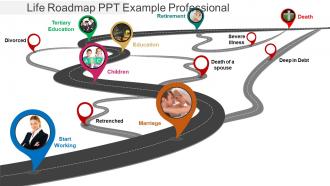
Life roadmap ppt example professional






Try Before you Buy Download Free Sample Product
 Impress Your
 Audience
 100%
100% Editable
 Save Hours
 of Time


Get the better of adverse circumstances with our Life Roadmap Ppt Example Professional. You will beat the jinx.
People who downloaded this PowerPoint presentation also viewed the following :
Life roadmap ppt example professional with all 5 slides:
Convert drawbacks into advantages with our Life Roadmap Ppt Example Professional. They excel at changing the game.

FAQs for Life roadmap
Okay so first thing - you gotta be brutally honest about where you're at right now. Your values, what you're good at, your whole situation. Most people hate this part but it's crucial. Figure out what success actually means to YOU, not your parents or whoever. Then pick like 3-5 big goals that match your values. Honestly, skipping the values thing is why so many people feel completely lost later. Break those massive goals down into smaller chunks with real deadlines. Oh and definitely set up quarterly check-ins to pivot when life gets messy. If mapping your entire life feels overwhelming, just pick one area to start.
Dude, seriously try sketching your roadmap instead of just typing it out. Visuals beat bullet points every time - people absorb that stuff way faster. I can't draw to save my life but even my terrible stick figures work better than plain text! Color-code different areas like career vs personal goals so people don't zone out. Timelines and flowcharts are clutch. Oh, and use actual metaphors - like mountain climbing or road trips - makes everything feel more real somehow. Your brain just connects with visual stuff differently, you know?
Honestly, SMART goals are pretty clutch for actually getting stuff done - makes everything measurable instead of just wishful thinking. Vision boards sound ridiculous but they work (don't ask me why). Try the Wheel of Life thing to see what parts of your world are totally out of whack. The 10-10-10 rule is solid too: will this matter in 10 minutes, 10 months, 10 years? Oh and the Eisenhower Matrix helps separate real priorities from just... busy work nonsense. Pick whatever clicks with you though - jumping around between different systems just makes you feel productive without actually being productive, you know?
Honestly, I'd start with the big picture first - like, where do you actually want to be in 10 years? Once you've got that vision, work backwards. Break it into 3-5 year chunks, then figure out what you need to hit in the next 3-12 months to get there. It's basically like building stepping stones across a river. Make your goals specific though - not just "get healthier" but actual measurable stuff. I write mine down in my notes app (weird but it works for me) and check in every few months. Things change, priorities shift, whatever. Don't stress if you need to pivot.
Honestly, self-reflection is like your personal GPS for life. You gotta regularly check in with yourself about what's actually working and what isn't. Are you chasing what YOU want or just what you think you should want? I do this monthly thing where I ask myself if I'm still heading toward stuff that matters to me. Because without that check-in, you're basically just following someone else's roadmap or directions from like, past you who maybe had different priorities. It's wild how much your values can shift without you realizing it. Short version: make time to recalibrate.
Don't lock yourself into super rigid timelines - go broader with your goals instead. Life's gonna throw curveballs (seriously, it's like the universe has nothing better to do), so step back and figure out what actually still matters vs. what needs to change. Think of your roadmap more like GPS that reroutes when there's traffic, not some unchangeable rule book. I'd say check in every few months and tweak things. Always keep a backup plan simmering too. Plot twists beat roadblocks - that mindset shift alone will help you recover way faster when stuff inevitably goes sideways.
Break your goals down by timeline first - what's happening in 1-2 years vs 3-5 years vs way down the road. Look at which ones will give you the most impact without killing yourself effort-wise. Some goals are gonna need to happen before others anyway (like you can't buy a house without decent credit, you know?). Be real about your bandwidth too. I learned this the hard way - chasing too many things just leads to burnout. Honestly? Pick your top 5 and actually stick to those. Everything else can wait.
Okay so basically instead of making your life sound like a boring timeline, turn it into actual stories people want to hear. Like don't just say "got promoted in 2019" - talk about the crazy challenges you faced getting there, the moments everything clicked, stuff like that. I always think of it like you're explaining your journey over drinks with a friend, not reading off your resume (way more interesting tbh). Each big phase of your life becomes its own "chapter" with a theme. Be real about the failures too - that's where the good stuff is. People connect with the messy parts way more than the highlight reel anyway.
Honestly, the worst thing you can do is make it super rigid. Life's gonna throw curveballs and you'll just get pissed when nothing goes as planned - trust me on this one! Skip the vague stuff like "be successful" too. Get specific: "land that senior analyst role by 2026." Don't obsess over every tiny detail either. You'll waste more time tweaking the plan than actually doing anything. Oh, and definitely check in on it every few months or so. Your whole perspective changes as you get older, so think of it like GPS - it'll reroute when needed.
Honestly, figure out what actually gets you fired up first - not what you think *should* matter to you. Then see how that lines up with the big stuff: your job, relationships, where you're living. I do this weird thing called the "deathbed test" (sounds dark but bear with me) - basically ask yourself if you'd be cool looking back on your current path. Your life plan needs to be about YOU, not what everyone else thinks you should do. Oh and don't treat it like it's set in stone - you'll change and it should too.
Honestly, mix hard numbers with gut feelings. Track the obvious stuff - savings, certifications, fitness goals, whatever applies to your situation. But don't ignore the fuzzy metrics like confidence or work-life balance (those matter way more than people think). I do quarterly check-ins where I look at actual data plus rate my satisfaction levels. Sometimes I throw in stress ratings too. The trick is not getting so caught up in tracking everything that you forget to, you know, actually live your life. Some progress just feels different rather than showing up on a spreadsheet.
Honestly, getting other people's input is a game-changer. You'll spot blind spots you never knew existed. I always run my plans by 2-3 people I trust - could be friends, mentors, whatever. They catch patterns in my behavior I'm totally oblivious to and suggest paths I hadn't even considered. It's way less overwhelming than trying to figure out your whole future alone (which is kinda impossible anyway). Their different experiences show you opportunities or red flags you missed. When you share your roadmap, ask specific questions about the parts where you're stuck. Trust me, fresh eyes see things differently.
Honestly, visuals are game-changers for life roadmaps. Your brain just remembers colorful, visual stuff way better than boring text lists. I like using different colors for each area - maybe blue for career goals, pink for relationships, green for money stuff. Icons and shapes work great too. It's kinda like the difference between reading a manual versus looking at an infographic, you know? Way more engaging. Plus you'll actually notice patterns and gaps when everything's laid out visually. I made mine look almost like a board game path once - sounds weird but it totally worked. Trust me, it beats staring at another sad spreadsheet of dreams.
Your experiences totally flip your roadmap around - they show you new interests and change what you actually care about. Like, a career setback might push you toward starting your own thing, or having kids could make work-life balance way more important than promotions. Some of my biggest "failures" were honestly the best redirects I could've asked for. You've gotta stay flexible though. Your roadmap isn't set in stone - it's more like a Google Maps route that keeps recalculating. I check mine every few months and adjust based on what I'm figuring out about myself.
Honestly, most successful people didn't follow some crazy detailed 10-year plan. Oprah switched from news to talk shows when the chance came up - she just stuck to empowering people. Jobs got booted from Apple (ouch) but that mess actually helped him come back stronger. Sara Blakely was literally selling fax machines while building Spanx on weekends. What they all did? Had strong values and a rough direction, but rolled with opportunities. I think rigid planning is overrated anyway. Focus on your core principles instead of mapping out every single career step.
-
Awesome presentation, really professional and easy to edit.
-
Innovative and Colorful designs.