

Research roadmap layout 1 powerpoint ideas




Try Before you Buy Download Free Sample Product
 Impress Your
 Audience
 100%
100% Editable
 Save Hours
 of Time


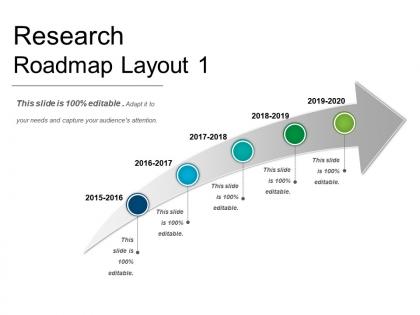
Breakdown your complex problem into subproblems with our Research Roadmap Layout 1 PowerPoint template which will help you in research planning. This will give you a deep understanding of what your problems are and how to deal with them. It is a five-stage roadmap that can also be used for depicting the progress made over the years. You can use this roadmap to guide your audience through the process of conducting a research project. Mapping out the whole process will be beneficial and it will provide a path for accomplishing a research project. With this roadmap template, you can also assess the success of your new developments. This slide will provide a pathway for your future research and development activities. Process of reaching a set goal can also be illustrated using a roadmap template.
People who downloaded this PowerPoint presentation also viewed the following :
Research roadmap layout 1 powerpoint ideas with all 5 slides:
Broadcast your brilliance effectively with our Research Roadmap Layout 1 Powerpoint Ideas. They help build consumer confidence.
FAQs for Research roadmap layout
Start with your research goals right at the top. Then map out key milestones - but don't go crazy with tiny details yet, that's where most people mess up. Break your methods into phases that make sense. Budget and resources come next, plus any risks you can think of. Oh, and build in decision points where you might need to change direction based on what you find. Regular check-ins with stakeholders are clutch too. Everything should tie back to your main objectives obviously. Honestly just grab a basic template and tweak it as you go - way easier than starting from scratch.
Colors are your best friend here - group similar stuff together or show what's high priority. Icons help people spot different milestone types super quick. Your brain just loves visuals way more than reading through paragraphs, you know? Arrows between phases show what depends on what, and timelines give everyone the "when" they're always asking about. Don't get too crazy with graphics though. I've seen roadmaps that look like someone threw up a rainbow on them. Keep it clean so your actual research doesn't get lost in all the pretty decorations.
Look at three things: impact, feasibility, and what depends on what. Which milestones unlock the biggest value or clear major roadblocks? That's your starting point. Then be real about what you can actually pull off with your resources and timeline. Dependencies matter too - some stuff just has to happen first, obviously. Honestly, I always sketch this out on paper or a whiteboard first because seeing it helps way more than keeping it all in my head. Try scoring each milestone 1-5 for both impact and how doable it is, then arrange them in logical order. Works pretty well.
Honestly, research roadmaps are totally different depending on your field. STEM stuff is pretty straightforward - you've got hypotheses, clear milestones, measurable results. Way more predictable. Social sciences though? You're basically wandering around until patterns start showing up. It's messy but that's just how it works. Humanities is all deep archive dives where timelines are... well, good luck predicting those. I learned this the hard way during my thesis. The trick is figuring out how much uncertainty your field naturally has, then build your roadmap around that instead of trying to force some generic template that probably won't fit anyway.
Yeah, definitely get input from stakeholders - otherwise you're just building in a vacuum. Talk to funders, users, partners, even the people who'll hate your idea (they're annoying but usually spot real problems). Their feedback helps you figure out what research questions actually matter vs. what sounds cool but nobody cares about. Plus they'll catch roadblocks you missed and tell you if your timeline is completely unrealistic. Oh, and don't just ask once at the start - check back with them regularly or you'll drift off course without realizing it.
Gantt charts are perfect for this - they'll show your time dependencies super clearly. Horizontal timelines with milestone markers work great too. Honestly, sometimes a well-organized table does the trick just fine. Show which activities overlap, build in buffer time because stuff always goes wrong, and map out what's blocking what. Color-coding by priority really helps people see the big picture at a glance. Critical path stuff between research components is crucial. Keep it simple at first though - you can always add more detail later if your stakeholders actually want that level of complexity. Most people just need to see what happens when and what might create bottlenecks.
Honestly, Miro's where I'd start - their research roadmap templates are chef's kiss and you can drag stuff around visually. Mural works great too for brainstorming sessions. If you need something more structured though, Notion or Airtable let you connect tasks and deadlines way better than basic tools. Don't sleep on Google Sheets either - sounds boring but it actually handles simple roadmaps really well. Lucidchart's good if you're doing flowcharts mixed with timelines. I'd mess around with Miro first since you can always export everything later if you outgrow it.
Honestly, I just use red or orange boxes right next to whatever milestones they could mess up. Works way better than hiding risks in some separate doc nobody checks. Sometimes I'll do a parallel timeline thing showing when each risk is most likely to hit - super helpful for timing. You could get all complicated with probability matrices but honestly that's overkill for most projects. The main thing is making sure your team spots potential blockers fast when they're looking at the roadmap. Nothing fancy needed, just visible and tied to actual dates.
Honestly, the worst thing you can do is go way too overboard at the start. You'll just end up frustrated when reality hits. Things change constantly, so don't waste time mapping every tiny detail for the next two years. Talk to your team early though - like, actually have conversations with the people doing the work. They know stuff you don't. Rigid timelines are killer too. Experiments always take longer than you think (trust me on this one). Start with big milestones and what depends on what, then fill in details later. Buffer time isn't optional.
Break everything into parallel tracks first - figure out who owns what pieces. Then map out the dependencies because that's honestly where everything goes to shit if you're not paying attention. Like when does Team A's data work need to wrap up so Team B can actually start their modeling? Schedule regular check-ins, not just the big milestone meetings. Everyone needs access to shared docs they can update in real time. The whole point is making those dependencies super obvious upfront. Nobody should be sitting around twiddling their thumbs waiting for stuff that's already behind.
Dude, you really need that roadmap if you want funding. Think about it - would you give money to someone with a messy napkin sketch or actual plans? Funders are drowning in proposals, so make their lives easier. Show clear phases, realistic deadlines, how everything connects. They want proof you've thought through the risks and won't just disappear with their cash. Honestly, the projects that skip this step are basically shooting themselves in the foot. Map it out properly upfront. Trust me, it's worth the extra work when decision time comes.
Honestly, I just throw status indicators right into my roadmap - way easier than tracking stuff separately. Color coding works great: green for done, yellow for ongoing, red when you're stuck. Percentage bars next to big deliverables help too, or even just simple checkboxes if you're feeling lazy. Target dates vs actual dates will show you real quick if things are going sideways. The trick is keeping it stupidly simple. Otherwise you'll spend more time updating the tracker than actually doing research, and nobody has time for that mess.
Look, I'd check your research roadmap every quarter, but only change stuff when you've got real data or user feedback pushing you that way. Trust me, don't mess with it just because some new methodology looks cool - been down that rabbit hole before. Document why you're shifting things around, whether it's new priorities or what you learned from recent studies. Loop in stakeholders for big changes. Minor timeline tweaks? Just do them. Keep a basic change log though - you'll thank yourself later when someone asks why you pivoted six months ago.
Honestly, user feedback is what makes the difference between a roadmap that actually works and one that just collects digital dust. Getting input from stakeholders and users helps you spot those blind spots you'd never see otherwise - plus it catches unrealistic deadlines before they become your problem. People will actually buy into a plan they helped create, which is huge. The feedback also confirms your research questions aren't totally off base from what the business actually needs. I'd set up quarterly check-ins or something similar. Gives you regular chances to pivot when things aren't working. Trust me, it's worth the extra effort upfront.
Honestly, knowing your audience changes everything about how you build that roadmap. Different people need totally different things - like, executives want the big picture while your research team needs all the nitty-gritty details. I made this mistake once where I showed our board this super technical timeline and their eyes just glazed over. It was painful. So now I always think about who's actually gonna use this thing first. That shapes what language you use, which milestones to highlight, how much methodology stuff to include. Even the format changes! Start by figuring out what decisions they need to make with your roadmap.
-
Amazing product with appealing content and design.
-
Amazing product with appealing content and design.