


Listening In Business Communication Training Module On Business Communication Edu Ppt




Try Before you Buy Download Free Sample Product
 Impress Your
 Audience
 100%
100% Editable
 Save Hours
 of Time


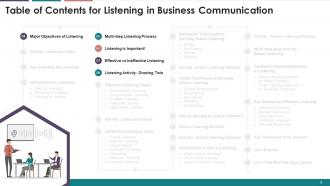
This PPT training deck covers the concept of Listening in Business Communication. It covers the principles, significance, and statistics of business listening, along with the difference between listening and hearing. It also covers effective listening types, such as discriminative, comprehensive, empathic, analytical, and appreciative listening. Further, it includes slides on ineffective listening types that are pseudo, selective, stage hogging, insensitive, ambushing, defensive, and insulated listening. The PPT training module also includes verbal and nonverbal techniques to develop active listening. Further, it covers barriers to effective listening, such as external distractions, speaker distractions, message intent, emotional language, and personal perspective. The PowerPoint deck also contains key takeaways, case studies, activities, discussion questions, MCQs, and memes to make the training session interactive. It also includes additional slides on about us, vision, mission, goal, 30-60-90 days plan, timeline, roadmap, training completion certificate, energizer activities.
People who downloaded this PowerPoint presentation also viewed the following :
Content of this Powerpoint Presentation
Slide 4
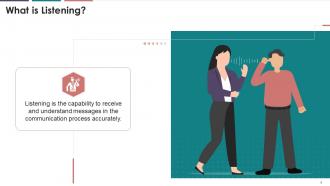
This slide provides information regarding the definition of listening in business communication.
Slide 5
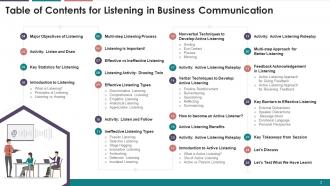
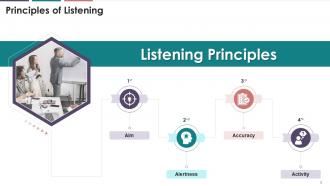
The purpose of this slide is to highlight the major principles of listening in business communication, such as aim, alertness, accuracy, and activity.
Instructor’s Notes:
The major principles of listening are:
· Aim: Looking for keywords, signals, or ideas
· Alertness: Focusing on what the speaker is saying instead of formulating a response
· Accuracy: Avoiding any type of premature evaluation of what is being said
· Activity: Taking a keen interest and thinking about responding in terms of answers or questions
Slide 6
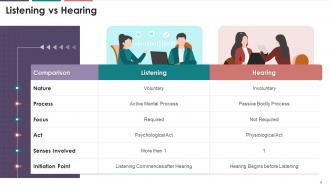
This slide tabulates the difference between listening and hearing. The multiple comparison parameters used are nature, process, focus, act, senses involved, and initiation point.
Slide 7
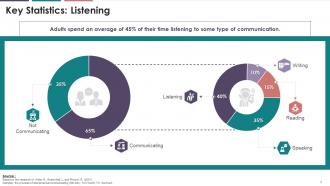
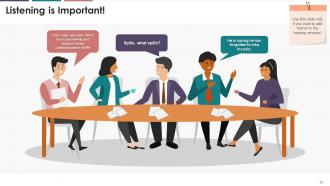
This slide visually presents the importance of listening in daily life of individuals.
Slide 8
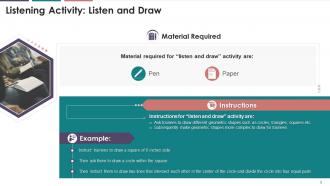
This slide highlights the business communication listening activity for the training session. It also includes the instructions and material required for exercise.
Instructor’s Notes:
Objectives:
· To help the trainee understand the importance of listening in communication
· To help the trainee understand the consequences of ineffective communication between the speaker and listener
Learning Outcomes: Trainees will develop their ability to listen attentively
Slide 10
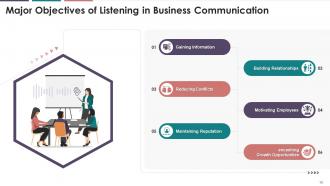
This slide highlights the key objectives of listening in business communication in terms of gaining information, building relationships, reducing conflicts, motivating employees, maintaining reputation and encashing growth opportunities.
Instructor’s Notes:
The purpose of listening is not to formulate a response. The key objectives of listening are listed as follows:
· Gaining Information: Listening helps extract relevant information from communication by clearly understanding the speaker's point of view and ideas
· Building Relationships: It fosters trust in team members as it allows individuals to understand each other better this build long-term associations
· Reducing Conflicts: It reduces conflicts in case an employee feels misunderstood or mistreated
· Motivating Employees: It boosts employee morale. For example, when a manager listens to employees' ideas, it makes them feel valued. They don't hesitate to go beyond the call of duty
· Maintaining Reputation: It helps maintain the reputation of a business. For example, listening and resolving customer complaints results in a positive brand image
· Encashing Growth Opportunities: It supports the encashment of growth opportunities. For example, a company can introduce new products and services and be a pioneer only after it makes the effort to listen to customers’ feedback, demands and needs
Slide 11
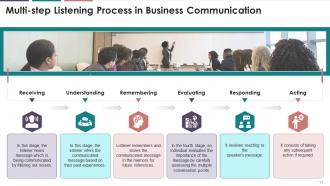
The slide provides information regarding the multiple-step listening process in business communication. The major stages highlighted are receiving, understanding, remembering, evaluating, responding, and acting.
Slide 12
The purpose of this slide is to showcase a listening meme to add humor to the business communication session. This slide depicts the phenomena of Chinese Whispers that dogs any communication.
Slide 13
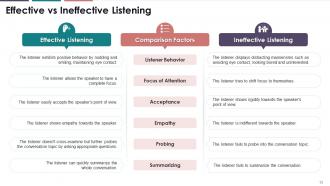
This slide tabulates the difference between effective and ineffective listening on multiple comparison factors of listener behavior, the focus of attention, acceptance, empathy, and probing.
Slide 14
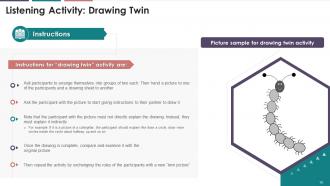
This slide illustrates the instructions for drawing twin activity. It also includes the picture sample for the listening activity.
Slide 15
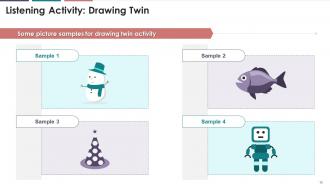
The purpose of this slide is to highlight multiple image samples to conduct the drawing twin activity in business communication training.
Slide 17
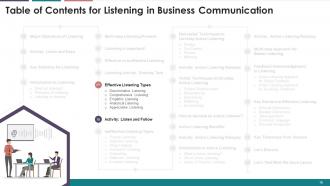
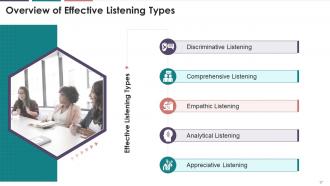
This slide provides an overview of effective and ineffective listening types. It also lists out effective listening types such as discriminative, comprehensive, empathic, analytical, and appreciative.
Slide 18
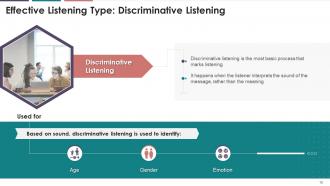
This slide provides information regarding the concept of discriminative listening and its usage.
Instructor's Notes:
Example of discriminative listening: An American, James, is sitting in the airport waiting area. Two Swedes are sitting behind him and are engaged in a conversation. Though James can't understand what the conversation is about, he can distinguish males and females based on the tone of the speaker's voice.
Slide 19
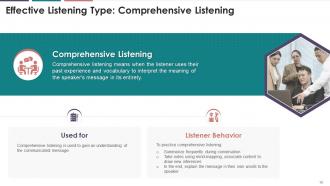
This slide provides information regarding the concept of comprehensive listening and its usage.
Instructor's Notes:
Example of comprehensive listening: Mathew is listening to his professor giving a lecture on digital marketing. He understands the meaning of the message delivered. Thus, Mathew is practising the comprehensive type of listening.
Slide 20
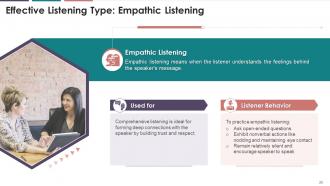
This slide provides information regarding the concept of empathic listening and its usage.
Instructor's Notes:
Example of empathic listening: When the manager is giving a motivating lecture, and some team members feel a rush of emotion. The charged-up members are practising empathetic listening.
Slide 21
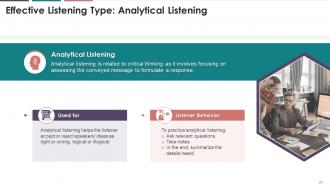
This slide provides information regarding the concept of analytical listening and its usage.
Instructor's Notes:
Example of analytical listening: When an associate shares the next quarter's sales targets with the area manager for approval, they listen, interpret and ask to increase/decrease the target depending on the demand of the product.
Slide 22
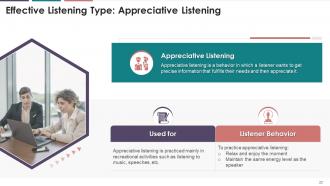
This slide provides information regarding the concept of appreciative listening and its usage.
Instructor's Notes:
Example of appreciative listening: When one listens to poetry to get words that excite or amaze. This also comes into play, when one listens to a political speech, to seek motivational phrases.
Slide 23
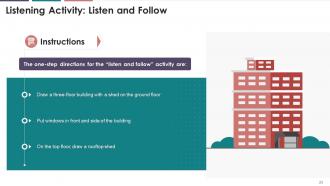
This slide depicts the instructions for listen and follow exercise. It can be used to conduct the listening activity in business communication training.
Slide 24
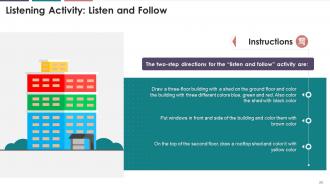
This slide illustrates the instructions for two-step listen and follow activity for listening in business communication.
Slide 26
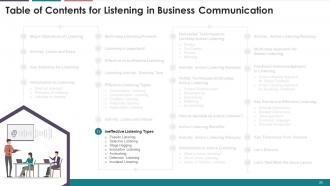
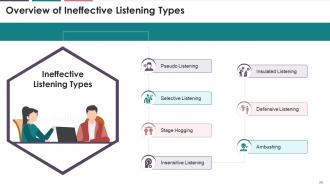
This slide provides information about the ineffective listening types such as pseudo, stage, selective, insulated, defensive, ambushing, and insensitive listening.
Slide 27
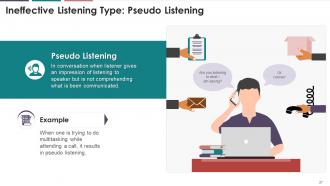
This slide provides information regarding the concept of pseudo listening. It also contains details of how to identify pseudo listener and ways to prevent it.
Instructor's Notes:
How to Identify a Pseudo Listener
· If the listener is simply nodding his/her head without any other expression
· Using conversation fillers such as ”hmmm”
How to Prevent Pseudo Listening
· As a listener, one should provide undivided attention to speaker
Slide 28
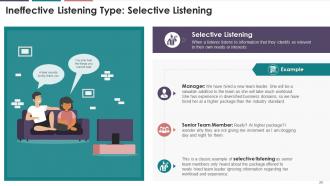
This slide highlights the concept of selective listening. It also provides information regarding how to identify a selective listener and techniques to prevent it.
Instructor's Notes:
How to Identify a Selective Listener
· The listeners respond according to one’s own will, carrying a wrong or misleading interpretation of the what was said
How to Prevent Selective Listening
· As listener, regularly summarize the conversation
· Ask relevant questions to the speaker to ensure constant engagement
Slide 29
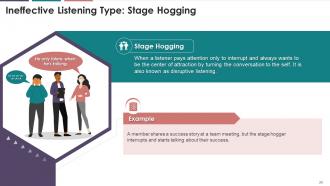
The purpose of this slide is to showcase the concept of stage hogging in ineffective business listening. It also contains details of how to identify a stage hogger and techniques to prevent stage hogging.
Instructor's Notes:
How to Identify a Stage Hogger
· The listener often interrupts the speaker
· The listener often plans what they are going to say as a response
How to Prevent Stage Hogging
· As a speaker, communicate your discomfort verbally to stage hogger (please let me complete first) or use nonverbal actions (breaking eye contact)
· As a listener, avoid interrupting the speaker and ask genuine questions when required
Slide 30
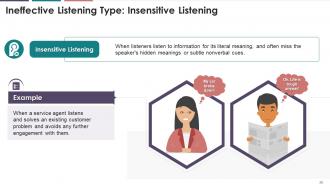
This slide provides information about insensitive listening, a type of ineffective listening. It also contains details of traits of an insensitive listener and methods to prevent it.
Instructor's Notes:
How to Identify a Insensitive Listener
· The listener looks absent-minded
· The listener often keeps the conversation brief by quickly offering a "solution" to "the problem.“
How to Prevent Insensitive Listening
· As a listener, give the speaker complete attention and provide nonverbal cues such as nodding in understanding
· Provide appropriate empathetic response as per the conversation requirement such as
· If it's a happy situation, say, "That is so great! Tell me more about it.“
· If someone is sharing difficult information, simply say, "I am sorry. If okay, please share in detail."
Slide 31
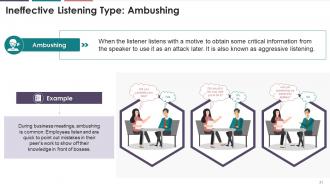
This slide highlights the overview of ambushing in ineffective listening. It also covers details of the characteristics of the ambush listener and techniques to avoid ambush listening.
Instructor's Notes:
How to Identify an Ambush Listener
· The ambush listener listens carefully, but isn't motivated by interest in the speaker
· Aggressive listeners often critique peers' ideas/solutions/work
· This behavior generally occurs due to poor interpersonal relationships with the speaker
· It also happens due to own low self-esteem and insecurities
How to Prevent Ambush Listening
· As a listener, avoid being aggressive with the sole objective of winning the argument
· Have an open-minded approach and respect other points of view in the conversation
Slide 32
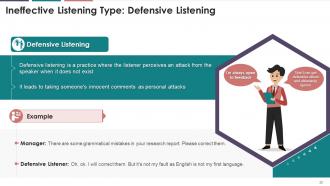
This slide highlights the overview of defensive listening. It also provides information about the traits of a defensive listener and techniques to avoid defensive listening.
Instructor's Notes:
How to Identify a Defensive Listener
· A defensive listener hears a general statement and personalizes it
· A defensive listener often showcases the following feelings towards the speaker
· Insecurity
· Jealousy
· Guilt
· Lack of confidence
How to Prevent Defensive Listening
· As a listener, avoid interrupting the speaker and hear them out with empathy
· If the speaker is saying something that will trigger an emotional response, the listener must stays calm and asks them to reframe what they are saying
· As a good listener, assume that you are interacting with the particular individual for the first time
Slide 33
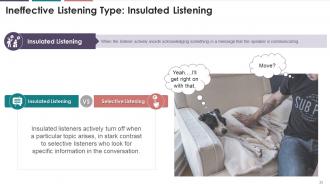
This slide provides information regarding the overview of insulated listening. It also covers details of the characteristic of the insulated listener and techniques to avoid insulated listening.
Instructor's Notes:
How to Identify Insulated Listener
· Insulated listener shows self-protective behavior
· They are always noncommittal towards a particular topic
How to Prevent Insulated Listening
· As a listener, try to listen to the speaker's point of view on a particular topic with an open mind
· If possible, showcase engagement using nonverbal cues
Slide 36
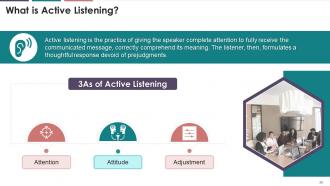
This slide provides information regarding the definition of active listening. It also includes details of 3As of active listening which are attitude, attention, and adjustment.
Instructor's Notes:
The three As of active listening are:
· Attention: Listener must be in the present moment and pay close attention to the speaker, disregarding any other anxieties of the day
· Attitude: Listener must listen to the speaker with a positive and open mind
· Adjustment: The listener must be willing to change and adapt their responses in line with to the speaker’s train of thought until the end of the conversation
Slide 37
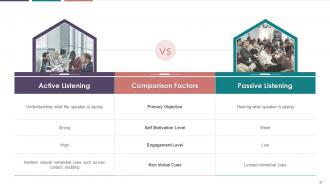
This slide tabulates the difference between active and passive listening on multiple comparison factors such as the primary objective, self-motivation level, engagement level, and nonverbal cues.
Slide 38
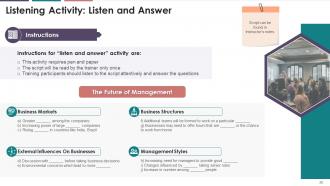
This slide illustrates the instruction that needed to be followed to conduct listen and answer activity in business communication training. The slide provides information about the set of questions that should to be answered by trainees on the basis of the script read by the trainer.
Instructor’s Notes:
Read the script to training attendees
Business Markets:
· I’ve been talking to business managers and reading surveys about the future of management. I will present some ideas about how businesses will change over ten years. It is not a scientific, mathematical analysis but only an idea for us to discuss. I’m sure a significant development will be a substantial increase in competition
· Global Companies are trying to sell identical products. Consumers now have better food products from Australia that might be manufactured in other countries like the USA, China, Finland, etc. Mergers and takeovers, happening in parallel, mean the governments are losing control over private companies
· We can all think of companies that exert significant influence on consumer choice. Market demand is growing rapidly in India, Brazil, and other rapidly expanding economies. The pressure on resources around the world is disturbing balance that marks the functioning of nature
External Influences on Businesses: Companies are taking advice from customers before making new business decisions. Companies are finding out what customer requires and provide it instead of making products and sell them. Another issue is that concerns about the environment will force manufacturers to extend product life cycles and reduce pollution and waste. Strengthened regulations will be the order of the day.
Business Structures: Many societies are much more flexible and democratic, and the structure of companies is changing to indicate that. We will see greater importance within companies on teams created with a specific project in mind. When it is completed, the teams will disband and will form new groups. People experience work as one part of their life and not the essential part of life. With workforce essentially reducing in some countries, businesses have to compete for staff instead of choosing among many candidates. Facilities that will attract and retain employees are flexible working hours and work from home.
Management Styles:
· People living in home cities, abroad can choose these facilities given by the company. The working of senior management will have to evolve and efficiency will be just one key trait. Excellent leadership skills will assume a much greater role
· Around the world, the senior managers of large businesses are mainly men in their 50s and 60s. The organization can initiate and respond to change in a fast-moving world, where they face lots of efficiency issue and competition
· The dominant management style will almost certainly become more consultative and collaborative, caused by women moving to senior positions
· Developments influence many changes in the broader business environment. The traditional emphasis of the business is manufacturing, and of course, the service sector is significantly essential. We should not overlook the growing financial contribution of intellectual property. Books and films contribute a lot to the generation of money from the sale of related DVDs, music, games, clothes, etc. Another point is that although I’ve been talking about companies, one trend they have to face is moving away from people working for the same employer for years. Instead, more and more people are becoming self-employed
Slide 39
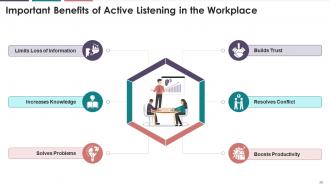
The slide showcases the significant advantages offered by active listening in business organizations. The key benefits of active listening are building trust, resolving conflict, boosting productivity, solving problems, increasing knowledge, and limiting the loss of information.
Instructor's Notes:
The key benefits of active listening in the workplace are:
· Builds Trust: Active listening helps build trust. When fellow employees know they can speak freely without being judged, they'll be more likely to confide in you, leading to the formation of a long-term relationship
· Resolves Conflict: In active listening by paraphrasing, the listener eliminates the possibility of misunderstandings, thus avoiding disagreements.
· Boosts Productivity: Actively listening helps in retaining employees as it allows them to express their ideas/opinions making them feel more freely energized, focused, and less prone to distraction
· Solves Problems: Active listening enables one to quickly identify issues that employees face and create an action plan to address these
· Increases Knowledge: Active listening improves one's knowledge base. You understand new topics across business domains
· Limits Loss of Information: Active listening helps avoid missing critical information, especially if the speaker is providing instructions or providing training on a new process
Slide 41
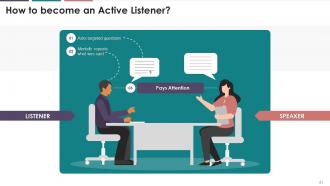
This slide provides information regarding the tips to become an active listener.
Slide 42
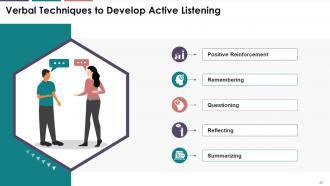
This slide provides information regarding the verbal methods to develop active listening such as positive reinforcement, remembering, questioning, reflecting and summarizing.
Slide 43
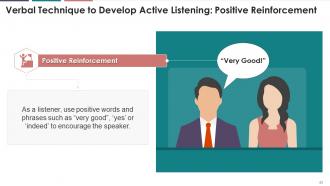
This slide indicates the verbal method of positive reinforcement to improve active listening in business communication.
Slide 44
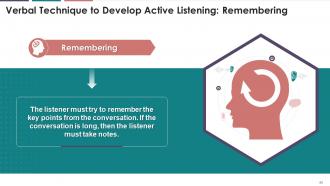
This slide highlights the verbal method of remembering to improve active listening in business communication.
Slide 45
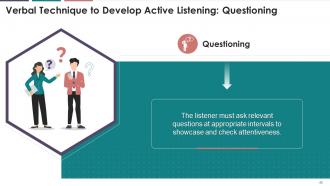
This slide showcases the verbal method of questioning to improve active listening.
Slide 46
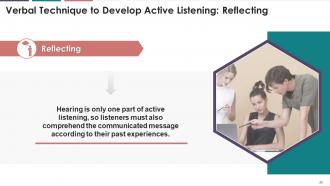
This slide provides information regarding the verbal method of reflecting to improve active listening.
Slide 47
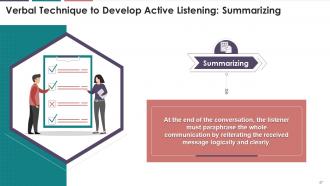
This slide provides information regarding the verbal method of summarizing to improve active listening in business communication.
Slide 48
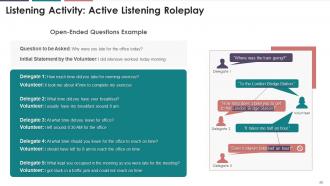
This slide illustrates the active listening activity that can be conducted in business communication training. It also contains the examples of open-ended questions for roleplay.
Slide 50
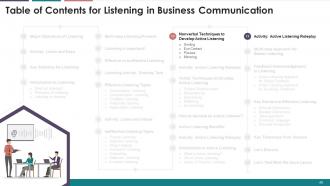
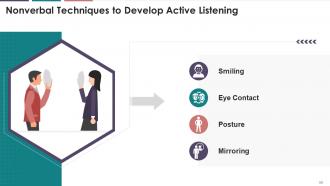
This slide lists nonverbal techniques to improve active listening in business communication. The major techniques are smiling, eye contact, posture and mirroring.
Slide 51
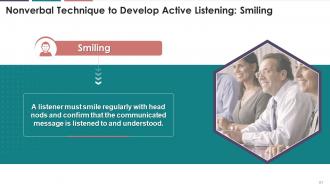
This slide provides information regarding the nonverbal method of smiling to improve active listening in business communication.
Slide 52
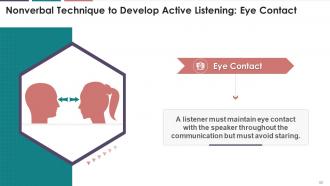
This slide indicates the nonverbal method of eye contact to enhance active listening.
Slide 53
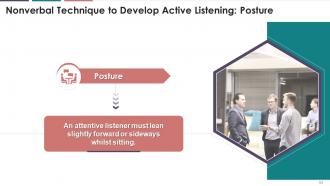
The purpose of this slide provides detail of nonverbal method of posture to improve active listening.
Slide 54
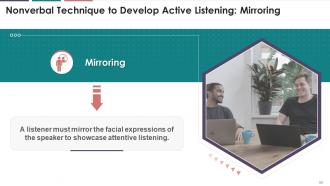
This slide provides information regarding the nonverbal method of mirroring to improve active listening.
Slide 55
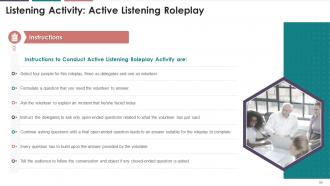
This slide showcases the instructions in active listening activity that can be conducted as listening roleplay in business communication training.
Instructor’s Notes:
Objectives:
· To develop active listening skills in training
· To highlight the importance of open-ended questions in communication
Slide 56
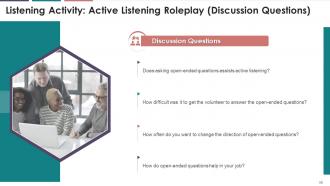
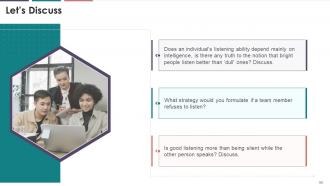
This slide illustrates information regarding the discussion questions that trainer can ask business communication training attendees for active listening roleplay activity.
Slide 58
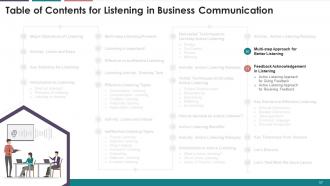
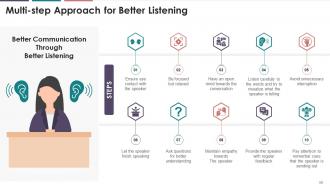
The purpose of this slide is to highlight the multi-step approach for developing better listening.
Slide 60
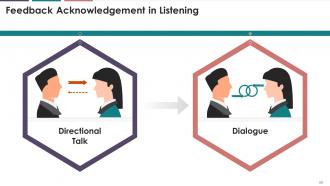
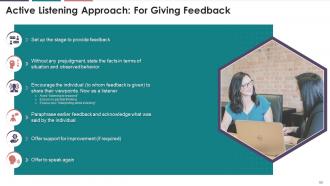
This slide lists the approach to give feedback using the active listening approach.
Slide 61
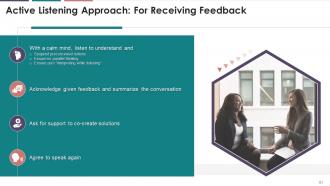
This slide provides information regarding the active listening approach for receiving feedback in business communication.
Slide 63
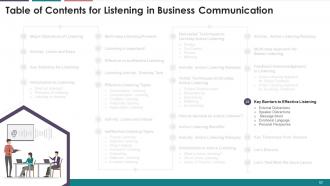
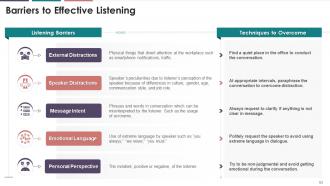
In this slide, multiple listening barriers are listed, such as external distractions, speaker distractions, message intent, emotional language, and personal perspective. It also includes information regarding techniques to overcome each barrier.
Slide 65
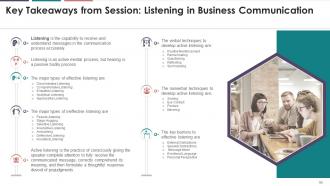
This slide depicts the summary of listening in business communication session.
Slide 88 to 99
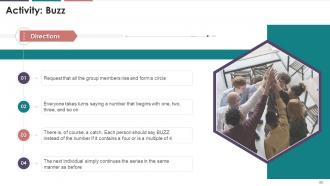
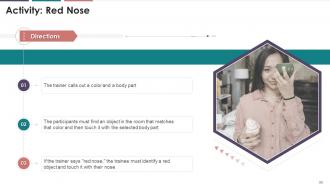
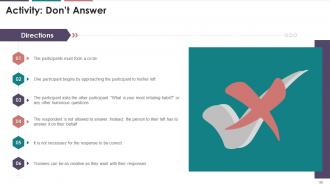
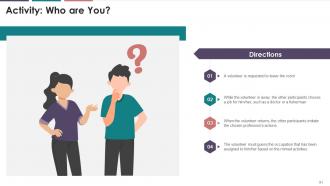
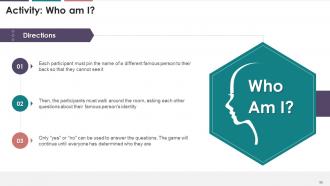
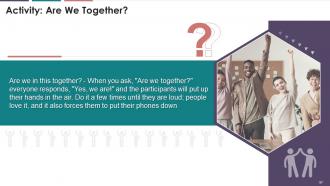
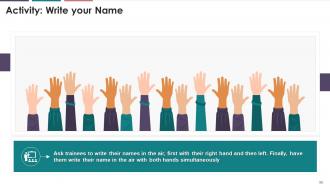
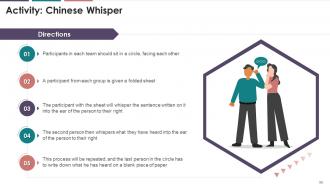
These slides depict energizer activities to engage the audience of the training session.
Slide 102
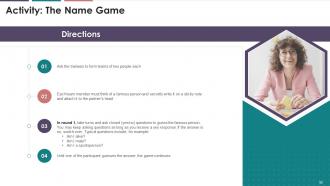
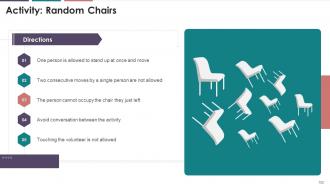
The above slide displays the activity for the team members found less energetic and enthusiastic. It will ensure an increase in energy levels and the productivity of employees at the workplace.
Instructor's Notes:
· Multiple chairs are to be adjusted in the empty and spacious room in a random order
· The chairs should be put in a manner that every chair points in a different direction and all the chairs are occupied
Now,
· Ask for a volunteer from the batch. (Batch may include a maximum of 15 people for a regular size room)
· The volunteer is supposed to walk slowly and approach his/her empty chair and sit down. If the chair is already occupied, then he/she is expected to occupy the other/next alternative empty chair available
· All other members will try to stop the person from approaching the relevant chair
Strategy Formulation:
· Multiple teams can be made to conduct the activity
· Each team can be allotted 2 minutes for planning
· Each round is to be reviewed for the outcomes achieved from the activity
· Each team should have a different volunteer, preferably the person with the lowest energy levels from the batch
· The volunteer should move cautiously so as to not bump into any of the props or persons in the room
Activity Review/Outcomes:
· How did the activity influence the teamwork and engagement skills of all the participants?
· How was the experience while planning and working with 15-20 members at a time?
· Was everybody clear about the purpose and conduct of the respective activity?
· Did you observe any flaws that you wish to improve? Or any other instructions you want to include to make the activity conduct easier?
Listening In Business Communication Training Module On Business Communication Edu Ppt with all 107 slides:
Use our Listening In Business Communication Training Module On Business Communication Edu Ppt to effectively help you save your valuable time. They are readymade to fit into any presentation structure.









FAQs for Listening In Business Communication Training Module On Business
Dude, active listening while presenting is seriously underrated. You're basically reading the room in real time - watching body language, catching confused looks, feeling the energy shift. Confused faces? Slow down. People leaning in? Go deeper with the details. I used to just barrel through my slides (bad idea), but now I pause and actually ask "make sense so far?" It transforms the whole vibe from lecture mode to actual conversation. The difference is wild - suddenly people are engaged instead of checking their phones. Try it next time, you'll see what I mean.
Honestly, asking for feedback during your presentation is a game-changer because it makes you way more aware of what's actually happening in the room. You start noticing when people look confused or when they're mentally checking out (which happens more than we'd like to admit). Instead of just plowing through your slides, you're actually tuned in. The crazy thing is how much you pick up on once you start really watching for reactions. Try stopping mid-way to ask stuff like "Does this match what you've seen?" It's like training yourself to listen while you're talking, which sounds weird but totally works.
You know what's wild? When you actually listen, you catch all these little things - like when someone sounds unsure, they're probably holding back concerns they haven't said yet. Plus you start picking up on different communication styles and the real reasons behind people's opinions. I swear, most of us are just sitting there planning what we'll say next instead of actually hearing them. When people feel heard, they'll share honest thoughts instead of just going along with whoever talks loudest. Try repeating back what they said before you respond - sounds basic but it really works.
Honestly, the biggest game-changer is just asking follow-up questions instead of planning what you'll say next (which I'm terrible at, not gonna lie). Also lean in and make eye contact - sounds basic but it actually works. Oh, and try summarizing what they said before you respond. Like "so you're saying..." It proves you weren't just waiting for your turn to talk. The hardest part? Not formulating your answer while they're still speaking. Maybe just pick one of these to work on per meeting or whatever, don't overwhelm yourself trying to do everything at once.
Ugh, virtual listening is honestly exhausting! Your brain has to work so much harder processing everything through a screen. All those little body language cues that usually help you read people? Gone. Plus you're constantly wondering if someone's deep in thought or just grabbing snacks off-camera. The audio quality thing is real too - headphones make my brain feel fried way faster than normal conversations. Eye contact gets weird when everyone's staring at their own screen instead of the camera. I'd say take way more breaks than you think you need, and just ask people to clarify stuff. We're all figuring this out.
Honestly, multitasking is probably the worst one - like when you're scrolling through emails while someone's trying to tell you something important. Your brain also has this annoying habit of assuming what people will say next based on stuff that happened before, so you stop actually listening. I do this all the time with my sister lol. Strong emotions mess with your focus too. Whether you're stressed out, pissed off, or even super excited about something else, it hijacks your attention. Oh and obviously distractions don't help. Before big conversations, I try putting my phone face down and just breathing for a sec. Works way better than you'd think.
Dude, stories work because we're basically hardwired to follow them - like, our brains literally can't resist wanting to know what happens next. It's the same reason you end up watching Netflix until 2am even though you have work tomorrow (been there lol). When you tell stories in presentations, people actually put their phones down and lean in. Way better than just rattling off boring facts. Stories help them picture what you're talking about and remember it later. Honestly, just start with something personal or a quick case study that connects to your main point. You'll see the difference immediately.
Dude, empathetic listening is seriously like having a secret weapon for connecting with people. Instead of just waiting for your turn to talk, you're actually tuning into their feelings and what they really mean - not just the surface stuff. People can totally sense when you're genuinely focused on understanding them vs. just being polite. Makes them way more likely to open up and actually engage with you. It's wild how much the whole vibe changes. Next time someone's talking, try zeroing in on the emotion behind their words rather than planning your response. The difference is honestly pretty crazy once you start doing it consistently.
Your brain processes stuff way better when it can see AND hear information at the same time. Charts and images break complex ideas into smaller pieces people can actually follow. Nobody wants to stare at boring slides full of text - that's torture for everyone lol. The trick is making sure your visuals match what you're saying instead of distracting from it. I learned this the hard way after using random stock photos that made no sense. Keep things simple and relevant. People will remember way more when they've got something visual to anchor the info to.
Honestly, the phone thing is huge - just put it away completely. Make actual eye contact and focus on what they're saying instead of planning your comeback. I used to be terrible at this lol. Don't jump straight into fix-it mode either, even though that's like... everyone's instinct. Ask questions instead. Nod when they're talking. Maybe repeat back what you heard to make sure you got it right? Lean in a bit but don't be weird about it. Oh, and try waiting three seconds before you respond - sounds dumb but it actually works.
Dude, your body language during presentations matters way more than you think. Speakers can totally tell when you're zoning out - it's kinda awkward for everyone. Eye contact and nodding shows you're actually listening, plus you'll remember more stuff when you look engaged. Lean forward a bit, put your phone down (I know, I know), and uncross your arms. The presenter feeds off that energy and it honestly makes the whole thing less painful. Small changes but they work.
First thing - kill all distractions. Phones off, laptops closed, find somewhere quiet. Do a sound check too because honestly nothing's more awkward than realizing people in the back can't hear you. Tell everyone upfront when they can ask questions so you're not getting interrupted mid-thought. Don't just lecture at them though - pause regularly and actually check if they're following along. Oh, and make sure everyone can actually see you clearly before you start. The whole thing falls apart if half your audience zones out because they missed something early on.
Think back to how you handled the Q&A - were you actually listening or just waiting for your turn to speak? We're all guilty of that sometimes. Did you catch those confused faces in the crowd? Could you tell when people were nodding along vs. totally lost? Honestly, the best move is asking someone you trust who was there to give you real feedback. Recording yourself next time is clutky but super helpful - you'll hear exactly how you sound when responding to questions. Also watch if you adjusted your presentation based on audience reactions, that's huge.
Dude, listening is honestly a game-changer for innovation. You catch those random sparks that turn into actual breakthroughs when you're really tuned in to your teammates. Half-formed thoughts, weird connections, those "what if" moments - they'd totally disappear otherwise. People throw out way wilder ideas when they know you're genuinely hearing them, not just waiting to jump in with your own stuff. The real magic? Building on what others say instead of competing. I swear, the "yes, and..." thing works so much better than shooting down ideas right away. Try it next brainstorm - you'll be surprised.
You've gotta watch your audience like a hawk and switch things up when they check out. Crossed arms, phone scrolling, side chats - that's your cue to change direction fast. But if they're nodding and leaning in? Keep doing whatever you're doing. Look, some crowds are just dead no matter what, so don't beat yourself up. Confusion means slow down and throw in examples. Boredom means skip ahead or tell a story. The trick is pausing enough to actually see how they're reacting, then adjust your whole approach on the fly.
-
Loved the fact that SlideTeam provides clean, high-definition, and professional PowerPoint products.
-
The ease of modifying templates is just superb! Also, the vast collection offers plenty of options to choose from.