


Concept Of Pseudo Listening Training Ppt




Try Before you Buy Download Free Sample Product
 Impress Your
 Audience
 100%
100% Editable
 Save Hours
 of Time


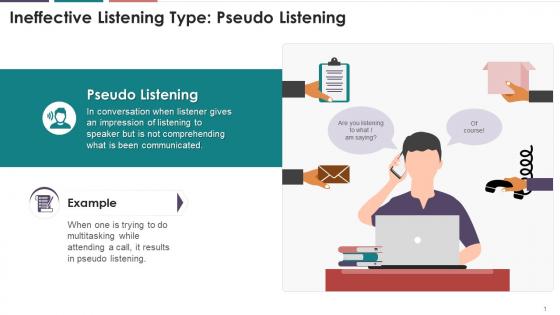
This slide provides information regarding the concept of pseudo listening. It also contains details of how to identify pseudo listener and ways to prevent it.
People who downloaded this PowerPoint presentation also viewed the following :
Concept Of Pseudo Listening Training Ppt with all 17 slides:
Use our Concept Of Pseudo Listening Training Ppt to effectively help you save your valuable time. They are readymade to fit into any presentation structure.










FAQs for Concept Of Pseudo
Pseudo listening characteristics include maintaining eye contact while mentally distracted, providing generic responses like "uh-huh," focusing on formulating replies rather than understanding, selectively hearing only preferred information, and displaying surface-level engagement without genuine comprehension. These behaviors undermine workplace communication by reducing team collaboration, decreasing meeting effectiveness, and ultimately damaging professional relationships, with many organizations finding that addressing pseudo listening significantly enhances operational efficiency.
Pseudo listening negatively impacts presentations by creating disconnection between presenters and audiences, reducing real-time feedback opportunities, and diminishing message retention and comprehension. When audiences engage in surface-level listening, presenters miss crucial nonverbal cues and questions, ultimately delivering less effective presentations that fail to achieve desired business outcomes or strategic communication goals.
Presenters can identify pseudo listening through monitoring audience body language, eye contact patterns, response quality, and engagement levels during interactive segments. Strategic techniques include asking unexpected follow-up questions, requesting specific examples, observing for repetitive nodding without comprehension, and noting delayed reactions to key points, with many experienced speakers finding that varying presentation pace and incorporating surprise elements reveals genuine attention levels.
Pseudo listening involves appearing engaged while mentally distracted or formulating responses, whereas active listening requires full attention, empathy, and genuine comprehension of the speaker's message. In professional settings like client meetings or team collaborations, active listening enables better problem-solving and relationship building, while pseudo listening often leads to miscommunication, missed opportunities, and ultimately undermines trust and organizational effectiveness.
Body language reveals pseudo listening through disconnected nonverbal cues like inconsistent eye contact, closed postures, fidgeting, and delayed responses that don't match engaged behavior. These physical indicators help presenters identify disengaged audience members, enabling real-time adjustments to content delivery, interactive elements, and engagement strategies, ultimately improving communication effectiveness and ensuring meaningful audience connection.
**INPUT**: What psychological factors contribute to a person engaging in pseudo listening? **OUTPUT**: Psychological factors contributing to pseudo listening include cognitive overload, preoccupation with personal concerns, confirmation bias, emotional defensiveness, and attention deficit challenges. These factors often emerge when individuals face overwhelming information streams, competing priorities, or emotionally charged conversations, with many professionals finding that stress, multitasking demands, and preformed judgments significantly impact their listening effectiveness. **Word count: 54 words**
Facilitators can encourage genuine listening by establishing clear ground rules, using interactive elements like polls and breakout discussions, maintaining eye contact, and creating psychological safety for questions. Through strategic pauses, storytelling, and varied presentation formats, organizations find that audiences become more engaged, retain information better, and participate more actively, ultimately delivering more productive meetings and stronger business outcomes.
Pseudo listening commonly occurs during lengthy presentations, routine status updates, technical discussions outside one's expertise, repetitive training sessions, and meetings perceived as irrelevant to personal responsibilities. These scenarios often involve information overload, unclear agendas, or competing priorities, with many organizations finding that strategic meeting design and interactive formats significantly enhance engagement and comprehension.
Feedback mechanisms enhance presentation engagement by incorporating real-time polls, Q&A sessions, interactive discussions, and audience response systems that require active participation. These tools transform passive audiences into engaged participants, with many organizations finding that interactive elements significantly reduce pseudo listening while improving comprehension, retention, and overall presentation effectiveness.
Presentation visuals play a crucial role in combating pseudo listening by engaging multiple senses, reinforcing key messages through charts and infographics, and providing visual anchors that redirect wandering attention. These visual elements enhance comprehension and retention by breaking up monotonous verbal delivery, with many organizations finding that strategic visual integration significantly improves audience engagement and message clarity.
Yes, audience response systems can significantly help mitigate pseudo listening by requiring active participation through real-time polls, quizzes, and interactive feedback mechanisms that demand genuine engagement. These technologies transform passive listeners into active participants, with many organizations finding that interactive elements like live Q&A sessions, sentiment tracking, and engagement analytics ultimately deliver measurable attention levels and enhanced comprehension rates.
Speakers can re-engage pseudo listeners through direct audience interaction, strategic pauses, storytelling with relatable scenarios, changing vocal tonality, and incorporating visual aids or demonstrations. These techniques work by breaking monotonous delivery patterns, creating participation opportunities, and connecting abstract concepts to real-world applications, ultimately transforming passive observers into active participants while enhancing message retention and comprehension.
Understanding cultural context helps avoid pseudo listening by recognizing different communication styles, nonverbal cues, attention patterns, and response expectations that vary across cultures. When presenters adapt their delivery methods, incorporate culturally relevant examples, and adjust their pacing to match audience norms, they create genuine engagement rather than surface-level attention, ultimately delivering more effective cross-cultural communication.
Repeated pseudo listening erodes trust, reduces emotional intimacy, and creates communication barriers that damage relationships over time. Partners, colleagues, and friends gradually recognize inauthentic engagement, leading to decreased willingness to share meaningful information, increased frustration, and ultimately weakened bonds, with many relationships experiencing significant deterioration in quality and depth.
Presenters combat pseudo listening by incorporating audience polls, breakout discussions, interactive Q&A sessions, real-time feedback tools, and hands-on activities throughout their presentations. These engagement strategies transform passive audiences into active participants, with many corporate trainers and conference speakers finding that interactive elements significantly improve information retention, maintain attention spans, and ultimately deliver more impactful learning experiences.
-
The slides come with appealing color schemes and relevant content that helped me deliver a stunning presentation without any hassle!
-
Presentation Design is very nice, good work with the content as well.