


Difference Between Active And Passive Listening Training Ppt




Try Before you Buy Download Free Sample Product
 Impress Your
 Audience
 100%
100% Editable
 Save Hours
 of Time


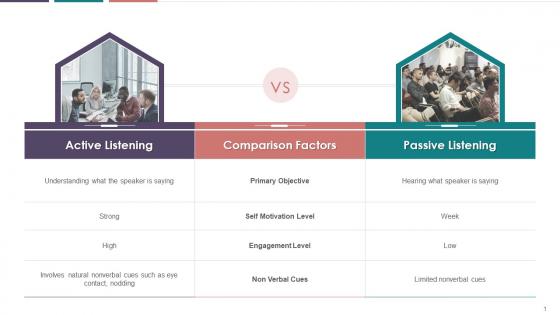
This slide tabulates the difference between active and passive listening on multiple comparison factors such as the primary objective, self motivation level, engagement level, and nonverbal cues.
People who downloaded this PowerPoint presentation also viewed the following :
Difference Between Active And Passive Listening Training Ppt with all 17 slides:
Use our Difference Between Active And Passive Listening Training Ppt to effectively help you save your valuable time. They are readymade to fit into any presentation structure.







FAQs for Difference Between Active And Passive
Active listening involves full engagement through eye contact, verbal acknowledgments, clarifying questions, paraphrasing responses, and providing meaningful feedback to demonstrate understanding. Passive listening typically means simply hearing information without interaction or engagement, with many organizations finding that active listening techniques significantly enhance team communication, reduce workplace misunderstandings, and ultimately deliver stronger client relationships and improved operational efficiency.
Active listening improves professional communication by encouraging deeper engagement, demonstrating genuine interest, and fostering mutual understanding through focused attention and thoughtful responses. In workplace environments like team meetings, client consultations, and performance reviews, this approach builds stronger relationships, reduces misunderstandings, and enhances collaboration, ultimately delivering improved productivity and trust.
Passive listening proves more appropriate during initial information-gathering phases, large group presentations, brainstorming sessions, and when processing complex data or instructions that require minimal interruption. This approach enables better absorption during lectures, conference calls, and strategic briefings, while allowing speakers to complete their thoughts uninterrupted, ultimately delivering clearer understanding and more comprehensive information retention.
**INPUT**: What techniques can be employed to enhance active listening skills during presentations? **OUTPUT**: Active listening techniques during presentations include maintaining eye contact, asking clarifying questions, paraphrasing key points, taking strategic notes, and providing nonverbal feedback through nodding or leaning forward. These approaches enhance audience engagement by demonstrating genuine interest, improving comprehension, and fostering meaningful dialogue, with many organizations finding that active listening significantly improves presentation outcomes and stakeholder relationships.
Passive listening negatively impacts team dynamics by creating communication breakdowns, fostering misunderstandings, and reducing psychological safety within groups. When team members engage in passive listening, projects experience delays, conflicts escalate unresolved, and collaborative innovation suffers, with many organizations finding that productivity drops significantly when employees feel unheard and undervalued.
Body language significantly distinguishes active from passive listening through eye contact, posture, facial expressions, and responsive gestures. In active listening, professionals maintain forward-leaning postures, consistent eye contact, and engaged facial expressions, while passive listening often involves distracted body positioning, minimal eye contact, and closed-off gestures, with many organizations finding that training employees in active body language enhances client relationships and team collaboration.
You can assess your listening style by evaluating your engagement level, response quality, and retention of details shared during conversations. Active listening involves asking clarifying questions, paraphrasing what you've heard, maintaining eye contact, and providing thoughtful feedback, while passive listening typically results in minimal interaction, difficulty recalling specific information, and generic responses that don't demonstrate true comprehension.
Common barriers include technical distractions, multitasking temptations, reduced nonverbal cues, audio delays, and screen fatigue that impede engagement. These challenges affect team collaboration by limiting feedback quality, reducing meeting effectiveness, and weakening interpersonal connections, with many organizations finding that structured virtual protocols and dedicated participation guidelines significantly enhance communication outcomes.
In active listening, feedback is immediate, specific, and demonstrative through verbal confirmations, clarifying questions, and paraphrasing to ensure understanding. Passive listening generates minimal or delayed feedback, with listeners offering basic acknowledgments without deep engagement. Active feedback enhances communication accuracy, builds stronger relationships, and accelerates problem-solving in team environments, ultimately delivering better collaboration and reduced misunderstandings across organizational levels.
Strategies to foster active listening include implementing structured feedback sessions, training managers in listening techniques, creating open-door policies, establishing regular team check-ins, and recognizing employees who demonstrate strong listening skills. These approaches enhance workplace communication by encouraging deeper engagement, reducing misunderstandings, and building trust, with many organizations finding that active listening cultures ultimately deliver improved collaboration, higher employee satisfaction, and more innovative problem-solving across all departments.
Active listeners interpret tone and emotion with greater accuracy by maintaining eye contact, asking clarifying questions, and providing verbal acknowledgments that confirm understanding. Passive listeners often miss emotional subtleties, misinterpret speaker intent, and fail to recognize underlying concerns, with many organizations finding that active listening training significantly enhances customer service interactions, team communication, and conflict resolution outcomes.
Active listening significantly improves conflict resolution by demonstrating respect, reducing misunderstandings, and creating psychological safety for all parties involved. Through techniques like paraphrasing, asking clarifying questions, and maintaining eye contact, mediators and participants can de-escalate tensions, uncover underlying concerns, and facilitate collaborative solutions, with many organizations finding that trained active listeners resolve workplace disputes faster and more effectively.
Educators can promote active listening by modeling attentive behavior, implementing interactive classroom discussions, using reflective questioning techniques, and creating structured peer-to-peer activities that require careful listening. Through these approaches, teachers enhance student engagement, comprehension, and collaborative skills, with many educational institutions finding that these strategies significantly improve classroom participation and academic outcomes.
Consistently practicing active listening enhances emotional intelligence, reduces interpersonal conflicts, and builds stronger professional relationships through improved empathy and communication skills. These psychological benefits streamline workplace collaboration, enhance team dynamics, and ultimately deliver better leadership capabilities, with many organizations finding that employees who practice active listening demonstrate increased job satisfaction and more effective conflict resolution abilities.
Organizations can measure active listening training effectiveness through employee feedback surveys, 360-degree assessments, customer satisfaction scores, communication quality audits, and behavioral observation metrics. These measurement approaches enable companies to track improvements in team collaboration, client relationships, and conflict resolution rates, with many businesses finding that systematic evaluation delivers enhanced workplace communication and stronger customer experiences, ultimately providing competitive advantage through better stakeholder engagement.
-
Out of the box and creative design.
-
Love how there are no boring templates here! The design is fresh and creative, just the way I like it. Can't wait to edit and use them for my extended projects!