

Literature review ppt slides deck




Try Before you Buy Download Free Sample Product
 Impress Your
 Audience
 100%
100% Editable
 Save Hours
 of Time


Our Literature Review Ppt Slides Deck are an emancipated lot. Remove any restrictions on your thoughts.
People who downloaded this PowerPoint presentation also viewed the following :
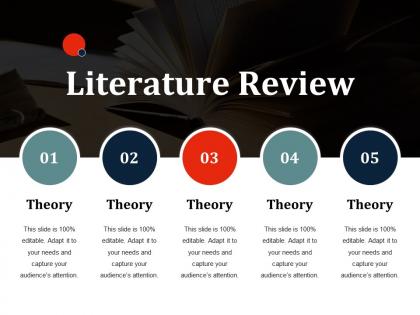
Literature review ppt slides deck with all 5 slides:
Grab that big chance with our Literature Review Ppt Slides Deck. They enable you to get it firmly in hand.
FAQs for Literature review
So basically you're mapping out what's already been studied and finding gaps where your research fits in. Don't want to spend forever researching something that's been beaten to death, right? You'll also establish your theoretical foundation and show you understand the ongoing conversation in your field. Building on existing methodologies saves you from reinventing everything from scratch - honestly such a time saver. Start with recent, solid sources in your area first. Then work backward to grab the foundational studies that everyone references.
So basically, you need a solid lit review to prove you're not just making stuff up. It shows reviewers you actually know what's already out there and where your research fits in. Without it, you look like you're randomly throwing variables together - which honestly, reviewers will tear apart. Map out the gaps and contradictions first before jumping into your study design. That way you'll catch potential issues that could mess with your results later. Plus it helps you build on methods that actually work instead of starting from scratch. Trust me, the extra time upfront is worth it.
Systematic reviews are super structured - you set exact search terms and criteria upfront, then methodically go through every single paper. Takes forever but they're way less biased and actually reproducible. Narrative reviews? Total opposite. You can explore themes freely and add broader context, but honestly they're pretty subjective. I always think of it like following a recipe vs. just throwing ingredients together. Both work, but systematic reviews carry more weight when you need solid evidence for decisions. Go systematic if you need definitive answers, narrative if you're just exploring new ideas or complex topics.
Honestly, I'd hit up PubMed and Google Scholar first - maybe some field-specific databases too if you're in a niche area. Boolean searches are your friend (AND, OR, NOT). Find a couple good systematic reviews to start since they'll show you what's already out there. Then dig into reference lists from solid papers you find - seriously, those are treasure troves. Set your criteria early: what years, study types, relevance stuff. Otherwise you'll be drowning in random papers later. Oh, and use a citation manager from the beginning! I learned this the hard way when I spent hours trying to relocate papers I'd already read.
So citation analysis tracks how much impact your lit review actually has on the field. Google Scholar or Web of Science will show you which parts get cited most often. Other researchers citing your work tells you if you're identifying the right foundational studies - honestly, it's kind of like academic popularity rankings but obviously quality beats raw numbers. The patterns also reveal gaps you might've missed or new research directions that are emerging. Worth checking what papers others reference from your review too, since that shows whether you're hitting the mark.
Your methodology totally shapes how you'll organize everything. Systematic reviews? You're stuck with chronological order or grouping by study types - super rigid inclusion criteria too. Narrative reviews are way more flexible though. You can group by themes or theories, but honestly that freedom can mess with your head sometimes. Meta-analyses force you to put all the statistical stuff upfront. Scoping reviews are chill - you cast a wider net and organize around whatever concepts make sense. The approach you pick also decides if you're being critical or just describing things. Choose your method first, then roll with it.
Don't just go study by study - that's boring as hell. Group them by themes instead and look for where they agree or totally contradict each other. I always make some kind of chart to map out how they connect (seriously saves so much time). You can organize by methodology, results, whatever makes sense. The good stuff happens when you show how studies build off each other or clash. Like, maybe three studies say one thing but then this fourth one comes in with completely different findings. Create a story that shows the big picture. Nobody wants to read a grocery list of "this study found X, that study found Y."
Yeah, critical analysis is what makes a lit review actually worth reading instead of just a glorified summary dump. You've gotta evaluate if each source's methodology is solid and whether their claims actually hold up. Look for patterns between studies, but also hunt for gaps and contradictions - that's where the good stuff is. Don't just regurgitate what authors said; question whether their findings are reliable. How does conflicting evidence fit together? Honestly, professors can smell a basic summary from a mile away. Your job is connecting dots and spotting what's missing in the research landscape.
Okay so biggest thing is citing everything properly and not misrepresenting what authors actually said. Also don't just pick studies that prove your point while conveniently ignoring ones that don't - super annoying when people do that. Be upfront about how you searched for sources and what criteria you used. If you're looking at unpublished stuff or have any conflicts of interest, mention those right away. Oh and keep detailed notes of your whole process because you'll probably forget half of it otherwise. Basically just be transparent about your methods and honest about what you found.
Honestly, visuals are a game-changer for lit reviews. Concept maps work great for showing how theories connect. Timelines help track research evolution over time. I'm a huge fan of comparison tables - they make gaps and contradictions super obvious. You could also do charts for publication trends or methods used. Nobody wants to read endless paragraphs, right? Wait until you're revising though, don't get caught up making graphics while you're still writing. That's when you'll actually see which relationships need visual help. Your readers will thank you for breaking up all that text.
Ugh, the worst thing you can do is just describe what each paper says instead of actually analyzing it. Connect your sources thematically - don't just summarize them one by one. Also, reviewers will destroy you if you cherry-pick studies that only back up what you want to prove. I've seen it happen so many times. Look for real gaps in the research, not made-up ones. Keep everything tied to your actual research question instead of throwing in random related studies you stumbled across. Oh, and make sure you're building toward a coherent argument throughout.
Okay so first thing - get a reference manager like Zotero or Mendeley. They'll save your sanity with organizing sources and auto-generating citations. Connected Papers is incredible for mapping how studies relate to each other, seriously wish I'd found it sooner. Semantic Scholar works great too. Once you've got your main sources, try visualization tools to spot research gaps. AI stuff like Elicit can summarize findings and suggest papers you might've missed. Citation analysis helps track which papers actually matter. Start simple with the reference manager though - don't overwhelm yourself with every tool at once.
Your lit review needs to cover the big sources in your field - but don't just summarize them. Make them have a conversation with each other. Show where they agree, clash, or leave holes. I swear this is where most people screw up. Organize it chronologically so readers can follow how ideas developed. Critical analysis matters more than just listing what everyone said. Good reviews help readers see the research landscape clearly and spot exactly where your work fits. If sources feel connected rather than random, you're on the right track.
Context is everything with lit reviews - it's basically your filter for the whole thing. Your research question and who you're writing for completely change which studies matter most. Like, a clinical review hits way different than an academic one, even on the same topic. Timeframe matters too. Emerging fields vs established ones? Totally different conclusions. I've literally seen the exact same research used to make opposite arguments depending on whether it was for doctors or policymakers. Wild, right? Just make sure you're upfront about your context from the start and let that drive how you pull everything together.
Honestly, systematic reviews are everywhere now - they're like the new gold standard. Mixed-methods stuff is huge too, where people combine the number-crunching bibliometrics with actual thematic analysis. STEM fields are doing these massive meta-analyses with insane datasets. Meanwhile humanities folks have jumped on the digital tools bandwagon for corpus work. Health sciences went totally overboard with PRISMA protocols (kinda makes everything feel cookie-cutter tbh), but social sciences are doing the opposite with more narrative reviews. Oh, and interdisciplinary approaches are definitely having a moment. Just browse recent journals in your area - you'll see what's actually getting published and what editors want right now.
-
Understandable and informative presentation.
-
Best way of representation of the topic.