


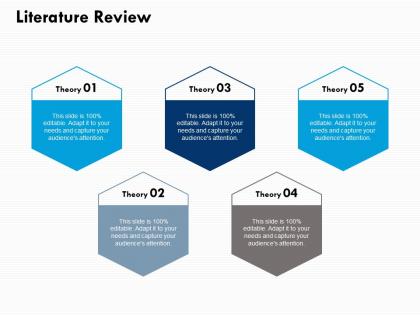
Literature review ppt powerpoint presentation file gallery




Try Before you Buy Download Free Sample Product
 Impress Your
 Audience
 100%
100% Editable
 Save Hours
 of Time


Anticipate events with our Literature Review Ppt Powerpoint Presentation File Gallery. Folks will feel you are clairvoyant.
People who downloaded this PowerPoint presentation also viewed the following :
Literature review ppt powerpoint presentation file gallery with all 5 slides:
Get by with a little help from our Literature Review Ppt Powerpoint Presentation File Gallery. They will put your act together.

FAQs for Literature review ppt powerpoint
Key components of an effective literature review include comprehensive source identification, critical analysis of existing research, thematic organization, identification of research gaps, and synthesis of findings across studies. These elements work together by establishing theoretical foundations, demonstrating scholarly engagement, and providing strategic direction for future research, with many academic institutions finding that well-structured reviews significantly enhance research credibility and impact.
A literature review differs from other academic writing by synthesizing existing research rather than presenting original arguments, focusing on identifying patterns, gaps, and trends across multiple sources instead of defending a thesis. Unlike research papers or essays, literature reviews systematically analyze scholarly conversations within a field, enabling researchers to position new studies strategically and identify unexplored opportunities for advancing knowledge.
**INPUT**: What methodologies are commonly used in conducting a literature review? **OUTPUT**: Literature review methodologies include systematic reviews, narrative reviews, meta-analyses, scoping reviews, and integrative reviews, each serving different research objectives and scope requirements. These approaches streamline research synthesis by establishing clear search protocols, defining inclusion criteria, and ensuring comprehensive coverage, with many academic institutions and organizations finding that structured methodologies ultimately deliver more credible insights and competitive research advantages. [Word count: 60 words]
Literature gaps can be identified through systematic analysis of current research themes, methodologies, contradictory findings, and unexplored areas within your field. Researchers accomplish this by conducting comprehensive database searches, comparing study outcomes across different populations or contexts, and examining temporal trends, with many academic institutions finding that synthesizing multiple review approaches ultimately delivers more robust research foundations and competitive publication opportunities.
A literature review identifies knowledge gaps, establishes theoretical frameworks, and reveals unexplored areas, directly informing the development of focused, relevant research questions. Through systematic analysis of existing studies, researchers can refine their inquiries, avoid duplication, and position their work strategically within academic discourse, ultimately delivering more impactful and methodologically sound research outcomes.
Sources should be evaluated through peer-review status, author credentials, publication reputation, methodology rigor, and direct relevance to research objectives. Academic institutions and research organizations increasingly emphasize systematic evaluation frameworks that streamline source selection, enhance review quality, and ultimately deliver more credible findings, with many researchers finding this structured approach significantly improves their literature review outcomes.
Common organizational structures for literature reviews include chronological, thematic, methodological, theoretical, and comparative approaches. These frameworks enable researchers to systematically present existing scholarship by grouping studies around time periods, central themes, research methods, or theoretical perspectives, with many academic institutions finding that thematic organization delivers the clearest synthesis and identifies research gaps most effectively.
Citation styles significantly affect literature review presentation through formatting consistency, source integration methods, and reader navigation ease. Different styles like APA, MLA, and Chicago influence how sources appear within text and reference lists, with many academic institutions finding that consistent citation formatting enhances credibility, streamlines peer review processes, and ultimately delivers clearer scholarly communication across diverse research disciplines.
**INPUT**: What strategies can be employed to synthesize information from multiple sources? **OUTPUT**: Effective synthesis strategies include thematic clustering, comparative analysis, chronological mapping, methodological triangulation, and gap identification across sources. These approaches enable researchers and analysts to create comprehensive frameworks by identifying patterns, contradictions, and knowledge gaps, while organizations in consulting, healthcare, and policy development find that systematic synthesis delivers deeper insights, reduces information overload, and ultimately supports more informed strategic decision-making. [Word count: 60]
Ensuring balanced representation requires systematically searching diverse databases, including studies with varying methodologies, contradictory findings, and perspectives from different theoretical frameworks, geographical regions, and time periods. Researchers should actively seek out opposing viewpoints, minority perspectives, and studies from various disciplines, while critically evaluating each source's credibility and contribution, ultimately delivering a comprehensive analysis that strengthens the review's validity and scholarly impact.
**INPUT**: What are the ethical considerations to keep in mind when writing a literature review? **OUTPUT**: Ethical considerations include proper attribution, avoiding plagiarism, maintaining objectivity, disclosing conflicts of interest, and ensuring comprehensive source representation without cherry-picking data. These practices enhance credibility by establishing transparent methodology, protecting intellectual property rights, and delivering balanced perspectives, with academic institutions and research organizations finding that rigorous ethical standards ultimately strengthen scholarly impact and professional reputation.
Technology streamlines literature review processes through AI-powered search engines, automated citation management systems, reference organizing software, and plagiarism detection tools. These technologies enhance research efficiency by accelerating source discovery, systematically organizing vast amounts of academic content, and ensuring citation accuracy, ultimately delivering faster, more comprehensive reviews while minimizing manual errors and administrative overhead.
Common pitfalls include lack of synthesis, excessive summarizing without analysis, poor organization, bias toward recent sources, and insufficient critical evaluation. These issues undermine academic credibility by creating disconnected narratives rather than cohesive arguments, with many researchers finding that strategic thematic organization and balanced source integration ultimately delivers stronger scholarly foundations and more compelling research frameworks.
Literature reviews contribute to policy development by synthesizing existing research evidence, identifying knowledge gaps, evaluating intervention effectiveness, and providing evidence-based recommendations for decision-makers. Through comprehensive analysis of academic studies, government reports, and case studies, policymakers can craft more informed strategies that address real-world challenges, ultimately delivering better outcomes for stakeholders while minimizing implementation risks.
Effective literature review presentations utilize thematic organization, visual synthesis maps, chronological timelines, comparative analysis tables, and gap identification frameworks. These techniques streamline complex research by categorizing findings into coherent themes, highlighting research evolution through visual timelines, and presenting contrasting viewpoints through structured comparisons, ultimately delivering clearer academic insights and enhanced audience comprehension for researchers and institutions.
No Reviews