


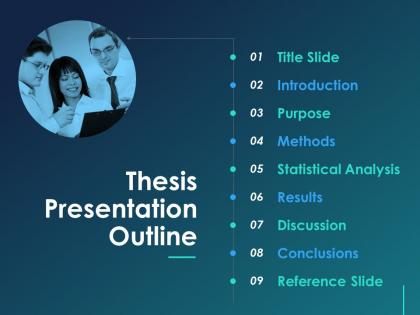
Thesis presentation outline ppt designs




Try Before you Buy Download Free Sample Product
 Impress Your
 Audience
 100%
100% Editable
 Save Hours
 of Time


Guide them to fulfilment with our Thesis Presentation Outline Ppt Designs. Your group will develop the drive.
People who downloaded this PowerPoint presentation also viewed the following :
Thesis presentation outline ppt designs with all 5 slides:
Our Thesis Presentation Outline Ppt Designs allow you to clown around. Entertain folks with humorous anecdotes.
FAQs for Thesis presentation
Okay so for your thesis presentation, you definitely need a strong intro that grabs people, then your research questions, methodology, and findings with solid evidence. The intro and findings are honestly where you'll either nail it or bomb - no pressure lol. Make sure you cover the implications of your work too, plus wrap up with future research ideas. Oh and practice those transitions between sections out loud! That's where everyone trips up and it gets awkward fast. Keep your slides clean but impactful. Save time for Q&A at the end. Trust me on this one.
Honestly, visuals are a game changer for thesis outlines. They break up all that text and help people actually see how your arguments connect. I'd start with flowcharts or simple diagrams - especially for the confusing parts that make people's eyes glaze over. Your methodology section? Perfect spot for a visual. Same with showing how chapters flow together. People retain info way better when they can see relationships instead of just reading about them. Plus, let's be real, nobody wants to stare at pages of dense text anymore. Find your outline's messiest sections first, then figure out what kind of chart or diagram would clean them up.
Start with something that'll grab them - a wild stat or question that makes people lean in. Don't just stand there like a robot! Move around, make eye contact. Tell stories to back up your points instead of just listing facts. Throw in some interaction too - quick polls or "raise your hand if..." moments work great. Your slides should be clean, not cluttered with tiny text that nobody can read anyway. Pausing is your friend - it adds drama. Oh, and here's the thing: always tie each point back to why they should actually care.
Honestly, I just match time to how important each part is. Background gets maybe 20% - just enough so people aren't lost. Your results and methods are the real meat, so give them like 60%. Then wrap up with conclusions in the remaining 20%. If your methodology is super weird or novel, maybe bump that up a bit. But seriously, practice with a timer first because you WILL go over. I learned that the hard way. When you're flying through slides, that's your sign to cut stuff. Be brutal about it - people only need to get your main contribution, not every tiny detail.
Biggest thing? Don't pack way too much stuff in there. You'll rush through everything and lose people completely. I learned this the hard way - jumped straight into technical stuff without any setup and literally watched everyone zone out in like 5 minutes lol. Also super important to plan Q&A time and practice how you'll move between sections. Your outline needs to flow: problem → solution → what it all means. Oh and definitely build in buffer time! Nothing worse than running over when people have other meetings. Keep sections realistic and simple.
Okay so I break feedback into three piles: missing content, flow problems, and stuff that's just confusing. Fix the big content gaps first - you'll probably need to restructure whole sections anyway. Flow issues come next, which means moving things around and adding transitions (super boring but whatever). The clarity stuff is last - like when you explain something in a way that makes zero sense to anyone else. Oh and definitely keep a list of what you've tackled vs what's still sitting there. Don't go crazy trying to use every comment though. Pick the ones that actually make your argument stronger.
Dude, think of your thesis presentation like telling a story instead of just throwing data at people. You've got all the classic elements already - there's a problem (your research gap), the investigation part (your methods), and the big reveal (what you discovered). Way better than those boring academic presentations that put everyone to sleep, honestly. Start with a hook that makes people think "okay, why should I care about this?" Then build up some tension before you drop your findings. I mean, your research is already a journey you went on - just present it that way! People will actually pay attention instead of checking their phones.
So you'll want to totally switch up your approach depending on who you're talking to. Academics eat up all the methodology stuff and theoretical deep dives - honestly they can't get enough of it. Industry people though? They just want to know how it actually works in practice and what results you got. Skip the process, show the impact. General audiences need the simple version - big picture, no jargon, clear points they can walk away with. Your main structure can stay the same, but you're basically moving around where you spend time and how nerdy you get. Just think: what does this crowd actually care about?
Honestly, just go with PowerPoint or Google Slides - your committee expects that standard format anyway. Canva looks pretty but can come off too "designery" for academia (professors are weird about that stuff). Prezi's cool if you need to show how everything connects visually. I made the mistake of going overboard with animations once and my advisor wasn't having it lol. Focus on clear flow over fancy effects. Start simple and make sure your argument comes through clearly - that's what actually matters.
Think of your outline like telling a story - problem first, then how you tackled it, what you found, and what it all means. After each section, I do this "so what?" check to make sure everything flows together. Your transitions need to be super clear because your audience hasn't been obsessing over this research like you have (trust me on this one). Read through it pretending you know nothing about your topic. If you hit any weird jumps or confusing parts, either reorder stuff or throw in a connecting sentence. The goal is someone should be able to follow your thinking without constantly wondering "wait, how'd we get here?"
So I'd definitely record yourself on your phone first - yeah it's weird but you'll catch all those "ums" and weird pauses. Talk through each section out loud and time it. Get your lab mates to listen and throw questions at you, that's honestly the most helpful part. Oh and you don't have to nail the whole thing at once - just work on the sections that feel clunky first. I usually start super basic with just my main points, then layer in details once I'm not stumbling over myself. The outline's basically your safety net so you won't forget anything important.
Oh man, Q&As totally change how you plan everything! You've gotta cut 10-15 minutes from your main content to make room for questions. I bombed this once - ran way over and had literally no time left. Super awkward. While you're building your slides, think about what'll confuse people and throw in extra context. Don't just end abruptly either - wrap up in a way that naturally opens the door for questions. The tricky part is switching from "presentation mode" to actual conversation, so practice that transition. Trust me, it feels weird at first but makes a huge difference.
Honestly, start with something that makes people sit up - a wild statistic or a "what if" question works great. Then hit them with what you actually found and why they should care. The structure I'd go with? Problem, your journey figuring it out, solution, then impact. Sounds basic but it works every time. Oh, and practice your opening way more than the rest. Like, seriously overdo it. If you nail those first two minutes, people will actually listen when you get into the boring methodology stuff later. The presentations I remember most had this "holy crap, this actually matters" vibe from minute one.
Ugh, cutting down thesis presentations is the worst! Start by axing methodology details - nobody really cares about the nitty-gritty process anyway. Your lit review can get chopped down to just the major gaps. Background stuff? Cut it way back. Keep your results and conclusions mostly untouched though - that's the meat everyone's there for. You can combine sections that overlap or use fewer examples. Don't spend forever on your intro either. Just hit your research question and dive in. Honestly, focus on your strongest evidence and main contributions, then ditch the rest. Oh, and definitely practice the short version! You don't want to panic mid-presentation and accidentally go over time.
Honestly, your thesis is like the spine of your whole presentation - everything else just hangs off it. It tells you exactly what points to hit and in what order. Plus transitions become super easy since you're always circling back to that main idea. I learned this the hard way after bombing a presentation that was just random thoughts thrown together lol. Without a solid thesis, you'll ramble and lose people fast. It keeps you on track so you don't go down weird rabbit holes that confuse everyone.
-
Unique research projects to present in meeting.
-
Really like the color and design of the presentation.