

Data management powerpoint presentation slides





Try Before you Buy Download Free Sample Product
 Impress Your
 Audience
 100%
100% Editable
 Save Hours
 of Time


Data governance is a quality control discipline, assess data accuracy consistency and timeliness with our content ready Data Management PowerPoint Presentation Slides . Utilize visually appealing information architecture PowerPoint templates to define a set of data management procedures and plans. The data governance program PowerPoint complete deck includes ready to use PowerPoint templates such as the need for data governance, why companies suffer from data governance, automated data governance, framework, roles and responsibilities, ways to establish data management process, improvement roadmap, etc. Set up data governance structure with this easy to use and fully editable information management PPT slides. You can modify, color, text, and font size. It has relevant templates to cater to your business needs. Implement data governance to improve the productivity and efficiency of the organization. Establish processes to ensure effective data management using Information Architecture PPT slides. Download information governance presentation deck to showcase data management practices. Our Data Management Powerpoint Presentation Slides denote authority. Folks automatically follow your guidelines.
People who downloaded this PowerPoint presentation also viewed the following :
Content of this Powerpoint Presentation
Slide 1: This slide introduces Data Management. State Your Company Name and begin.
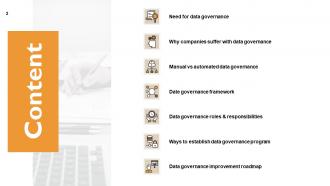
Slide 2: This slide shows Content of the presentation.
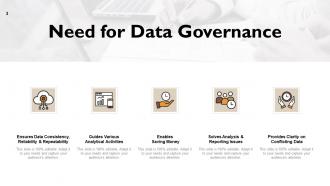
Slide 3: This slide presents Need for Data Governance describing- Guides Various Analytical Activities, Solves Analysis & Reporting Issues, Ensures Data Consistency, Reliability & Repeatability, Enables Saving Money, Provides Clarity on Conflicting Data.
Slide 4: This slide showcases Why Companies Suffer with Data Governance.
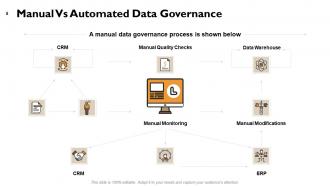
Slide 5: This slide displays Manual Vs Automated Data Governance with related chart.
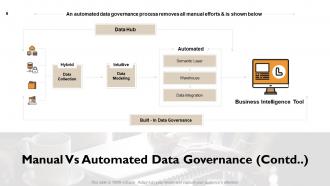
Slide 6: This is another slide continuing Manual Vs Automated Data Governance.
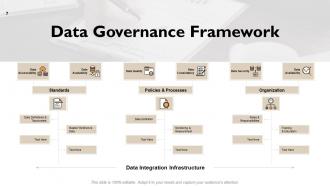
Slide 7: This slide represents Data Governance Framework describing- Standards, Policies & Processes, Organization.
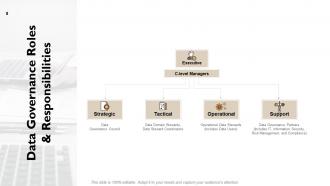
Slide 8: This slide shows Data Governance Roles & Responsibilities describing- Strategic, Tactical, Operational and Support.
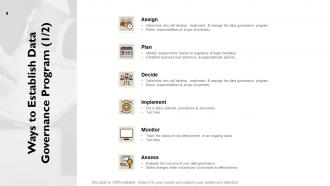
Slide 9: This slide presents Ways To Establish Data Governance Program describing- Assign, Decide, Plan, Implement, Assess and Monitor.
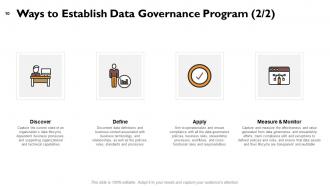
Slide 10: This slide displays Ways To Establish governance Program describing- Discover, Define, Apply, Measure & Monitor.
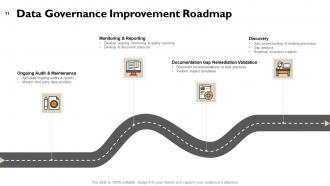
Slide 11: This slide represents Data Governance Improvement Roadmap describing- Discovery, Documentation Gap Remediation Validation, Monitoring & Reporting, Ongoing Audit & Maintenance.
Slide 12: This slide showcases Data Management Icons.
Slide 13: This slide is titled as Additional Slides for moving forward.
Slide 14: This is About Us slide to show company specifications etc.
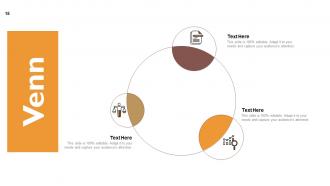
Slide 15: This is a Venn slide with text boxes.
Slide 16: This is an optional Venn slide.
Slide 17: This slide displays Magnifying Glass to highlight information.
Slide 18: This is an Idea Bulb & Brain slide to state a new idea or highlight information, specifications etc.
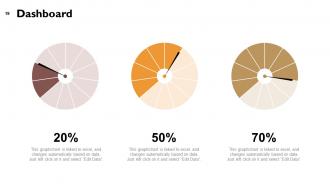
Slide 19: This slide shows Dashboard with data in percentage.
Slide 20: This is a Location slide with maps to show data related with different locations.
Slide 21: This is Our Goal slide. Show your firm's goals here.
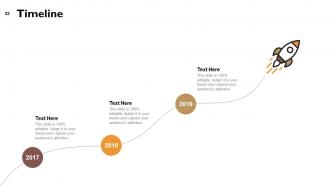
Slide 22: This is a Timeline slide to show information related with time period.
Slide 23: This is Our Mission slide with related imagery and text.
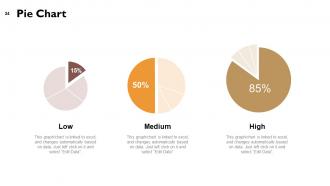
Slide 24: This slide displays Pie Chart with data in percentage.
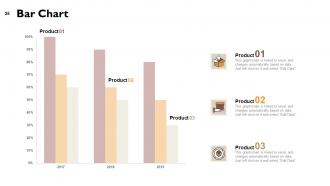
Slide 25: This slide shows Bar Chart with three products comparison.
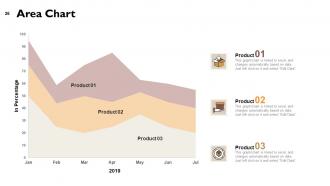
Slide 26: This slide presents Area Chart with three products comparison.
Slide 27: This is a Thank You slide with address, contact numbers and email address.
Data management powerpoint presentation slides with all 27 slides:
Our Data Management Powerpoint Presentation Slides are like a warm breeze. Your thoughts will soar on the strength of their lift.









FAQs for Data management
Honestly, start by figuring out what data you actually have - can't fix what you don't know about. Data quality and security are the big ones, plus you need someone actually owning this stuff (governance). Set up proper backups because things will break at the worst possible moment. Classification matters too - separate your sensitive data from the random spreadsheets everyone shares. Don't let everyone access everything either. And yeah, document your processes even though it's tedious. Trust me, you'll be grateful when someone inevitably asks "how does this work again?" six months later.
Build validation rules straight into your pipeline - don't wait until the end to check stuff. Automated testing at every stage will save your ass later, trust me. Monitor everything so you catch problems right away instead of finding out your reports are trash three weeks down the line. The whole "garbage in, garbage out" thing? Yeah, that's annoyingly accurate. Get clear policies written down so everyone knows what good data looks like. Someone needs to own each dataset - can't have nobody accountable. Document your processes and actually train people on handling data properly.
Cloud-native stuff is everywhere now, plus AI/ML automation is handling way more of the heavy lifting. Real-time streaming is pretty much mandatory if you're dealing with serious data volumes. DataOps is blowing up too - think DevOps but for data pipelines, makes deployments so much smoother. Modern data catalogs are actually worth the investment now, especially with all these new compliance requirements. Oh, and self-service analytics is getting big, so you'll want infrastructure that doesn't require a PhD to use. Honestly, the governance tools alone will save your sanity.
Look, data governance is basically your rulebook for handling all company data. It decides who gets access to what, storage protocols, quality standards - the whole nine yards. Without it? You're basically running a library with zero organization (been there, it sucks). Your data management falls apart fast. Governance keeps you compliant and reduces those nightmare scenarios where sensitive info goes missing. Plus everyone actually knows what they're supposed to do with data instead of just winging it. I'd start by mapping out how your data currently moves around and figure out who the key players are first.
Ugh, storage costs will absolutely kill your budget first. Then you've got data quality issues everywhere - half your info is basically garbage. Finding anything becomes impossible when it's scattered across like 10 different systems. Security gets messy fast with sensitive data spread all over the place. Your queries start crawling instead of running properly, which drives everyone crazy. Teams can't even reach the data they actually need because everything's locked in silos. Honestly, just start by figuring out what you're actually using - I bet you can ditch tons of stuff immediately and save yourself the headache.
Honestly, the biggest mistake I see companies make is building these incredible data systems that just... sit there unused. Nobody cares how fancy your dashboard is if it doesn't actually solve business problems, you know? Start with your real strategic goals first - like boosting customer retention or cutting costs. Then figure out what data you actually need to move the needle on those things. Get your business leaders involved from the start, not just IT. Make sure everyone's speaking the same language and can point to clear ROI. Otherwise you'll end up with another expensive project gathering digital dust.
First things first - figure out what data you actually have and where it's sitting right now. That'll save you tons of headaches later. Encrypt everything, obviously - both when it's stored and moving around. Set up access controls so people only see what they need to see. Automated backups are your best friend, but actually test your recovery process because backups that don't work are basically useless. Don't let old data pile up forever either - costs add up fast. Oh, and use the cloud provider's built-in security tools when you can. They've done most of the hard work already. Data classification helps too so your really sensitive stuff gets extra protection.
Honestly, big data totally flips how you handle storage and processing. Your old relational databases? They're gonna choke on the volume and variety. You'll need distributed systems, data lakes, cloud storage - the whole nine yards. Real-time processing becomes critical instead of those slow overnight batch jobs. Governance gets messier too when you're juggling multiple data sources and formats. Oh, and the speed requirements are insane. I'd probably start by figuring out what you actually have right now, then see which datasets really need the big data approach. Not everything does, despite what vendors tell you.
First thing - map out where all your personal data actually lives. Honestly, most companies are shocked by how scattered it is. Build privacy stuff right into how you handle data from day one: minimize what you collect, set up automatic deletion, manage consent properly. The documentation is a total pain but you gotta do it - track your processing activities and audit regularly. Train your team so they can handle data requests fast. Oh, and set up monitoring to catch problems early. Trust me, fixing issues after the fact costs way more than doing it right initially.
Think of metadata like labels on moving boxes - you know how awful it is digging through unmarked ones, right? It's your data's GPS, telling you what something is, where it came from, and when it was made. Without it, you're basically flying blind trying to find anything useful. Good metadata saves you tons of time discovering relevant datasets and understanding their quality. Plus it stops those super awkward moments when your boss asks "where'd this number come from?" and you just... stare blankly. Honestly, just start documenting your data sources now. Future you will be so grateful.
So healthcare and finance are basically opposite worlds when it comes to data. Healthcare's obsessed with HIPAA and patient privacy - they're dealing with messy stuff like doctor's notes and X-rays that need to stick around forever. Finance is more about catching fraud and those regulatory headaches like SOX. Their data's way more structured, just transactions flying around that need processing instantly. Honestly, the security focus is different too - healthcare guards patient secrets while finance worries about transaction integrity. You've gotta build your governance around whatever regulatory nightmare your industry throws at you.
Start with figuring out what roles you actually need - data engineers, analysts, maybe an architect for the complex stuff. Honestly? The whole "data scientist" thing is so overused these days. Focus on real skills instead. Get someone who can talk to both the tech people and business folks, that's where teams usually crash and burn. Cross-training is clutch - knowledge silos suck. Set up clear ownership for different areas and some basic governance from day one. Oh, and start small! Like 2-3 good people, then build from there.
Dude, you NEED to document your data stuff and track where it comes from. Trust me on this one. I got totally burned last year trying to debug some pipeline at 2am with zero clues about the data flow - never again lol. It'll save you so much time when things break (and they will break). Plus handoffs become way less painful when the next person isn't texting you constantly. Honestly, compliance teams love it too. Just start with your most important datasets and note the big transformations. Future you will be grateful you're not playing detective with your own code.
Honestly? The time savings alone make it worth it. No more copying data between spreadsheets or fixing the same typos over and over - automation just runs in the background doing all that tedious stuff. Your results get way more consistent too since there's no human error creeping in. I'd probably start with whatever weekly task is driving you most crazy and automate just that one thing first. Then your team can actually spend time on the interesting analysis work instead of just shuffling data around all day. Trust me, once you see how much time you get back, you'll wonder why you waited so long.
Honestly, AI is perfect for all that boring data stuff nobody wants to do. You know - cleaning datasets, checking quality, sorting through endless spreadsheets. ML gets ridiculously good at catching patterns and weird outliers that would take you forever to spot. Plus it can predict when you'll need more storage space, which is actually pretty helpful. The best part? It'll automatically tag and organize everything so you can actually find your data later (because let's be real, we've all lost files in poorly named folders). I'd say start with whatever task your team complains about most. There's probably an AI tool for it.
No Reviews