

Low maintenance landscape design service proposal powerpoint presentation slides




Try Before you Buy Download Free Sample Product
 Impress Your
 Audience
 100%
100% Editable
 Save Hours
 of Time


If you are a landscape architectural firm offering various landscape services, creating a proposal to be sent to your clients is a must. This is a highly detailed proposal template designed for you to be brief while still allowing you to add your personal touches. Land can be beautified in many ways and different landscape services offer different facilities to the clients. Use this PPT slide to pitch your services like lawn care, irrigation services, lighting, etc. and show how your services add value and beauty to the property of the clients. Show how your services can help conceive beautiful surroundings that increase the worth of the property with time. Use this template to show that your team is competent enough to handle any difficulty while beautifying a land because your team consists of only expert landscapers. This template includes various sections, like the cover letter, pricing schedule, service schedule, etc. in which you can add your personalized information. You can also show that you employ only the best techniques and tools to provide an outstanding experience to your clients. This template can be customized depending upon the services you and your organization offers. It also contains e Signature technology so you can get your proposal signed by your customers online as well. This template is reusable, which can be sent to various prospects multiple times. Therefore, download this low maintenance landscape proposal template to get new customers rolling in.
People who downloaded this PowerPoint presentation also viewed the following :
Content of this Powerpoint Presentation
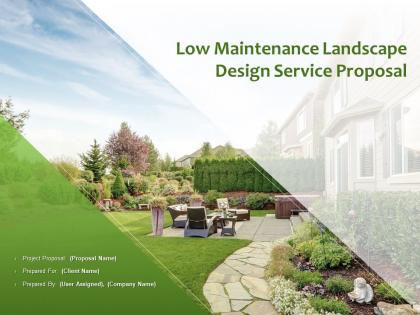
Slide 1: This slide introduces Low Maintenance Landscape Design Service Proposal. Add Client Name and Company Name to begin.
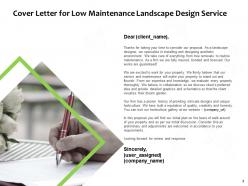
Slide 2: This slide showcases the Cover Letter for Low Maintenance Landscape Design Service.
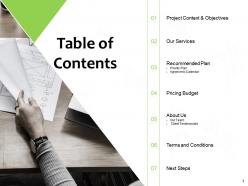
Slide 3: This slide showcases the Table of Contents- Project Context & Objectives, Our Services, Recommended Plan, Priority Plan, Agronomic Calendar, Pricing Budget, About Us, Our Team, Client Testimonials, Terms and Conditions, Next Steps.
Slide 4: This slide shows the Project Context & Objectives.
Slide 5: This slide portrays the Project Context & Objectives for Low Maintenance Landscape Design Service.
Slide 6: This slide portrays Our Services.
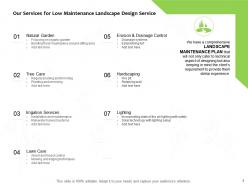
Slide 7: This slide portrays Our Services for Low Maintenance Landscape Design Service like- Natural Garden, Tree Care, Irrigation Services, Lawn Care, Erosion & Drainage Control, Hardscaping, Lighting.
Slide 8: This slide shows the Recommended Plan.
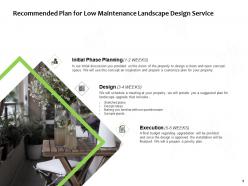
Slide 9: This slide shows the Recommended Plan for Low Maintenance Landscape Design Service.
Slide 10: 1 This slide portrays the Priority Plan for Low Maintenance Landscape Design Service.
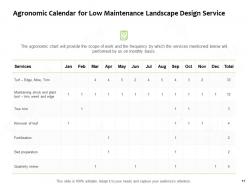
Slide 11: This slide presents the Agronomic Calendar for Low Maintenance Landscape Design Service.
Slide 12: This slide shows the Pricing Budget.
Slide 13: This slide depicts the Pricing Budget for Low Maintenance Landscape Design Service.
Slide 14: This slide shows About Us- Our Team, and Client Testimonials.
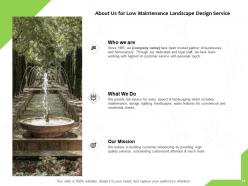
Slide 15: This slide shows About Us for Low Maintenance Landscape Design Service.
Slide 16: This slide reveals the names and designation of Our Team members.
Slide 17: This slide again reveals the names and designation of Our Team members.
Slide 18: This slide reveals Client Testimonials.
Slide 19: This slide again reveals the Client Testimonials.
Slide 20: This slide shows the Terms and Conditions.
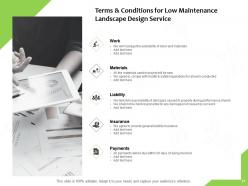
Slide 21: This slide shows the Terms & Conditions for Low Maintenance Landscape Design Service pertaining to- Work, Materials, Liability, Insurance, Payments.
Slide 22: This slide shows the Next Steps.
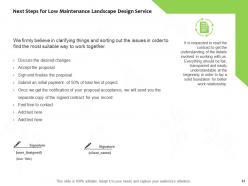
Slide 23: This slide shows the Next Steps for Low Maintenance Landscape Design Service.
Slide 24: This is a Contact us slide consisting of Address, contact numbers, and email address.
Slide 25: This slide is titled Additional Slides for moving forward.
Slide 26: This slide shows About Us- Target Audience, Preferred by Many, Value Clients.
Slide 27: This slide reveals Our Mission.
Slide 28: This slide shows the 30 60 90 Days Plan.
Slide 29: This slide unveils the Roadmap for Process Flow.
Slide 30: This slide depicts the Timeline for various years.
Low maintenance landscape design service proposal powerpoint presentation slides with all 30 slides:
Use our Low Maintenance Landscape Design Service Proposal Powerpoint Presentation Slides to effectively help you save your valuable time. They are readymade to fit into any presentation structure.
















FAQs for Low maintenance landscape design service proposal
Figure out your soil and light situation first - that's gonna save you so much headache later. Native plants are your best friend since they don't need constant attention once established. I always group stuff with similar watering needs together, makes maintenance way easier. Mulch everything you can to keep weeds down and hold moisture. Oh, and resist buying every cool plant you see at the nursery! Stick with bigger groupings of fewer varieties instead of scattered random specimens. Trust me, simple designs look better and you'll actually enjoy your yard instead of being its slave.
Honestly, native plants are perfect for lazy gardeners like us. They're already used to whatever weird weather your area throws at them, so no constant watering or fancy fertilizers needed. Birds and butterflies love them too - my neighbor's native garden is like a nature documentary sometimes. Disease and pest problems? Way less of a headache since these plants co-evolved with local conditions. Look up what's actually native to your area first though - some "native" plant lists online are pretty broad. Pick a few that bloom at different times so you've got something happening all season.
Honestly, good irrigation is a game changer if you want less work later. Get a drip system with timers - no more dragging hoses around or that guilty feeling when you forget to water for like a week. Group plants by how much water they actually need, otherwise you'll drown your succulents while your hydrangeas are dying of thirst. The automated watering keeps plants way healthier too since they're not constantly stressed. I learned this the hard way after killing way too many plants. Just design your zones right from the start and you'll thank yourself later.
Honestly, hardscaping is a game-changer for lazy gardeners like me. Stone patios and gravel paths just sit there looking nice - no watering, no pruning, nothing. You might sweep them once in a while or hit them with the hose, but that beats dealing with dead plants every weekend. I'd start by swapping out whatever garden bed gives you the most grief for some stone features instead. You'll still want some actual plants mixed in so it doesn't look like a parking lot, but the balance makes such a difference. Concrete and retaining walls are workhorses too.
Dude, creeping thyme and sedum are your best bet - they literally don't care if you ignore them. I'm totally obsessed with sedum right now, it's weirdly sculptural and handles drought like a champ. Pachysandra works great in shade. Oh, and creeping phlox gives you those pretty spring flowers if you want color. The soil prep matters upfront though - don't skip that part. After year one they barely need water and definitely no mowing. Just match them to your sun situation and you're golden. They'll spread and fill in gaps naturally.
Honestly, it all comes down to your climate and location. You want plants that'll actually survive where you live without constant fussing. Like, succulents are perfect for Arizona but they'd just rot in Seattle's soggy winters. First thing - check your hardiness zone, then think about how much rain you get and what your soil's like. Native plants are clutch here since they've been thriving in your area forever anyway. I always tell people to just look around and see what's growing wild nearby. Those plants basically take care of themselves once they're established.
Dude, try swapping out sections with groundcovers - creeping thyme or clover are clutch because they barely need water and you'll never mow again. Native plants are solid too once they get going, they pretty much take care of themselves. Or go with hardscaping like gravel paths, rock gardens, maybe expand your patio? I swear my neighbor did this and now spends way less time on yard work. Oh, and start with that annoying strip by your driveway that always looks terrible anyway - perfect test spot. You'll be shocked how nice it is not dealing with the mower constantly.
Dude, seriously get some mulch. I'm telling you it's a total game-changer - way less weeding and watering. The stuff basically acts like a blanket over your soil so it doesn't dry out as fast. Wood chips are my go-to but honestly any organic mulch works fine. Just dump 2-3 inches around your plants (not right against the stems though). Oh and it makes everything look super clean and finished too. You'll only need to add more like once a year. Your garden basically runs itself after that.
Honestly, smart irrigation is where I'd start - it waters based on weather and soil moisture so your plants won't die when you're away. Robotic mowers are cool but still expensive as hell. You could also get drip irrigation timers for your garden beds. Those smart sprinkler controllers that connect to your phone work pretty well too. Soil sensors will tell you about moisture and nutrients, which is actually super helpful. Some people love those automated fertilizer things but I haven't tried one yet. Don't go crazy trying to automate everything right away though - pick one system first.
So basically you want to get other creatures doing the dirty work for you lol. I'd start with some native stuff like coneflowers and black-eyed Susans - ladybugs go crazy for those. Throw in a few shrubs where birds can nest because they'll demolish bug populations way better than any spray. Creeping thyme works great as ground cover and apparently bugs hate the smell it gives off. Mix different plant heights so you get this whole natural pest control thing going. Don't go overboard at first though - just pick 2-3 native plants and see how it goes.
Dude, seriously - get your soil right first or you'll regret it all season. Test the pH and throw in some compost or whatever organic stuff you can find. Bad soil = stressed plants = you watering and fertilizing constantly. My neighbor skipped this step last year (thought it was overkill) and spent his whole summer babying dying tomatoes while mine were basically growing themselves. Takes like one weekend upfront but saves you months of headaches later. Trust me on this one.
Ugh, my biggest fail was buying plants that looked amazing at the store but totally wrong for my yard's conditions. Trust me, you'll just kill them slowly. Don't make my other mistake either - I went crazy with variety and created this weird plant museum that made no sense. Way better to pick a few types that actually want the same amount of water and sun. Oh, and check how big things get! I'm constantly hacking back stuff I didn't realize would turn into monsters. Start with native plants - they're basically bulletproof once established.
Dude, go with native bunch grasses - they're seriously the laziest option. Fountain grass and feather reed grass are great, or buffalo grass if you're somewhere dry. Once they get settled, you literally don't have to think about them. Blue fescue's another good one that doesn't need much water. I mean, I guess maiden grass works too but it can get huge if you're not careful. Just pick whatever grows naturally in your area and they'll basically run themselves. Trim them back once in late winter and you're done.
Honestly, go for stuff that looks good year-round without you babying it. Ornamental grasses are amazing - they dry beautifully in winter and you literally do nothing. Spring bulbs will blow your mind, plant them once and they keep popping up every year. I'd start with evergreens as your backbone, then layer in shrubs with killer fall colors. Berry plants are great too, plus birds love them. Oh, and trees with cool bark texture! The trick is avoiding those high-maintenance flowers that look gorgeous for like two seconds then need constant deadheading. Focus on plants that earn their keep across multiple seasons instead.
Check out your extension office first - they're amazing for region-specific stuff and usually do free consultations. The National Wildlife Federation website has solid plant lists, and your state's native plant society is clutch too. Pinterest is weirdly helpful for this, don't judge me lol. "The Well-Tended Perennial Garden" is old but gold if you want a book. Local nurseries often have drought-tolerant specialists on staff. Oh, and figure out your hardiness zone first - saves you from buying plants that'll just die on you.
-
Excellent Designs.