

Management evolution chart powerpoint ideas




Try Before you Buy Download Free Sample Product
 Impress Your
Audience
 100%
Editable
 Save Hours
of Time


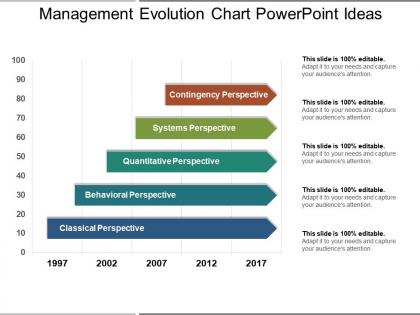
Choose this management evolution chart PowerPoint ideas PowerPoint shape for creating an organizational presentation which is the framework of processes and procedures and can be used to ensure that an organization can fulfill all tasks required to achieve its objectives. The primary focus of this evolution of management figure PowerPoint diagram is to assist the presenter to work out on the statistical quality control, inventory control, cost minimization, mass production, assembly line, work specialization, hierarchies of command, mass consumption, statistical mass markets and forecasting. By using the business process management diagram PPT slide, the user shall be able to discuss about the reengineering of the process, re-integrating of the individual components into effective, more autonomous and even self-manageable wholes. So quickly download this template for the purpose of throwing light on the concept of business management while presenting a remarkable business presentation and enjoy appreciation from the viewers and team members. Display good anticipation with our Management Evolution Chart Powerpoint Ideas. They contain an element of foresight
People who downloaded this PowerPoint presentation also viewed the following :
Management evolution chart powerpoint ideas with all 5 slides:
If you need ideas to create the most appealing presentations that could lead to that once in a lifetime opportunity make use of our premade PowerPoint Templates and Slides. You are free to edit it as you wish.





FAQs for Management evolution
Key milestones in management evolution include Scientific Management (1900s), Administrative Theory (1920s), Human Relations Movement (1930s), Systems Theory (1950s), and Modern Strategic Management (1980s-present). These theoretical developments revolutionized organizational practices by introducing systematic processes, emphasizing human factors, and integrating technology-driven approaches, with many corporations finding that combining these methodologies delivers enhanced operational efficiency and competitive advantage.
A PowerPoint presentation can effectively illustrate management evolution through chronological timelines, comparative charts, interactive flowcharts, visual milestones, and theory mapping slides. These presentation elements streamline complex management history by highlighting key theorists, methodologies, and paradigm shifts across different eras, while enabling organizations to contextualize current practices and identify strategic opportunities for future leadership development.
Visual elements that enhance management evolution presentations include timeline graphics, evolutionary arrows, organizational charts, comparison matrices, and milestone icons. These design components streamline complex historical progressions by illustrating theory transitions, leadership style changes, and structural developments across different eras, with many organizations finding that visual storytelling delivers clearer understanding and stronger audience engagement.
Management theories directly mirror socio-economic shifts, with classical approaches reflecting industrial efficiency needs, human relations theories emerging during labor movements, and modern frameworks addressing globalization, technology, and sustainability challenges. These evolutionary changes demonstrate how organizations adapt leadership philosophies to economic conditions, social expectations, and technological advances, with many companies finding that integrating historical insights with contemporary approaches delivers enhanced organizational resilience and competitive advantage.
Technology revolutionizes management practices by automating routine tasks, enhancing data-driven decision making, and enabling real-time collaboration across global teams. Through AI analytics and cloud platforms, organizations streamline operations, improve employee engagement, and accelerate strategic planning, with many companies finding that digital transformation ultimately delivers competitive advantages and operational efficiency.
Management evolution charts can be tailored by incorporating industry-specific terminology, regulatory frameworks, technological milestones, and sector-relevant leadership models that reflect each field's unique developmental trajectory. For example, healthcare charts emphasize patient-centered care evolution, while manufacturing focuses on lean methodologies and automation phases, with financial services highlighting risk management and digital transformation, ultimately delivering more relevant insights and strategic alignment.
The most influential management theorists include Henri Fayol with administrative principles, Frederick Taylor with scientific management, Max Weber with bureaucratic theory, Elton Mayo with human relations, and Peter Drucker with modern management by objectives. These foundational theories revolutionize organizational efficiency by establishing systematic planning, optimizing workflows, and balancing structural control with employee motivation, ultimately delivering competitive advantage in increasingly complex business environments.
Case studies can be integrated by showcasing real companies that exemplify each management era, such as Ford's assembly line for scientific management, Toyota's lean manufacturing for quality movements, and Google's flat hierarchies for modern approaches. These concrete examples transform abstract theories into relatable business scenarios, with many organizations finding that historical case studies demonstrate practical applications while illustrating how management evolution directly impacts operational efficiency and competitive advantage.
Historical challenges shaping management evolution include industrial revolution disruptions, technological advances, workforce demographic shifts, globalization pressures, and regulatory changes. These challenges have driven organizations to adapt through scientific management principles, human relations approaches, and digital transformation strategies, with many companies finding that flexible, data-driven management practices deliver competitive advantage in increasingly complex business environments.
Visualizing management evolution involves timeline charts showing progression from hierarchical to collaborative structures, comparative diagrams highlighting traditional versus modern approaches, and transformation matrices displaying leadership style shifts. These presentations effectively demonstrate transitions through before-and-after organizational charts, leadership competency comparisons, and workflow evolution graphics, with many organizations finding that visual storytelling accelerates management transformation initiatives and stakeholder buy-in.
Comparing Eastern and Western management evolution in presentations highlights contrasting philosophical approaches, implementation strategies, cultural contexts, and organizational structures that shape modern business practices. This comparative analysis enables organizations to identify best practices from both traditions, adapt diverse methodologies to their specific contexts, and develop more comprehensive management frameworks, ultimately delivering competitive advantage in an increasingly globalized business environment.
Cultural differences significantly affect historical management theories through varying leadership styles, communication patterns, hierarchical structures, decision-making processes, and employee motivation approaches. Western theories emphasizing individualism may clash with collectivist cultures, while rigid hierarchical models face challenges in egalitarian societies, with many multinational organizations finding that adaptive, culturally-sensitive management frameworks deliver better engagement and operational efficiency.
**INPUT**: What graphical formats work best for depicting complex management evolution ideas? **OUTPUT**: Timeline charts, flowcharts, pyramid diagrams, matrix comparisons, and circular process models work best for depicting complex management evolution ideas. These formats enable organizations to visualize transformation stages, strategic shifts, and leadership transitions clearly, with many companies finding that combining multiple visual approaches enhances stakeholder understanding and accelerates decision-making processes. [Word count: 51 words]
Engaging storytelling transforms management evolution charts by weaving historical context, challenges overcome, and strategic pivots into compelling narratives that resonate with audiences. Through character-driven case studies, milestone celebrations, and future visioning, presenters can illustrate how organizational transformations deliver competitive advantages, enhanced operational efficiency, and sustainable growth outcomes.
Interactive elements for management evolution PowerPoints include clickable timeline buttons, hover-over theory explanations, animated leadership style comparisons, quiz polls about historical practices, and drag-and-drop exercises matching theories to eras. These features enhance engagement by encouraging active participation, visual exploration, and knowledge testing, with many presenters finding that interactive timelines and theory-matching activities significantly improve audience retention and discussion quality.
-
Excellent template with unique design.
-
Appreciate the research and its presentable format.