


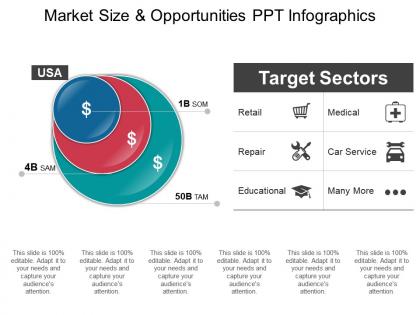
Market size and opportunities ppt infographics




Try Before you Buy Download Free Sample Product
 Impress Your
 Audience
 100%
100% Editable
 Save Hours
 of Time


Convince folks that they will be back on their feet with our Market Size And Opportunities Ppt Infographics. It helps assure the injured.
People who downloaded this PowerPoint presentation also viewed the following :
Market size and opportunities ppt infographics with all 5 slides:
Get on the altar with our Market Size And Opportunities Ppt Infographics. They help you earn their faith.




FAQs for Market size and
Dude, three big things are totally reshaping markets right now. Digital stuff is exploding - cloud services, cybersecurity, AI. Everyone's just dumping cash into tech. Then there's the whole sustainability push creating new green markets because of ESG requirements. Oh, and demographics are wild - aging boomers mean healthcare's booming while Gen Z's fueling creator platforms and mental health apps. Honestly, I'd watch where regulations meet generational shifts. That's usually where the money flows. Also maybe avoid crypto for now lol, but that's just me being conservative.
New tech basically flips everything upside down - old industries get disrupted while fresh markets pop up overnight. That's your golden opportunity as a startup because suddenly you're not David vs Goliath anymore. Look at AI with automation or how blockchain spawned the whole DeFi thing. Big companies? They're stuck dealing with their ancient systems and can't pivot fast enough. Honestly, watching them try to adapt is pretty painful sometimes. You get this sweet spot where you can actually beat them to market. Just pick something that works but hasn't hit mainstream yet in whatever space you're targeting.
Start with industry reports and government data for the big picture stuff. Then get specific with surveys, competitor research, and talking to actual customers. Google Trends is clutch - seriously, most people sleep on search data but it tells you so much. Social media analytics are useful too. Don't put all your eggs in one basket though, you want multiple sources backing up your findings. Oh and markets change crazy fast now, so revisit your research monthly or you'll be working with outdated info.
Honestly, Southeast Asia and parts of Africa are absolutely exploding right now. The growth there has been insane to watch. You've got younger populations going straight to mobile solutions - they're basically skipping all the old infrastructure we had to deal with. Latin America's getting hot too, especially Brazil and Mexico. Their middle classes are growing and internet access is way better than it used to be. Oh, and their economies are expanding way faster than the traditional markets we're used to. If you're looking for the biggest growth potential, that's where I'd put my money.
Yeah so basically when people's buying habits shift, your whole market sizing gets thrown off. Like during COVID - nobody saw that remote work thing coming and it completely changed who was buying what. Now I always segment based on actual current behaviors instead of those old school demographic buckets. Historical data? Pretty much useless at this point. You've gotta factor in new trends and consumption patterns when you're calculating TAM, SAM, SOM. Otherwise you're just guessing with outdated info. Start fresh with how people actually behave now, then build your projections from there.
Look, competitive analysis is basically finding the holes your competitors left open. Pick 3-5 direct competitors and study their pricing, who they target, what features they push. You'll spot patterns pretty quick - like areas where they're all weak or customer segments nobody's really serving well. Honestly, most companies guess at what customers want instead of actually listening. This research shows you what people truly value vs what businesses think matters. Plus you can catch market trends early. The goal? Find those white spaces where you can either do something better or serve people they're ignoring completely.
Dude, segmentation is a game changer for sizing markets. Instead of just counting everyone and guessing, you're looking at how different groups actually buy stuff. High earners will adopt a luxury product way differently than middle-class folks, right? So break your market into 3-4 segments that behave totally different. Size each one separately with realistic adoption rates. Then add them up. Way more accurate than slapping some random percentage on the whole population - I learned this the hard way on my last project.
For market forecasting, I always start with the last 5-10 years of industry data. Then layer in stuff like demographic changes, new regulations, tech disruptions - basically anything that could shake things up. Economic conditions are huge too since recessions totally change how people spend. Competition shifts matter as well. Honestly, building three scenarios works way better than trying to nail one perfect forecast - I learned that the hard way. Conservative, realistic, and optimistic versions give you flexibility. Just make sure you're updating your assumptions every quarter because things change fast.
Look, economic indicators are like having a heads up on which sectors might tank or take off. When GDP's growing, most stuff does well. Unemployment though? That crushes anything discretionary - people aren't buying fancy stuff when they're scared about their paycheck. Interest rates are massive. Low rates boost real estate and tech, high rates help banks but kill construction companies. Inflation's weird because it can mean the economy's hot OR falling apart - honestly the hardest one to figure out. Don't rely on just one number. Track like 3-4 together and you'll get a better picture.
So there's basically three ways to tackle this. Bottom-up is where you calculate pricing × potential customers - super straightforward. Top-down does the opposite, starts with the whole industry size then figures out your slice. Value theory is trickier (and honestly kind of a pain) but it estimates based on what problem you're actually solving. I'd definitely use two methods minimum since investors love poking holes in TAM numbers. Bottom-up gives you the most credibility IMO, then back it up with some top-down market data to make sure you're not totally off base.
Regulation changes are wild - they can totally kill your market or create massive new ones out of nowhere. Look at GDPR - suddenly there's this whole privacy industry that didn't exist before. Same with weed legalization going from illegal to multi-billion dollar markets. Here's the thing though: changes that seem like a pain often hurt big companies more since they're slow to adapt. You can actually gain ground while they're figuring things out. The trick is getting ahead of it - follow those boring regulatory discussions so you're not scrambling with everyone else when stuff hits.
Honestly, you want to find the stuff people are frustrated with but just dealing with anyway. Do some surveys, but also check out social media - people complain about everything there and companies totally miss it. I'd look at competitor reviews too, especially the bad ones. What keeps coming up? Short tests are your friend before you commit to anything big. Oh and don't just ask what people are buying - ask what they're settling for. That's usually where the real opportunities hide. Adjacent markets can be goldmines if you've got transferable skills.
Look at your industry's import/export ratios - that'll tell you what's happening. More imports means you're dealing with extra competition for the same customers. Exports growing? That usually means demand is strong, so your market might actually be expanding. I'd honestly focus more on the ratio between the two rather than just one side. Track this stuff over time and adjust your market models based on whether you're seeing compression or growth. It's kinda like watching the tide - you need to see which direction it's actually moving before you make your move.
Honestly, going digital breaks down all those geographic walls - suddenly you're selling to people anywhere instead of just your local area. E-commerce opens up global markets, and analytics help you find customer segments you didn't even know existed. You can create totally new digital products too. The scaling part is where it gets interesting though - automation lets you grow without hiring proportionally more people, which obviously helps your bottom line. Social media targeting is way more precise than old-school advertising ever was. I'd say pick one digital channel that matches what you're already good at, then build from there once you get the hang of it.
You know how TAM calculations can miss those sweet spots? Niche markets are where you actually make money - less competition, more specific needs. Break down your bigger market by customer types or use cases first. Then look for the underserved pockets. Honestly, I've watched companies completely change direction after finding a niche that was way more profitable than what they started with. The thing is, you can dominate a smaller space much easier, then expand from there. Way better than trying to tackle everything at once.
-
The Designed Graphic are very professional and classic.
-
Very well designed and informative templates.