

Marketing Agency Departmental Organization Chart




Try Before you Buy Download Free Sample Product
 Impress Your
 Audience
 100%
100% Editable
 Save Hours
 of Time


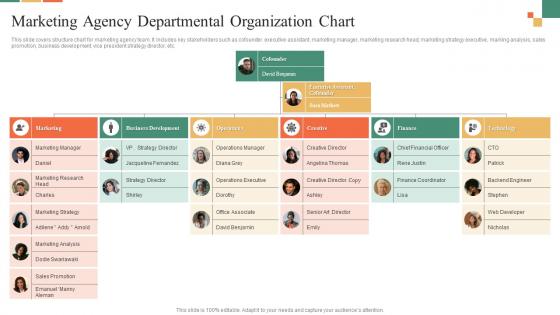
This slide covers structure chart for marketing agency team. It includes key stakeholders such as cofounder. executive assistant, marketing manager, marketing research head, marketing strategy executive, marking analysis, sales promotion, business development, vice president strategy director, etc.
People who downloaded this PowerPoint presentation also viewed the following :
Content of this Powerpoint Presentation
How would subordinates feel when they don't know whom to report inside the company? How would a manager from marketing know about the manager's name in the operations team? These questions won't arise when there is a proper organizational chart. It is a best practice if the company follows the hierarchy and all employees know their seniors and subordinates. Therefore, SlideTeam has prepared PowerPoint templates to resolve hierarchy issues.
Introduce your team to your clients with their professional photo, name, and designation using our PowerPoint layout.
Purpose of SlideTeam's Chart Template
The aim of this presentation is simple: to streamline the communication and operational processes inside the company. Companies can smoothly operate once they have proper guidelines for their hierarchy.
Prepare a professional hierarchy chart for a logistics company with our PowerPoint frameworks.
Key Features
This template includes the major departments, such as Marketing, Business Development, Operations, Creative, Finance, and Technology. It offers customization, which means you can include more departments as per your choice. Moreover, you can remove or add pictures, change the department's color, change the font size, put a company logo, and perform many more actions.
Do you want to build a hierarchy structure in a scrum organization? Click here to know more.
Advantages of Using the Template
Implementing this PowerPoint framework can enhance communication across departments. For example, whenever there is a job vacancy, the human resource department can know from this presentation and start hiring for the job position.
Template 1: Marketing Agency Departmental Organization Chart
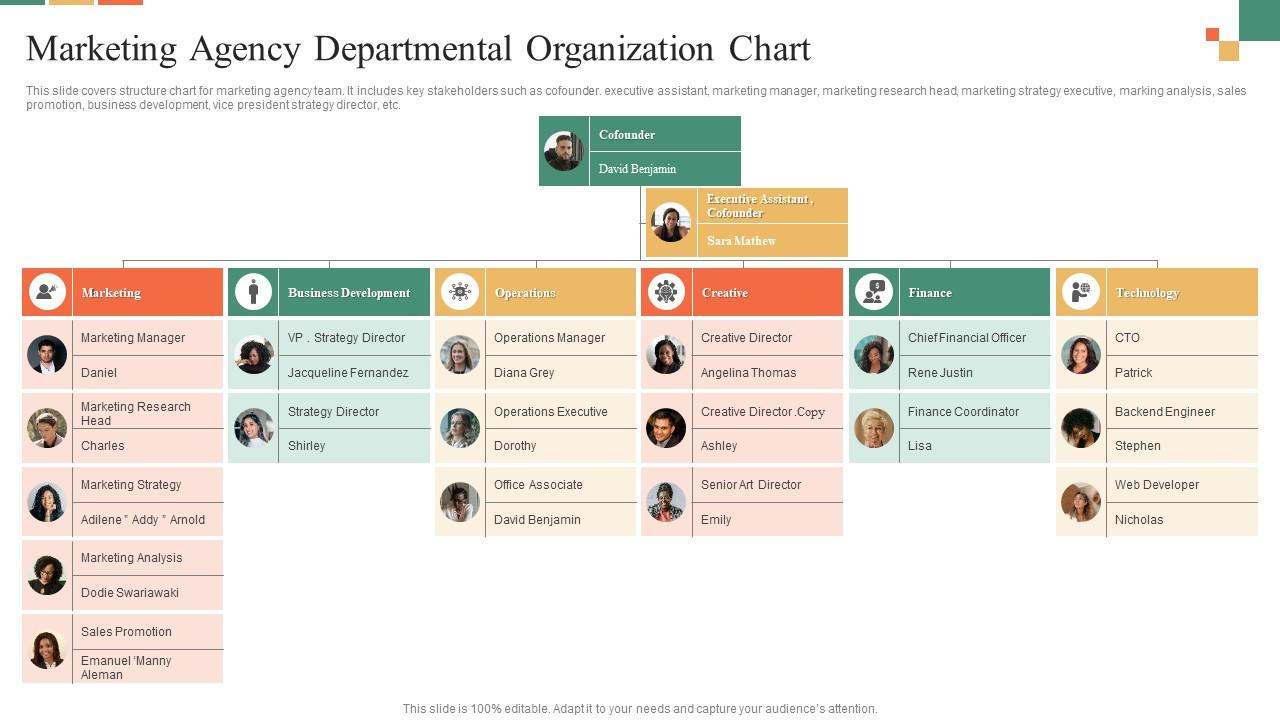
Companies need to document their hierarchy system so that there is no confusion when a subordinate reaches a senior. If you need to streamline your hierarchy process, explore our PowerPoint Framework. At the top comes the founder and the co-founder. Then, you can show roles for various departments. The company's main departments are Marketing, Business Development, Operations, Creative, Finance, and Technology. Furthermore, you can divide this presentation further based on job roles. You can show the Marketing Manager, Strategy Director, Creative Director, and CTO with their professional photo. It can lead to proper communication in your organization.
Show A Complete Hierarchy with Our Template
In conclusion, our PowerPoint Template empowers marketing agencies. This tool enhances their operations and communication. Furthermore, the employees can understand and adhere to the complete hierarchy in one place.
Marketing Agency Departmental Organization Chart with all 6 slides:
Use our Marketing Agency Departmental Organization Chart to effectively help you save your valuable time. They are readymade to fit into any presentation structure.





FAQs for Marketing Agency
Okay so three things you gotta focus on: role definitions, workflows, and client systems. Figure out who handles creative vs strategy vs account stuff first - trust me, people hate stepping on each other. Map out your whole process from onboarding to delivery (boring but necessary). Get decent project management tools so nobody's confused about what's happening. The trick is having enough structure without killing the creative vibe, you know? I'd start by looking at your current setup and finding what's driving everyone crazy. Those are your first fixes.
Agency structure is huge for how smooth things go. Traditional setups are the worst - your project bounces around from creative to account people to strategy like a pinball machine. Pod structures work way better since you get one team that actually communicates (shocking, I know). Flat orgs mean you can text the creative director directly, which is cool but sometimes feels like organized chaos. Hierarchical ones have their processes down but everything takes forever to get approved. Honestly, just ask who's gonna be working on your stuff and how often they actually talk to each other.
So you definitely need account managers - they're basically the translator between clients and your team. Project managers are non-negotiable too, trust me on this one. Without them it's just pure chaos. Get some solid creatives who can actually deliver, plus strategists to figure out the big picture stuff. Oh and data people to track if anything's actually working. Make sure everyone knows their lane but still talks to each other regularly. We do weekly check-ins across teams and it's saved our butts so many times when things start slipping.
Put your data people right in with the creative teams from day one - not stuck on different floors like most agencies do (seriously, why is that still a thing?). Cross-functional pods work way better than silos. Get them talking regularly with "creative reviews" where analysts share insights to spark ideas, plus "data reviews" so creatives can explain their concepts. Your analysts need to understand what they're actually measuring, not just get handed campaigns at the end. I'd start simple - pair one analyst with each creative lead and see how it goes.
You definitely need dedicated account people - they're like the glue between your clients and everyone else. Clients get one person who actually knows their business instead of talking to random team members every time. Trust me, that relationship piece is huge for retention. Your creatives can focus on the actual work instead of fielding calls about timelines and budgets all day. Account managers also catch those expansion opportunities you'd totally miss otherwise. I'd probably start with one person handling 3-5 big accounts, maybe more if they're smaller clients. It's honestly one of those things that pays for itself pretty quickly.
So agencies are basically tearing down those old department walls and mixing everyone together - creative people working directly with data folks, media planners sitting next to designers. It's way faster than the old pass-it-down-the-line approach. Most are hiring their own tech people too instead of waiting forever for outside developers (seriously, that back-and-forth used to take weeks). Teams now organize around what the client actually needs rather than job titles. Like, you might have a strategist, analyst, and creative all under one account person. Honestly? Just look at where your projects get stuck the longest - that's where you restructure first.
Flat structure is honestly a game-changer for marketing agencies. Decision-making gets way faster since you're not waiting for approvals from like five different people. Creative teams can actually pivot when needed, and client feedback doesn't sit in some manager's inbox for days. People seem happier too - probably because they actually own their work instead of just executing someone else's vision. Plus you're not paying a ton of management salaries. The catch? It gets messy once you hit around 50 people. But if you're stuck in approval hell right now, definitely worth trying.
Honestly, your structure makes or breaks everything. Clear departments and solid handoff processes? You can just keep adding people without chaos. Most founders mess this up though - they bottleneck everything through themselves and wonder why they're stuck at 15 employees. I've watched it happen so many times. The agencies hitting 50+ people all figured out delegation early. They built frameworks before they desperately needed them. Document your processes now even if it feels weird doing it with like 5 people. You'll thank yourself later when you're not the answer to every single question.
Look, your onboarding basically controls how you build your whole team structure. Complex process with tons of steps? You're gonna need account managers, project people, maybe even a whole onboarding squad. Keep it simple and you can get by with fewer specialized roles. Here's the thing though - whatever you choose sets the tone for everything after. Communication style, deadlines, who talks to who. I've watched agencies blow up their entire setup because onboarding was creating these weird bottlenecks they didn't see coming. Just map out what you're doing now and figure out where you actually need dedicated people versus sharing responsibilities.
Honestly, weekly check-ins between team leads will save your sanity - trust me on this one. Get everyone using the same project management tool so people can actually see what's happening in other departments. Someone needs to own communication for each big project, otherwise you'll keep getting those "wait, what?" moments. Shared docs help too, though good luck getting people to update them consistently lol. The main thing is having one place where everyone can check project status and client stuff. Start small with just the weekly syncs - you can always add more structure later if it's working.
Honestly, start with making people feel safe to mess up - innovation dies when everyone's terrified of failure. Get different teams mixing more often... like having your social media person jump into strategy sessions. Those cross-pollinations create the weirdest (and best) ideas. Brainstorming sessions help, but only if you actually welcome the crazy suggestions instead of just pretending to. Oh, and give people some freedom - maybe 10% of their time to play around with new stuff. Here's the kicker though: you've gotta actually DO something with the ideas people bring you. I can't tell you how many agencies I've seen turn into idea graveyards where good concepts go to die.
Look, your team's culture is everything. Happy people create better work - it's that simple. When your crew feels safe throwing out wild ideas without getting shut down, that's where the magic happens. Turnover will kill you though. I've seen agencies constantly onboarding new folks and it's exhausting for everyone. Clients can smell dysfunction from a mile away too. You want people comfortable enough to say "hey, I messed up" before small problems become disasters. Building that psychological safety thing isn't just HR fluff - it actually drives results.
Honestly, remote work kinda breaks down those natural office hierarchies - no more corner offices or casual shoulder taps. Communication gets super deliberate since everything's scheduled now. You'll definitely need tighter project management and crystal clear roles because it's harder to keep tabs on everyone. Client stuff needs more structure too, like regular video calls instead of random drop-ins. But here's the thing - you can literally hire anyone from anywhere, and your rent drops big time. Just don't cheap out on collaboration tools and set up consistent check-ins, or it turns into chaos real quick.
Stop treating freelancers like random contractors you found on Upwork. Add them to your Slack channels, invite them to meetings that matter, and actually give them the tools they need. I've watched so many agencies just dump work on people and then act shocked when it comes back terrible. Get some solid onboarding docs together - brand stuff, processes, what clients expect. Check in regularly too. Honestly, the freelancers who feel like they're actually part of your team? They'll do way better work and won't ghost you for the next shiny project.
Honestly, start with the basics - client retention and project delivery times will tell you if your structure actually makes sense. Revenue per employee is huge too. Don't ignore employee satisfaction though, because if people are confused about who does what, they'll hate their jobs and it shows. I'd also track how often departments actually talk to each other (spoiler: probably not enough) and decision-making speed. Pick maybe 2-3 of these metrics, get your baseline numbers now, then check back quarterly. Way easier to fix structural problems early than wait until everything's on fire.
-
The best part about SlideTeam is their meticulously prepared presentations (complete-decks and single-slides both), infused with high-quality graphics and easy to edit. All-in-all worthy products.
-
Unique and attractive product design.