


Mckinsey 7s Model Case Study Powerpoint Presentation Slides





Try Before you Buy Download Free Sample Product
 Impress Your
 Audience
 100%
100% Editable
 Save Hours
 of Time


Building a case study PowerPoint presentation show up from scratch is indeed a mega task. To help you out in this here we are presenting our pre-made 55 slides Mckinsey 7s Model Case Study Powerpoint Presentation Slides. With support of our excellent Mckinsey 7s Model Case Study presentation deck you can easily cover topics like agenda, strategy, structure, systems, staff, style, skills and shared values, hard values, soft values, business strategy, resource GAP analysis, skill GAP analysis, 7-S framework, etc. With so many potential customers, it’s absolute necessary for businesses to bang on marketing. Using the designs of this descriptive presentation show you can also brief onlookers about the importance of marketing and its advantages. Furthermore, using our PPT example deck consultants can discuss outcome and impact of marketing on the business to ensure whether proper marketing strategies and regulations are followed correctly or not. Exclusive PowerPoint presentation slides like our team, about us, stacked bar, target, comparison, financial, quotes, dashboard, pie chart, scatter chart, location, timelines, post in notes, mind map, venn etc. are included for better awareness of the topic. What are you waiting for? Download this Mckinsey 7s Model Case Study PPT sample deck file and make onlookers get the better side of the right marketing model. Advise folks to analyze events gone by with our Mckinsey 7s Model Case Study Powerpoint Presentation Slides. Encourage them to introspect.
People who downloaded this PowerPoint presentation also viewed the following :
Content of this Powerpoint Presentation
Slide 1: This slide introduces McKinsey 7S Model Case Study. State Your Company Name and get started.
Slide 2: This is an Agenda slide. State agendas here.
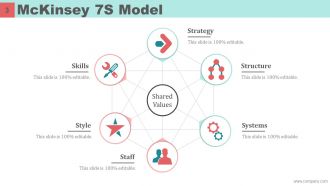
Slide 3: This slide presents a McKinsey 7S Model. The constituents are- Shared Values, Strategy, Structure, Systems, Staff, Style, Skills.
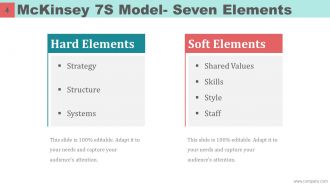
Slide 4: This slide presents segregated McKinsey 7S Model- Seven Elements into- Hard Elements (Strategy, Structure, Systems) Soft Elements (Shared Values, Skills, Staff, Style).
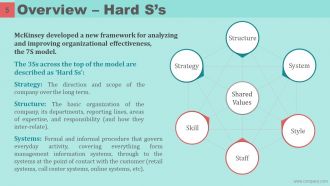
Slide 5: This slide presents Overview – Hard S’s covering- Strategy, Structure, Systems.
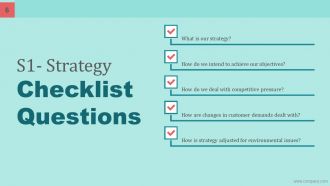
Slide 6: This slide showcases S1- Strategy Checklist Questions- What is our strategy? How do we intend to achieve our objectives? How do we deal with competitive pressure? How are changes in customer demands dealt with? How is strategy adjusted for environmental issues?
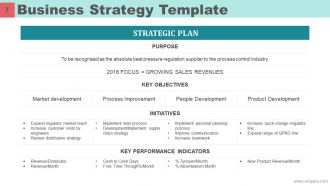
Slide 7: This slide shows a Business Strategy Template.
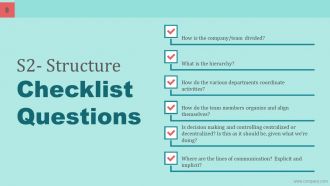
Slide 8: This slide showcases S2- Structure Checklist Questions- How is the company/team divided? What is the hierarchy? How do the various departments coordinate activities? How do the team members organize and align themselves? Is decision making and controlling centralized or decentralized? Is this as it should be, given what we're doing? Where are the lines of communication? Explicit and implicit?
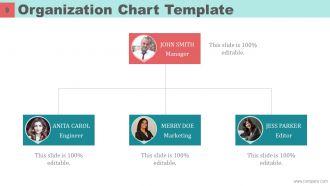
Slide 9: This slide presents an Organization Chart Template.
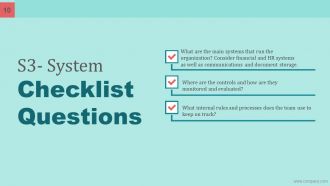
Slide 10: This slide showcases S3- System Checklist Questions- What are the main systems that run the organization? Consider financial and HR systems as well as communications and document storage. Where are the controls and how are they monitored and evaluated? What internal rules and processes does the team use to keep on track?
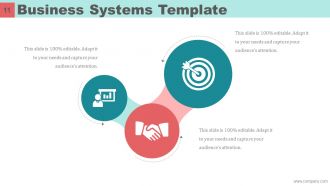
Slide 11: This slide shows a Business Systems Template.
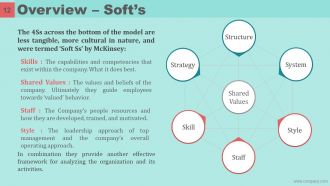
Slide 12: This slide presents Overview – Soft’s with- The 4Ss across the bottom of the model are less tangible, more cultural in nature, and were termed ‘Soft Ss’ by McKinsey: Skills : The capabilities and competencies that exist within the company. What it does best. Shared Values : The values and beliefs of the company. Ultimately they guide employees towards ‘valued’ behavior. Staff : The Company’s people resources and how they are developed, trained, and motivated. Style : The leadership approach of top management and the company’s overall operating approach.
Slide 13: This slide presents S4- Shared Values Checklist Questions- What are the core values? What is the corporate/team culture? How strong are the values? What are the fundamental values that the company/team was built on?
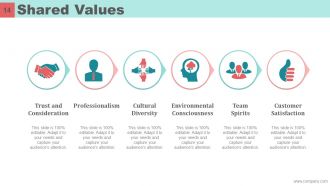
Slide 14: This slide presents Shared Values- Trust and Consideration, Team Spirits, Customer Satisfaction, Cultural Diversity, Environmental Consciousness, Professionalism.
Slide 15: This slide showcases S5- StyleChecklist Questions- How participative is the management/leadership style? How effective is that leadership? Do employees/team members tend to be competitive or cooperative? Are there real teams functioning within the organization or are they just nominal groups?
Slide 16: This slide is titled Leadership Style Template to move forward.
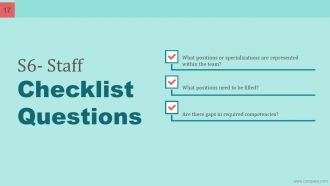
Slide 17: This slide showcases S6- Staff Checklist Questions- What positions or specializations are represented within the team? What positions need to be filled? Are there gaps in required competencies?
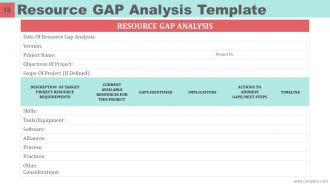
Slide 18: This slide presents Resource GAP Analysis Template.
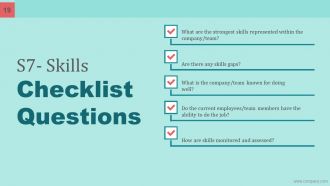
Slide 19: This slide showcases S7- Skills Checklist Questions- What are the strongest skills represented within the company/team? Are there any skills gaps? What is the company/team known for doing well? Do the current employees/team members have the ability to do the job? How are skills monitored and assessed?
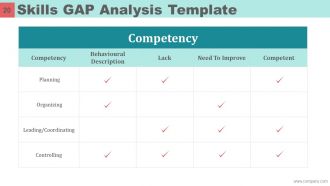
Slide 20: This is Skills GAP Analysis Template slide.
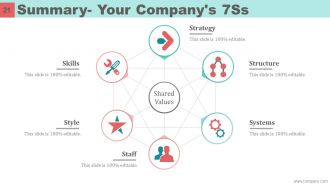
Slide 21: This slide presents Summary- Your Company's 7Ss Shared Values, Strategy, Structure, Systems, Staff, Style, Skills.
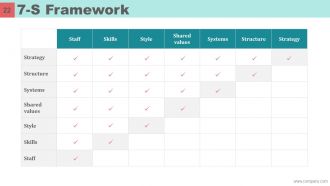
Slide 22: This slide showcases a 7-S Framework.
Slide 23: This slide is titled Additional Slides to move forward.
Slide 24: This is Our Mission slide. State company mission here.
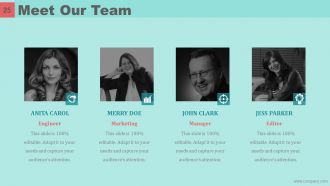
Slide 25: This is Meet Our Team slide with names, designation and image boxes.
Slide 26: This is an About Us slide. State company/team specifications here.
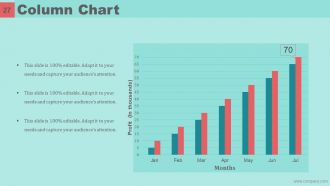
Slide 27: This is a Column Chart slide to show product/entity comparison etc.
Slide 28: This is Our Main Goal slide. State goals here.
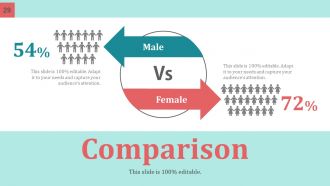
Slide 29: This is a Comparison slide for showing product/entity comparison.
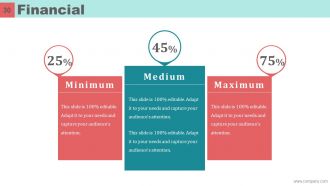
Slide 30: This is a Financial score slide given in terms of Medium, Minimum and Maximum.
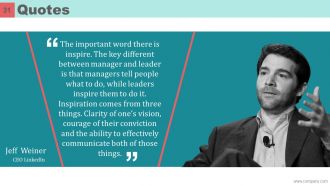
Slide 31: This is a Quotes slide to convey message, beliefs etc.
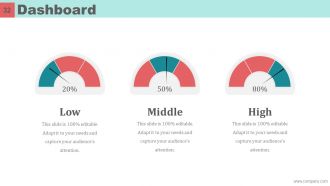
Slide 32: This is a Dashboard slide to show Low, Middle and High aspects.
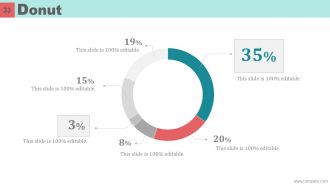
Slide 33: This is a Donut pie chart slide to show information, specifications etc.
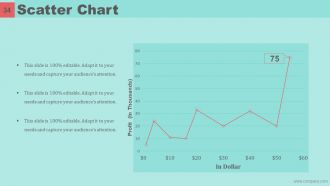
Slide 34: This is a Scatter chart slide to show information, specifications etc.
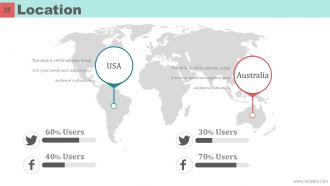
Slide 35: This is a Location slide of world map to show global growth, presence etc.
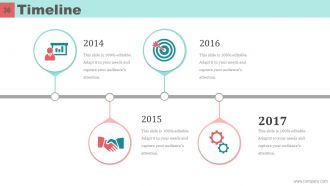
Slide 36: This is a Timeline slide to show highlighting factors, milestones, evolution etc.
Slide 37: This is a Post It Notes slide for events, reminders etc.
Slide 38: This is a Newspaper image slide for showing news, events etc. You can change the slide content as per need.
Slide 39: This is a Puzzle image slide to show information, specifications etc.
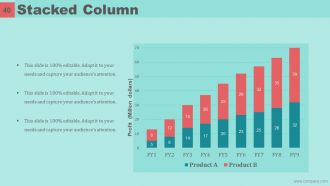
Slide 40: This is a Stacked Column slide to show product/entity comparison etc.
Slide 41: This is a Target slide. State targets etc. here.
Slide 42: This is a Circular image slide to show information, specifications etc.
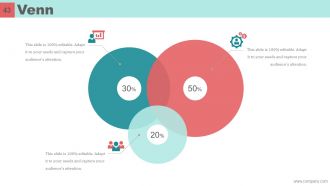
Slide 43: This is a Venn diagram image slide to show information, specifications etc.
Slide 44: This is a Mind map image slide to show information, specifications etc.
Slide 45: This is a Matrix slide to show information, specifications etc.
Slide 46: This is a Lego image slide to show information, specifications etc.
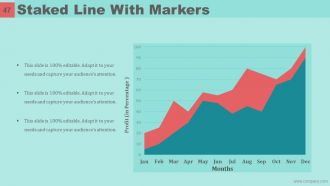
Slide 47: This is a Staked Line with markers slide to show product/entity comparison etc.
Slide 48: This is an Idea image slide to show information, specifications etc.
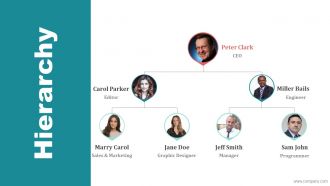
Slide 49: This is a Hierarchy slide to showcase team/departments etc. specifications.
Slide 50: This is a Coffee Break slide to halt. You can change the slide content as per need.
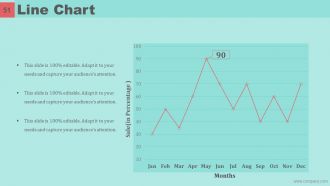
Slide 51: This is a Line Chart slide to show information, specifications etc.
Slide 52: This is a Magnifying Glass image slide to show information, specifications etc.
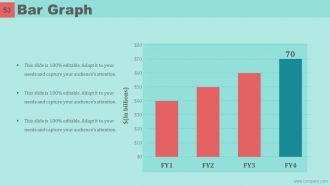
Slide 53: This is a Bar Graph slide to show product/entity comparison etc.
Slide 54: This is a Funnel image slide to show information, specifications etc.
Slide 55: This is a Thank You slide with Address# street number, city, state, Contact Numbers, Email Address.
Mckinsey 7s Model Case Study Powerpoint Presentation Slides with all 55 slides:
Enhance existing capabilities with our Mckinsey 7s Model Case Study Powerpoint Presentation Slides. Be the catalyst for greater development.


FAQs for Mckinsey 7s Model Case Study
Ok so the 7S Model has these two groups - hard stuff (Strategy, Structure, Systems) and soft stuff (Shared Values, Skills, Style, Staff). Everything's connected though, which honestly makes it pretty messy to work with sometimes. Shared Values is like the hub in the middle. Change your strategy? Your staff might freak out. Tweak the structure? Suddenly your systems don't make sense anymore. The hard elements are way easier to pin down and actually change. Soft ones are slippery but they're usually what makes or breaks things. Start by mapping out where you are with all seven, then spot where things don't line up.
The 7S Model is perfect for this - map out all seven pieces (strategy, structure, systems, skills, staff, style, shared values) before you do anything major. Most teams mess up because they only fix the obvious stuff like org charts. Culture and capabilities? Totally ignored. Here's the thing though - everything's connected, so when you change one element, the others shift too. I'd start by figuring out where each S sits now, then spot what needs to move. Oh, and don't tackle them separately - that never works. You've gotta think holistically or you'll just create new problems.
So Shared Values are basically the center of the whole 7S thing - like the glue holding everything together. Your org's real beliefs and culture, not just whatever's hanging on the break room wall. These values actually shape how strategy, structure, systems (all that other stuff) play out day-to-day. Here's the thing though - people will push back hard if your changes don't match what the team genuinely cares about. I learned this the hard way once. Figure out what your people *actually* value first, not what the executives think they should value. Makes all the difference.
So basically, survey and interview people across all seven areas - strategy, structure, systems, shared values, style, staff, and skills. Map out where you're at right now, then hunt for the disconnects. Like, does your structure actually back up your strategy? Or are you stuck trying to innovate through some ancient hierarchy? (I swear this happens everywhere.) Get different teams in workshops to hash out how well everything connects. Here's the thing though - you've gotta be brutally honest about what's broken instead of just celebrating what sounds impressive in meetings. The gaps between elements are where the real problems hide.
The 7S Model is basically a reality check for when everything's changing fast. You map out seven things - strategy, structure, systems, shared values, skills, style, and staff - before making big moves. Here's the thing though: most companies obsess over strategy and structure, then wonder why their plans crash and burn. Those "soft" elements like culture and leadership style? They'll absolutely wreck your best-laid plans if you ignore them. I'd start by figuring out where you are now across all seven areas. Then spot what needs fixing for where you're headed. It's like having a checklist that actually catches the stuff people usually miss.
Yeah, definitely! I always run SWOT or PEST first to figure out what's happening externally. Then I'll use the 7S Model to see if we can actually pull off whatever strategy we're dreaming up. The 7S part is honestly the reality check - like, sure we found this amazing market opportunity, but do our systems and people actually support it? I've seen too many companies get excited about external analysis then completely ignore whether they're set up internally to execute. Works especially well when you're doing major pivots or expansions. External analysis gets you hyped, 7S keeps you grounded.
Ugh, the hardest part is juggling all seven pieces at once - it gets overwhelming fast. People hate change anyway, but mess with their culture and values? Good luck with that resistance. You can measure structure changes easily enough, but try tracking "soft" stuff like shared beliefs... yeah, that's fun. Oh, and here's the kicker - tweak one element and suddenly three others go haywire. Ripple effects everywhere. Honestly, I'd map out where you're at with all seven areas first. At least then you won't be totally blindsided when fixing your strategy accidentally breaks your systems.
Honestly, the 'Style' piece is huge - it's literally how your leaders act every single day. When managers are actually collaborative and transparent (not just saying they are), that behavior spreads like crazy through the whole company. Forget whatever's written on your values poster. What matters is how your leadership team makes real decisions and handles drama. That's what creates the actual culture people live in. Oh, and if you're trying to change things? Start with getting leaders to model what you want first. Everything else follows from there.
Start with process mapping and flowcharts - they'll show you the gap between what's happening and what should be happening. Most companies have zero useful documentation anyway, so don't rely on that. Interview people who actually use these systems daily. They know where the real pain points are. Value stream mapping works well for spotting bottlenecks too. Check your performance metrics to see where things are breaking down. Focus on your most critical processes first, then branch out. Honestly, stakeholder interviews usually give you the best insights since people love complaining about broken systems.
The 7S Model is perfect for this - it's like a diagnostic checklist for teams. Map out where you stand on all seven elements: strategy, structure, systems, shared values, style, staff, and skills. Look for disconnects between them (there's always something wonky). Start with the "soft" stuff though - leadership style, team values, skills gaps. That's usually where the real problems hide. Once you spot 2-3 major misalignments, build action plans around those. Way better than just fixing random issues as they pop up. The whole point is seeing the big picture instead of playing whack-a-mole with symptoms.
So the 7S Model is this diagnostic thing that's super helpful for M&A stuff - way more useful than just staring at spreadsheets and org charts. Map out where the two companies actually align or completely clash across all seven areas. Culture clashes? You'll catch them early since those "soft S" elements like values and management style are honestly the messiest part. Plus you can identify redundant systems that need combining and figure out what skill gaps you're gonna face afterward. I'd run through it like a checklist during due diligence to gauge how complex integration will be, then check back monthly while you're actually merging everything together.
Look, people are literally everything when it comes to pulling off your strategy. You could have the most brilliant plan ever, but wrong team = dead in the water. Most companies totally blow this part, honestly. Skills matter, but so does putting folks where they actually fit. Your staff shapes the whole vibe of how things get done too - like, culture isn't some poster on the wall, it's Bob from accounting being helpful or whatever. Performance issues? I'd start by figuring out if you've got the right mix of talent and if you're actually developing people properly.
Honestly, the 7S Model feels pretty outdated for digital stuff. It assumes companies stay relatively stable, but when your team structure shifts every month and systems update constantly, mapping all seven elements becomes pointless. Plus it's way too inward-looking - completely ignores customer feedback loops, platform dependencies, all that external ecosystem stuff that actually matters now. Traditional hierarchies? Sure, it works fine. Agile cross-functional teams though... not so much. I'd say use it as a rough starting point if you want, but you'll definitely need more dynamic tools that actually keep up with how fast digital orgs change.
Yeah totally! Just flip the focus from profit to mission. Strategy becomes how you'll actually achieve your mission goals. Structure covers stuff like volunteer coordination and board setup - honestly, board governance can be a nightmare but it matters. Systems are things like donor databases or program workflows. Skills matter even more for nonprofits since you're juggling volunteers with totally different backgrounds. Don't forget "staff" includes volunteers and community partners, not just paid employees. Your leadership style should reflect those values-driven vibes. Shared values? That's where most nonprofits already crush it. Make sure everything points toward mission impact instead of revenue.
Yeah totally, the 7S Model needs major adjustments when you're working across cultures. Like, your shared values that work great in the US will probably bomb in collectivist countries - you can't just copy-paste that stuff. Leadership styles are tricky too. What feels appropriately direct in Germany might come off as super rude in Japan, or way too stiff for a Silicon Valley crowd. I'd keep your main strategy the same globally but tweak everything else for local culture. Map out the cultural differences that actually matter in each region first. Then adjust from there - honestly it's more art than science sometimes.
-
Easily Editable.
-
Design layout is very impressive.