


Memorandum Of Agreement Contract Proposal Powerpoint Presentation Slides




Try Before you Buy Download Free Sample Product
 Impress Your
 Audience
 100%
100% Editable
 Save Hours
 of Time


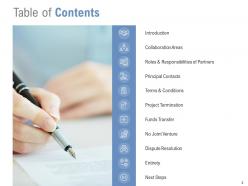
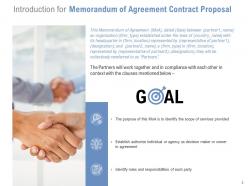
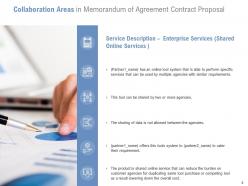
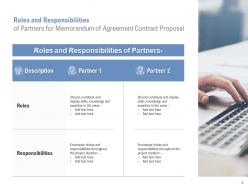
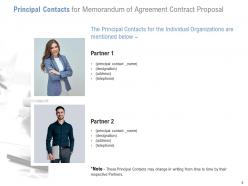
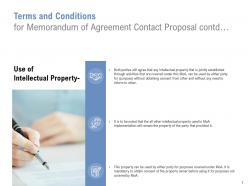
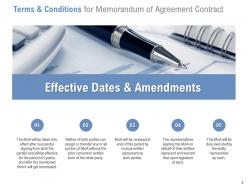
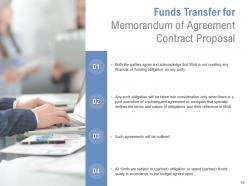
Acquire your target enterprise by incorporating this ready-made Memorandum Of Agreement Contract Proposal PowerPoint Presentation Slides and convince the other party. This business acquisition PowerPoint graphic can have a great impact on the target firm and be very helpful for entrepreneurs. Illustrate the primary objectives of MoA to showcase the facilities provided and establish your company as a key decision-maker. The authority and responsibility of each partner can be illustrated with our fully editable new partnership contract PPT slideshow. The topics discussed in this bid are huge consisting of sections such as introduction, alliance areas, roles and responsibilities, principal contacts, terms and conditions, project termination, funds transfer, etc. Incorporating this MoA contract PowerPoint theme you can give the investment and work plan to the target firm for the smooth collaboration transition. Important discussion topics like fund transfer and dispute resolutions can be elucidated effectively in this memorandum of agreement PowerPoint theme. The terms and conditions mentioning the effective dates and amendments can be listed for the legal transparency to be observed by both the collaborating parties here. This professionally designed company amalgamation PPT layout can play a crucial role in the business venture process as it highlights all the points to be discussed impactfully. Give details of your contact information in this customizable enterprise collaboration PPT slideshow. You can also introduce your competent workforce to illustrate your technical proficiency and prove your worth with the aid of our business expansion contract PPT layout. Download our partnership proposal PowerPoint layout that can serve as a guide for explaining the complete process of organization amalgamation with ease.
People who downloaded this PowerPoint presentation also viewed the following :
Memorandum Of Agreement Contract Proposal Powerpoint Presentation Slides with all 22 slides:
Use our Memorandum Of Agreement Contract Proposal Powerpoint Presentation Slides to effectively help you save your valuable time. They are readymade to fit into any presentation structure.



FAQs for Memorandum Of Agreement Contract Proposal
For your agreement, you'll want the basic stuff first - who's involved, what you're actually trying to accomplish, and everyone's specific responsibilities. Timeline matters too, with clear milestones so nobody's confused about deadlines. Dispute resolution is huge (learned this the hard way). Also spell out how either party can exit the agreement - seriously, don't skip this part. Include what resources each side commits and any reporting you need. Get signatures and dates obviously. Honestly, if there's real money or liability at stake, have a lawyer glance at it before you finalize anything.
So basically, MOAs are the real deal - legally binding with actual consequences if you bail. MOUs? More like "yeah, this sounds cool, let's see what happens" paperwork. I always think of MOUs as that handshake you do before signing anything serious. MOAs get into the nitty-gritty details, money stuff, who does what exactly. They've got legal teeth. With MOUs, you're just documenting that everyone's on the same page theoretically, but nobody's getting sued if it falls apart. Quick test: do you need lawyers involved if someone flakes? If yes, go MOA.
MOAs are great for those in-between situations - like when you're partnering with another org but don't need a heavy legal contract. Perfect for joint events, sharing resources, or testing out collaborations. Honestly, they're lifesavers when a handshake feels too loose but lawyers seem excessive. Draft one whenever you think "we should write this down somewhere." Just cover the basics: who's doing what, timeline stuff, and how you'll split costs. I've seen too many good partnerships get messy because people skipped this step. It's way easier than you'd think.
Yeah, MOAs are legally binding - you can definitely get sued if you don't follow through. The other party could take you to court for damages or force you to stick to what you agreed to. How enforceable it is really depends on the wording and whether there's actual consideration involved (like money or services changing hands). I mean, they're not quite as ironclad as full contracts, but they still pack a punch. My advice? Read every single line before signing. Don't agree to anything you can't actually deliver on - trust me on this one.
Be crazy specific about everything - no vague language that people can twist later. Put exact dates, who does what, and define any terms that might confuse people. I can't tell you how many agreements I've seen blow up because someone wrote "soon" instead of "by March 15th." Break down complex stuff with bullet points instead of those exhausting paragraph walls. Oh, and definitely get someone fresh to read it over - they'll spot the confusing parts you're blind to. Don't forget dispute resolution either, because things get messy when partners disagree.
Ugh, the worst mistake? Being vague about who does what and when. You'll kick yourself later when everyone's confused about deadlines. Always include a termination clause - trust me, you'll want an exit strategy if things get messy. IP ownership is huge too, so spell out who keeps what deliverables. Oh and figure out dispute resolution upfront, not when you're already fighting. One thing people forget constantly is checking if the person signing actually has authority to make deals for their company. That's embarrassing to discover later. Basically just be super specific about everything and you'll save yourself headaches.
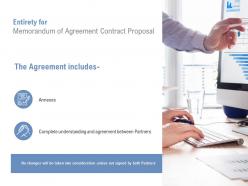
Yeah, you can totally change an MOA after signing it. Just need everyone to agree first - can't do it solo. Most agreements have a section about modifications, usually saying you need written amendments with all signatures. Don't just scribble changes and initial them (seen that disaster before lol). Check your original MOA for specific rules about changes. If there aren't any spelled out, just get everyone's signature on whatever modifications you're making. Document everything properly with a formal amendment. Pretty straightforward process honestly, just make sure you follow the paperwork trail.
So basically, an MOA gets everyone clear on who's doing what and when. Think of it as writing down the ground rules so nobody's like "wait, wasn't that your job?" later on. You'll map out responsibilities, communication styles, what each side brings to the table - all that stuff. Honestly, the best part is it makes you deal with potential problems before they actually blow up. My take? Work on it together instead of one person just drafting everything. That way both sides actually buy into it and want things to succeed.
Your MOA basically lives or dies by whether you nail down what everyone actually wants. I'd start by talking to each stakeholder separately - people are way more honest when they're not performing for the group. Map out their priorities and absolute no-gos first. It's kinda like planning a trip with friends where one person needs a pool and another can't fly... you gotta find where interests overlap instead of just writing something that sounds nice but nobody can actually live with. The whole thing works better when you build from real needs up.
Templates are honestly a lifesaver - they've got all the standard MOA stuff already laid out like parties, objectives, responsibilities, timelines. You just fill in your specific details instead of building everything from scratch. They also stop you from forgetting important clauses (trust me, I've been there). The legal language is usually already vetted too, which saves headaches down the road. Oh, and don't just use them as-is - you'll want to tweak things for your actual situation. Way better than staring at a blank document wondering where to start.
First thing - get super clear on what everyone actually wants before you even start. No assumptions! Get all the important people in the room early or you'll be redoing stuff later (learned that the hard way). Be specific about who's doing what and when. Vague language will bite you in the ass later. Write everything down as you negotiate and confirm decisions right away - don't rely on memory. Oh, and definitely plan regular check-ins from day one. Have an exit plan too, just in case. Get a second pair of eyes on the final draft before signing anything.
So basically, an MOA becomes binding when it hits all the contract basics - offer, acceptance, consideration, and everyone actually intends to be legally bound. Just calling something an "MOA" doesn't magically make it non-binding, even though people think that sometimes. Courts care way more about what's actually written and the situation around it. If your MOA spells out specific requirements, deadlines, and what happens if someone screws up, it's probably enforceable. You'll want to check the language closely. Oh and maybe throw in a clause that clearly states whether you want it binding or just a starting point for later talks.
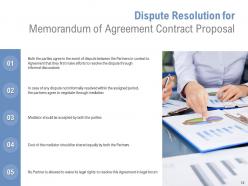
Definitely put in a clear dispute resolution clause that maps out exactly what happens - like mediation first, then arbitration if that fails. Try working things out informally before lawyers get involved (trust me, your wallet will thank you). Without specifying this stuff, you're stuck with whatever local laws decide, which could be weird. Oh, and spell out timelines, who covers mediation costs, and what state's laws apply. I know it's boring legal stuff, but read that section super carefully before you sign.
Government agencies use MOAs constantly - same with nonprofits, hospitals, and universities. They're perfect when organizations want to partner up but don't need a full legal contract. Like when agencies collaborate on projects or hospitals team up for community health stuff. Construction and consulting companies are big on them too, honestly anywhere people need to split responsibilities without calling lawyers every other day. I've seen research partnerships at universities rely on these things heavily. If you're in any of these fields, definitely keep a good template handy. Trust me, it'll save you so much time down the road.
Honestly, tech has been a lifesaver for MOAs. Document automation and templates mean you won't forget important clauses. Google Docs or SharePoint lets everyone edit at once - no more nightmare email threads with 15 versions floating around. Contract management software tracks your deadlines and renewals automatically, which is clutch. Some tools even catch weird language or flag legal red flags while you're writing. The best part? Everything lives in one place where you can search old agreements and steal good language from past deals. I'd start simple with basic templates and just build it up over time.
-
Wonderful templates design to use in business meetings.