

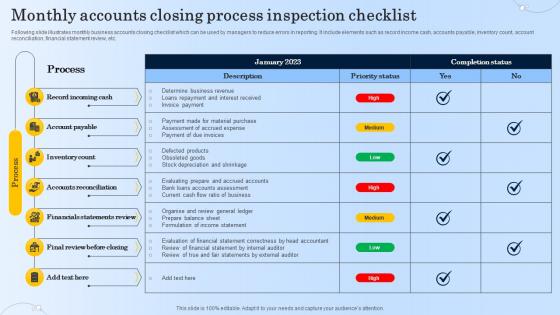
Monthly Accounts Closing Process Inspection Checklist




Try Before you Buy Download Free Sample Product
 Impress Your
 Audience
 100%
100% Editable
 Save Hours
 of Time


Following slide illustrates monthly business accounts closing checklist which can be used by managers to reduce errors in reporting. It include elements such as record income cash, accounts payable, inventory count, account reconciliation, financial statement review, etc.
People who downloaded this PowerPoint presentation also viewed the following :
Monthly Accounts Closing Process Inspection Checklist with all 6 slides:
Use our Monthly Accounts Closing Process Inspection Checklist to effectively help you save your valuable time. They are readymade to fit into any presentation structure.





FAQs for Monthly Accounts Closing
Okay so definitely start with your trial balance and general ledger - those are non-negotiable. Bank recs and journal entries too. Then you'll need your AR/AP aging reports and inventory reconciliations. Fixed asset schedules are crucial because trust me, those always bite you later if they're missing. Get all your supporting docs organized - invoices, receipts, contracts, the usual mess. A closing timeline with sign-offs helps so much for tracking what's actually done. Honestly I'd start pulling this stuff together like 3-4 days early because month-end always gets crazy and you don't want to be hunting for documents at the last minute.
Hey! So first thing - reconcile everything before you close out. Match your bank statements against what's in your books, same with credit cards. I'd honestly do this twice because I always catch stuff I missed the first round (learned that the hard way lol). Check your payables and receivables too, especially any last-minute adjustments or accruals. Those deposits and payments from the final few days? Make sure they actually hit your records. Keep all your reconciliation sheets as backup - you'll thank me later if questions come up.
Okay so don't wait until the last second to start reconciliations - I learned this the hard way lol. Missing cutoff stuff will screw you over, especially with revenue recognition. Those weird journal entries that seem fine? Yeah, review them anyway because they always come back to haunt you. Oh and reach out to other departments early for any docs you need - nobody likes scrambling at 5pm on close day. I'd start prepping like a week out if you can. Make yourself a checklist too, otherwise you'll definitely forget something important when you're stressed.
Honestly? Automate everything you can. Set up those journal entries and bank recs to run automatically - saves me hours every month. Real-time dashboards are clutch because you'll actually know where you stand instead of guessing. Workflow tools can ping people when their stuff's ready, which beats chasing everyone down constantly. Oh, and cloud systems are worth it just for avoiding those awful version control disasters alone. I'd start with whatever manual task annoys you most and find software for that first. Once it's configured right, you won't want to go back.
Honestly, communication makes or breaks the whole thing. Get AP, AR, treasury, and tax folks in the loop from day one - trust me on this. I've watched so many closes completely implode because someone missed a deadline change or new requirement. Short, regular check-ins are your friend here. They help you spot problems while you can still fix them instead of scrambling at the last minute. Oh, and set up clear escalation paths too - nothing worse than an issue sitting in someone's inbox for days. The channels you create upfront? Actually use them consistently.
Quarterly at minimum, but monthly's way better if you can manage it. I tie mine to month-end since that's when the chaos happens anyway and problems show up. Your processes shift more than you'd expect, plus fresh eyes catch stuff the rest of us miss. Definitely review after any big system changes or compliance updates too. Oh, and after major screw-ups - learned that one the hard way. Keep notes throughout the month of what needs tweaking so you're not trying to remember everything later when review time hits.
Build compliance right into your closing process from day one - don't just tack it on at the end. Create a solid checklist covering all the regulatory stuff and documentation your industry needs. Get the right people to sign off at each step (trust me, auditors will thank you later). Catch issues early with regular check-ins instead of scrambling last minute. Keep detailed records of everything - who did what, when they did it. That paper trail is gold during audits. Oh, and definitely automate what you can. Always have someone else review the critical stuff though. Two sets of eyes beats one every time.
Definitely track days to close and close rate percentage - those are your main ones. Revenue retention matters too when you're handing stuff off. The days to close thing is huge because when deals just sit there forever, it crushes everyone's vibe. Nobody wants to deal with accounts in limbo, you know? I'd also watch client satisfaction scores during transitions and whether knowledge transfers actually get finished. Oh, and keep an eye on outstanding deliverables. A weekly dashboard works great for catching problems before they snowball. Close rate shows you which accounts wrap up clean versus the ones that turn into headaches.
Run your trial balance and variance reports first - seriously, most discrepancies are just timing issues or typos that'll pop right out. Hit the big accounts next: cash, AP, AR since those create the worst headaches. Anything left over? Document it and bug the department heads for answers. Oh, and don't waste hours chasing down like $50 differences. Set a threshold for what actually matters and stick to it - your sanity isn't worth obsessing over every tiny variance.
Yeah, so every industry has its own weird stuff to deal with. Healthcare's got HIPAA compliance and patient records - that's seriously a nightmare. Financial services means regulatory filings and moving client assets to new custodians. SaaS companies have to export data and revoke API keys. Manufacturing? You're looking at equipment leases and supplier contracts. Retail's all about liquidating inventory and getting out of leases. Honestly, the compliance stuff is what'll bite you if you wait too long. Talk to your compliance team first thing - those industry requirements always take forever and have the tightest deadlines.
Public companies are such a pain compared to private ones - you've got SOX compliance, SEC deadlines, and all that investor stuff to worry about. Private companies just handle internal reporting and that's basically it. Way easier IMO. Your close process gets crazy complicated with public companies because of quarterly filing deadlines. Honestly, the checklist becomes like 2-3x longer with all the regulatory boxes you need to hit. I'd make separate templates for each type so you don't mess up and forget something important for the public company side.
Honestly, start with reconciling every balance sheet account to your supporting schedules - that's where most issues hide. Documentation is huge too, so back up every journal entry properly. I learned this the hard way, but one tiny missed accrual will screw everything up. Get multiple people reviewing different pieces so you catch errors early. Don't rush your cutoff procedures either, especially for revenue and expenses. Oh, and set your closing calendar way ahead of time! Create checklists for each account type because trust me, you'll forget stuff when it gets crazy.
Dude, you NEED a timeline for your closing checklist. Seriously, this is what saves you from total chaos. Work backwards from your final deadline and give each task a real due date - not some wishful thinking timeframe, but how long stuff actually takes. Build in buffer time too because something always goes sideways (usually the thing you least expect). I learned this the hard way after a few brutal month-ends where I was basically pulling all-nighters. Map it out now and actually follow it. Trust me, future you will be so much happier when closing week doesn't feel like the apocalypse.
Honestly, cross-training is huge here - when Sarah was out last month, we were completely stuck waiting for her to approve stuff. Document everything with templates and checklists so people aren't reinventing the wheel every time. Workflow software helps track who's doing what (and sends those passive-aggressive reminder emails lol). I'd start by figuring out where you're bleeding the most time right now. Is it waiting for approvals? Data entry taking forever? Fix the biggest pain point first, then work your way down.
Honestly, that checklist is a lifesaver. It catches all the dumb mistakes before they blow up - like missing transactions or wonky reconciliations that'll make your statements look terrible. I go through mine every month religiously because I've been burned before. You systematically hit all your journal entries and accruals, which gives you that extra set of eyes on everything. Plus auditors eat this stuff up when they see you've got proper procedures documented. My old boss used to say it's boring work, but boring beats explaining errors to executives later. Trust me, use it every single month.
-
Enough space for editing and adding your own content.
-
“Easy to use. I always wanted to have a quick search for products and SlideTeam has helped me have it.”