


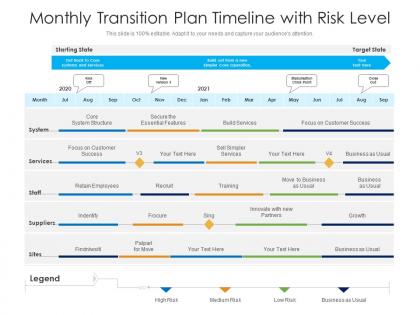
Monthly transition plan timeline with risk level




Try Before you Buy Download Free Sample Product
 Impress Your
 Audience
 100%
100% Editable
 Save Hours
 of Time


Our Monthly Transition Plan Timeline With Risk Level are topically designed to provide an attractive backdrop to any subject. Use them to look like a presentation pro.
People who downloaded this PowerPoint presentation also viewed the following :
Monthly transition plan timeline with risk level with all 2 slides:
Use our Monthly Transition Plan Timeline With Risk Level to effectively help you save your valuable time. They are readymade to fit into any presentation structure.

FAQs for Monthly transition plan timeline
The key phases of a transition timeline in risk management include assessment and planning, stakeholder engagement, implementation and monitoring, testing and validation, and post-transition evaluation. These phases work together by establishing clear risk baselines, ensuring seamless communication across teams, and maintaining operational continuity, with many organizations finding that structured phased approaches reduce transition-related disruptions while delivering enhanced risk oversight and strategic operational resilience.
Organizations can effectively assess transition risks through comprehensive stakeholder analysis, impact mapping, resource dependency evaluation, timeline vulnerability assessments, and scenario planning exercises. These methodologies enable companies to identify potential disruptions across departments, anticipate resource constraints, and develop contingency strategies, with many financial services and healthcare organizations finding that structured risk frameworks ultimately streamline change management and minimize operational disruptions.
Tools for visualizing transition timeline risk management include Gantt charts, risk heat maps, milestone tracking dashboards, critical path diagrams, and scenario planning matrices. These visualization tools streamline risk identification, enhance stakeholder communication, and enable proactive mitigation strategies, with many organizations finding that comprehensive timeline visualization ultimately delivers improved project outcomes and reduced operational disruptions.
Stakeholder engagement minimizes transition risks by ensuring clear communication, gathering diverse perspectives, and securing buy-in across all organizational levels. Through regular updates, feedback sessions, and collaborative planning, organizations can identify potential roadblocks early, address resistance proactively, and maintain alignment, with many companies finding that engaged stakeholders become advocates who facilitate smoother transitions.
Key transition risk metrics include schedule variance, budget deviation, resource utilization rates, quality defect counts, and stakeholder satisfaction scores. These measurements enable organizations to track progress across financial, operational, and human dimensions, while early identification of deviations allows for proactive adjustments, ultimately ensuring smoother transitions and minimizing costly disruptions.
Clear communication strategies mitigate transition risks by establishing transparent information flows, setting realistic expectations, and maintaining stakeholder alignment throughout change processes. Through regular updates, feedback mechanisms, and targeted messaging, organizations reduce uncertainty, minimize resistance, and accelerate adoption rates, with many companies finding that proactive communication prevents costly delays and ensures smoother implementation outcomes.
Common pitfalls in transition risk management include inadequate stakeholder communication, insufficient resource allocation, unrealistic timelines, poor change management processes, and lack of contingency planning. Organizations can avoid these by establishing clear communication channels, conducting thorough risk assessments, building buffer time into schedules, implementing structured change protocols, and developing comprehensive backup strategies, with many finding that proactive planning and regular stakeholder engagement ultimately deliver smoother transitions and competitive advantage.
Change management intersects with risk management by identifying potential resistance points, communication gaps, and implementation bottlenecks before they disrupt transition timelines. This strategic combination enables organizations to develop contingency plans, stakeholder engagement strategies, and phased rollout approaches, with many companies finding that proactive change management reduces transition risks by up to 40% while maintaining operational continuity.
Technology revolutionizes transition timeline risk management through AI-powered predictive analytics, real-time monitoring systems, automated workflow orchestration, and integrated communication platforms. These solutions streamline risk identification, enhance decision-making speed, and minimize project delays by providing comprehensive visibility, with many organizations finding that strategic technology integration ultimately delivers 40% faster transitions and significantly improved stakeholder coordination.
Past transition failures inform future risk management by revealing common patterns like inadequate stakeholder communication, insufficient resource allocation, and unrealistic timelines that organizations can systematically address. Through comprehensive post-mortem analyses, companies across sectors like financial services and healthcare develop enhanced contingency planning, improved change management protocols, and more accurate timeline forecasting, ultimately reducing transition-related disruptions and delivering smoother organizational transformations.
Best practices for smooth risk-managed transitions include comprehensive stakeholder mapping, phased implementation schedules, robust communication protocols, continuous monitoring systems, and detailed contingency planning. These approaches streamline organizational change by minimizing operational disruptions, maintaining service continuity, and ensuring resource alignment, with many institutions finding that early stakeholder engagement and regular checkpoint reviews ultimately deliver faster adoption rates and reduced transition costs.
Training and support are critical for successful transition risk management, as they ensure employees understand new processes, technologies, and roles while minimizing resistance to change. Comprehensive training programs enable organizations to reduce operational errors, accelerate adoption timelines, and maintain productivity during transitions, with many companies finding that well-supported employees become change advocates rather than obstacles.
Ignoring risk management during transitions can lead to project delays, budget overruns, operational disruptions, stakeholder resistance, and complete initiative failures. Organizations across industries, from healthcare system implementations to manufacturing process changes, often experience cascading issues that compound over time, ultimately resulting in significantly higher costs, damaged relationships, and lost competitive advantage in an increasingly dynamic business environment.
Organizations can prepare for unforeseen risks during transitions by establishing comprehensive risk assessment frameworks, creating detailed contingency plans, maintaining flexible resource reserves, and implementing continuous monitoring systems throughout the process. Many businesses find that cross-functional crisis teams, regular scenario planning sessions, and phased rollback procedures enable rapid response capabilities, ultimately delivering operational resilience and minimizing disruption.
Documentation serves as the central communication hub during transition timelines, ensuring all stakeholders understand roles, deadlines, progress updates, and decision points throughout the process. Through comprehensive project logs, status reports, and milestone tracking, organizations maintain operational transparency, minimize miscommunication risks, and enable seamless handoffs between teams, ultimately delivering smoother transitions and measurable accountability across complex organizational changes.
-
Content of slide is easy to understand and edit.
-
Content of slide is easy to understand and edit.
-
Very unique, user-friendly presentation interface.