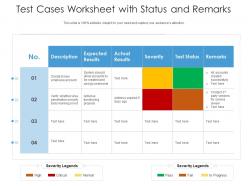
Test cases worksheet with status and remarks
Try Before you Buy Download Free Sample Product
Audience
Editable
of Time
Our Test Cases Worksheet With Status And Remarks are topically designed to provide an attractive backdrop to any subject. Use them to look like a presentation pro.
People who downloaded this PowerPoint presentation also viewed the following :
Test cases worksheet with status and remarks with all 2 slides:
Use our Test Cases Worksheet With Status And Remarks to effectively help you save your valuable time. They are readymade to fit into any presentation structure.
FAQs for Test cases worksheet with
**INPUT**: What are the key components of an effective test case? **OUTPUT**: Effective test cases include clear test objectives, detailed preconditions, specific input data, step-by-step execution procedures, and expected results with validation criteria. These components streamline quality assurance by ensuring comprehensive coverage, reducing testing time, and minimizing defects, with many software development teams finding that structured test cases ultimately deliver faster releases and enhanced user experiences.
Test case prioritization involves ranking by business impact, risk level, functionality criticality, user frequency, and regulatory requirements. Through risk-based testing approaches, development teams focus on high-priority scenarios first, ensuring critical features receive thorough validation while optimizing resource allocation, ultimately delivering more reliable software releases with faster time-to-market advantages.
Test cases in Agile methodology serve as living documentation that evolves with each sprint, ensuring continuous quality validation through automated testing, behavior-driven development, and rapid feedback loops. They enable cross-functional teams to maintain development velocity while delivering reliable software, with many organizations finding that well-structured test cases significantly reduce deployment risks and accelerate time-to-market in iterative development cycles.
Automation enhances test case execution efficiency by eliminating manual repetition, accelerating regression testing, and enabling continuous integration workflows. Through automated frameworks, organizations streamline testing cycles, reduce human error, and execute comprehensive test suites overnight, with many software development teams finding that automation delivers faster release cycles and significantly lower testing costs.
Positive test cases validate that systems function correctly with valid inputs and expected user behaviors, while negative test cases verify proper handling of invalid inputs, error conditions, and unexpected scenarios. These complementary approaches enable organizations to deliver robust software by identifying both functional accuracy and system resilience, with many development teams finding that balanced testing ultimately reduces post-deployment issues and enhances user experiences.
Test case coverage for all requirements is ensured through requirements traceability matrices, comprehensive test planning, and systematic mapping of each functional and non-functional requirement to corresponding test scenarios. This approach enables organizations to identify coverage gaps, validate that every business rule is tested, and maintain audit trails, ultimately delivering higher software quality and reduced post-deployment defects across development cycles.
Strategies for edge case test cases include boundary value analysis, equivalence partitioning, negative testing, data limit exploration, and error condition simulation. These approaches enhance software reliability by identifying system breaking points, validating input constraints, and testing unusual user behaviors, with many development teams finding that comprehensive edge case coverage significantly reduces post-deployment failures and customer complaints.
Managing test cases during requirement changes involves systematic impact analysis, traceability mapping, version control, and collaborative review processes to ensure comprehensive coverage. Test management tools enable teams to track dependencies, prioritize updates, and maintain audit trails, with many organizations finding that automated notifications and cross-functional alignment streamline updates while minimizing regression risks.
**INPUT**: What metrics can be used to evaluate the effectiveness of test cases? **OUTPUT**: Test case effectiveness metrics include defect detection rate, code coverage percentage, test execution time, pass/fail ratios, and requirements coverage analysis. These measurements enable development teams to streamline quality assurance processes, minimize post-release issues, and accelerate delivery cycles, with many software organizations finding that comprehensive metric tracking ultimately delivers higher product reliability and reduced maintenance costs.
Test cases can be structured for better collaboration by using standardized templates, clear naming conventions, detailed preconditions, step-by-step instructions, and shared documentation platforms. Through centralized test management systems, development teams streamline communication, enhance transparency across testing phases, and minimize redundant efforts, while enabling real-time updates and feedback loops that ultimately accelerate project delivery timelines.
Common pitfalls include writing overly complex scenarios, lacking clear acceptance criteria, insufficient boundary testing, poor documentation, and neglecting edge cases. These issues streamline by establishing standardized templates, implementing peer reviews, and maintaining traceability matrices, with many development teams finding that systematic approaches ultimately deliver faster debugging, reduced production defects, and enhanced software reliability.
Test case documentation significantly enhances the testing process by standardizing procedures, improving test coverage, and enabling knowledge transfer across teams. Well-documented test cases streamline quality assurance workflows, reduce testing time, and minimize errors, with many software development organizations finding that comprehensive documentation ultimately delivers more reliable products and faster release cycles.
Exploratory testing complements traditional test cases by uncovering unexpected defects, validating user workflows beyond scripted scenarios, and providing real-time feedback on usability issues that structured testing might miss. This approach enables development teams to identify edge cases, enhance software quality through spontaneous testing paths, and deliver more robust applications, with many organizations finding that combining both methodologies significantly improves overall test coverage and user satisfaction.
Test case management tools include TestRail, Zephyr, qTest, PractiTest, and TestLink, while frameworks encompass TestNG, JUnit, and Pytest. These technologies streamline testing workflows by centralizing test documentation, automating execution tracking, and enabling real-time collaboration across development teams, with many organizations finding that integrated platforms significantly reduce testing cycles and enhance software quality.
User stories inform test cases by translating user requirements into specific acceptance criteria, defining expected behaviors, and identifying edge cases that need validation. Through behavior-driven development approaches, teams can create comprehensive test scenarios that verify functionality from the user's perspective, ensuring applications meet real-world needs while streamlining quality assurance processes and ultimately delivering better user experiences.
-
I discovered this website through a google search, the services matched my needs perfectly and the pricing was very reasonable. I was thrilled with the product and the customer service. I will definitely use their slides again for my presentations and recommend them to other colleagues.
-
Visually stunning presentation, love the content.
-
Innovative and Colorful designs.