

Open AI Language Model IT Powerpoint Presentation Slides




Try Before you Buy Download Free Sample Product
 Impress Your
 Audience
 100%
100% Editable
 Save Hours
 of Time


Chat GPT multitasks by picking up on and naturally expressing more than one aim at a time. Grab our professionally curated OpenAI language model IT template. It includes an introduction, advantages, and features of OpenAIs ChatGPT model and discusses the price and availability of it is enhanced version, called ChatGPT Pro. Our ChatGPT deck represents the working and architecture of ChatGPT technology, including a large language model and self-attention mechanism. Additionally, it demonstrates the various applications of ChatGPT in several domains, such as education, medicine, research, information technology, advertisement, banking, finance, etc. Our chatbot using GPT-3 PowerPoint presentation represents the three reinforcement learning from human feedback models supervised fine-tuning, reward, and reinforcement learning. Furthermore, it discusses integrating the ChatGPT model into web applications and best practices for successful deployment. Moreover, our ChatGPT integration into the web applications module contains sections about the impact of ChatGPT on social media and artificial intelligence tokens. Lastly, this chatbot using GPT-3 deck comprises a roadmap, a timeline, a 30-60-90 days plan, a checklist to integrate OpenAIs GPT-3 model into web applications and a case study on mental health and ChatGPT collaboration. Get access now.
People who downloaded this PowerPoint presentation also viewed the following :
Content of this Powerpoint Presentation
Slide 1: This slide introduces OpenAI language model (IT). Commence by stating Your Company Name.
Slide 2: This slide depicts the Agenda of the presentation.
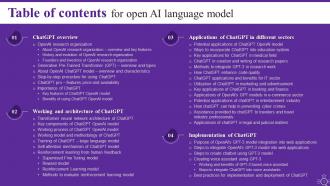
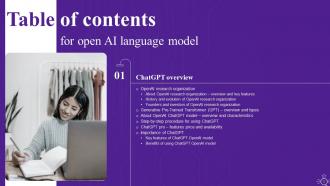
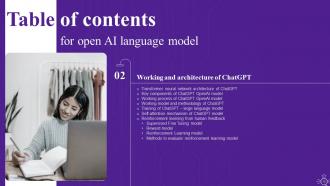
Slide 3: This slide incorporates the Table of contents.
Slide 4: This is yet another slide continuing the Table of contents.
Slide 5: This slide highlights the Title for the Topics to be discussed further.
Slide 6: This slide discusses about OpenAI artificial intelligence research organization.
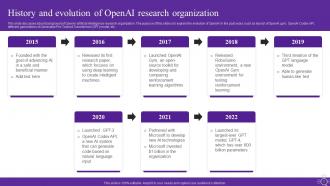
Slide 7: This slide showcases the History and evolution of OpenAI research organization.
Slide 8: This slide talks about the several founders of OpenAI who initiated this to develop advance artificial intelligence.
Slide 9: This slide represents the various versions of Generative Pre-trained Transformer(GPT) model.
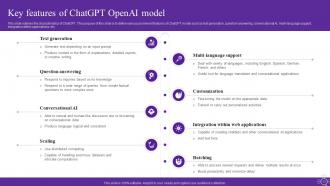
Slide 10: This slide mentions the overview of OpenAI’s ChatGPT model.
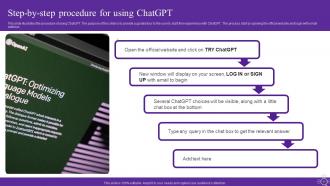
Slide 11: This slide illustrates the procedure of using ChatGPT.
Slide 12: This slide represents the overview of ChatGPT pro.
Slide 13: This slide outlines the various advantages of utilizing ChatGPT.
Slide 14: This slide indicates the Heading for the Components to be covered in the forth-coming template.
Slide 15: This slide demonstrates the architecture diagram of ChatGPT.
Slide 16: This slide highlights the Key components of ChatGPT OpenAI model.
Slide 17: This slide portrays the Working process of ChatGPT OpenAI model.
Slide 18: This slide discusses the overview of ChatGPT’s working model.
Slide 19: This slide talks about the training of ChatGPT model using natural language processing.
Slide 20: This slide demonstrates the working procedure of self-attention mechanism used by ChatGPT model to provide precise output to the user.
Slide 21: This slide represents the supervised fine tuning model of reinforcement learning.
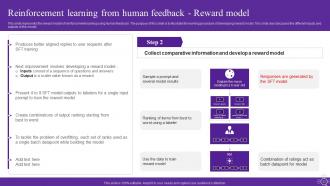
Slide 22: This slide showcases the reward model of reinforcement learning using human feedback.
Slide 23: This slide highlights the reinforcement learning model using human feedback.
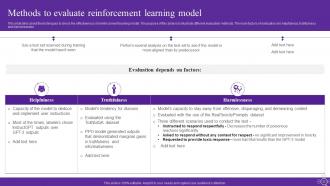
Slide 24: This slide talks about the techniques to check the effectiveness of reinforcement learning model.
Slide 25: This slide depicts the Title for the Ideas to be discussed further.
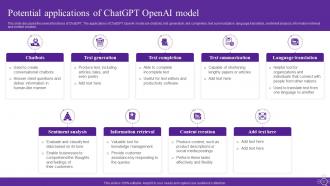
Slide 26: This slide discusses the several functions of ChatGPT.
Slide 27: This slide demonstrates the various methods of utilizing ChatGPT in classrooms.
Slide 28: This slide showcases the various uses of ChatGPT in medical industry.
Slide 29: This slide represents the various applications of ChatGPT in creating research papers.
Slide 30: This slide discusses the ways of integrating GPT-3 into research.
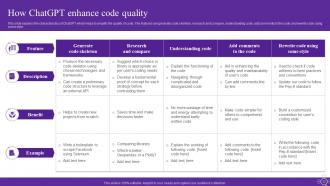
Slide 31: This slide explains the characteristics of ChatGPT which helps to amplify the quality of code.
Slide 32: The purpose of this slide is to outline the various uses of ChatGPT in information technology sector.
Slide 33: This slide elucidates the applications of ChatGPT in business marketing and advertisement.
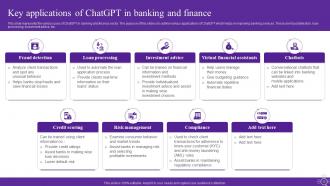
Slide 34: This slide exhibits the Key applications of ChatGPT in banking and finance.
Slide 35: This slide deals with Applications of OpenAI's GPT models in e-commerce sector.
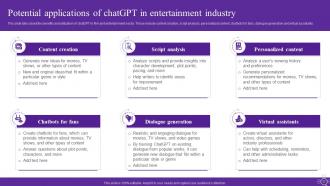
Slide 36: This slide talks about the benefits and utilization of chatGPT in film and entertainment sector.
Slide 37: This slide demonstrates the various applications of chatGPT in the field of cybersecurity.
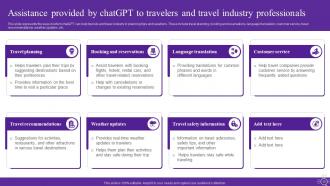
Slide 38: This slide represents the ways in which chatGPT can help tourists and travel industry in planning trips and vacations.
Slide 39: This slide highlights the Applications of chatGPT in legal and judicial matters.
Slide 40: This slide depicts the Heading for the Ideas to be covered further.
Slide 41: This slide discusses the reason behind integration of ChatGPT into various applications.
Slide 42: This slide demonstrates the procedure of implementing OpenAI’s GPT-3 model into various applications.
Slide 43: This slide states the Steps to create chatbot using GPT-3 model.
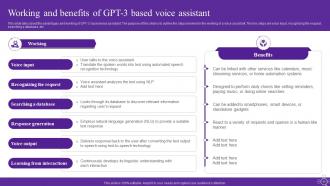
Slide 44: This slide talks about the advantages and working of GPT-3 based voice assistant.
Slide 45: This slide demonstrates the procedure of implementing ChatGPT into voice assistants.
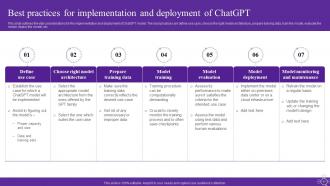
Slide 46: This slide outlines the vital considerations for the implementation and deployment of ChatGPT model.
Slide 47: This slide portrays the Title for the Components to be discussed in the forth-coming template.
Slide 48: This slide talks about the response received by ChatGPT on social networking sites.
Slide 49: This slide depicts the change in the prices of five artificial intelligence tokens after the launch of OpenAI’s ChatGPT model.
Slide 50: This slide contains the Heading for the Topics to be covered in the upcoming template.
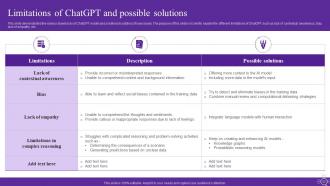
Slide 51: This slide demonstrates the various drawbacks of ChatGPT model and solutions to address those issues.
Slide 52: This slide outlines the Future role of ChatGPT OpenAI model.
Slide 53: This slide displays the Title for the Topics to be discussed next.
Slide 54: This slide represents the checklist to integrate OpenAI's GPT-3 model into web applications.
Slide 55: This slide mentions the Heading for the Components to be covered in the following template.
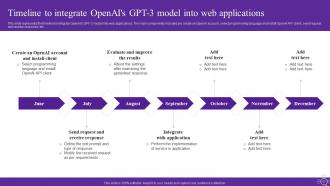
Slide 56: This slide reveals the timeline to integrate OpenAI's GPT-3 model into web applications.
Slide 57: This slide exhibits the Title for the Ideas to be further discussed.
Slide 58: This slide portrays 30-60-90 plan to integrate OpenAI's GPT-3 model into web applications.
Slide 59: This slide elucidates the Heading for the Ideas to be covered next.
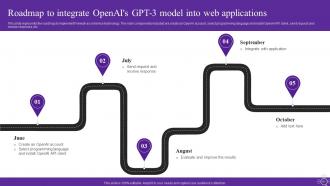
Slide 60: This slide represents the roadmap to implement Firewall-as-a-Service technology.
Slide 61: This side indicates the Title for the Components to be discussed further.
Slide 62: This slide demonstrates a case study on the utilization of chatGPT while creating online therapy model.
Slide 63: This is the Icons slide containing all the Icons used in the plan.
Slide 64: This slide is used for showcasing some Additional information.
Slide 65: This slide contains the Post it notes for reminders and deadlines.
Slide 66: This is Meet our team slide. State your team-related information here.
Slide 67: This slide showcases the Timeline of the organization.
Slide 68: This slide elucidates the Venn Diagram.
Slide 69: This is the Puzzle slide with related imagery.
Slide 70: This slide presents the Circular diagram.
Slide 71: This is Our Goal slide. State your firm's long-term goals here.
Slide 72: This is the Thank you slide for acknowledgement.
Open AI Language Model IT Powerpoint Presentation Slides with all 76 slides:
Use our Open AI Language Model IT Powerpoint Presentation Slides to effectively help you save your valuable time. They are readymade to fit into any presentation structure.




































FAQs for Open AI Language Model IT
So OpenAI basically wants AGI to help everyone, not just tech bros with deep pockets. They switched to this "capped-profit" thing a while back - kinda weird but it lets them fund research while staying true to their original nonprofit vibe. Safety's huge for them. They're big on transparency and making stuff like ChatGPT actually accessible to normal people instead of keeping it locked away. Honestly, that's what I'd look for if you're comparing AI companies - who's actually being responsible about this stuff and not just chasing profit.
So OpenAI has this whole safety thing down pretty well. They test everything before releasing it, plus they've got usage policies that block harmful stuff. There's monitoring too if people try to misuse it. Honestly, I like that they're upfront about the limitations - nobody's pretending AI is flawless here. Content filters are built in, rate limits exist. They even work with outside researchers to catch issues they might miss. Oh, and if you're using their APIs, definitely check those usage policies first. Trust me, you don't want to accidentally break their rules.
Honestly, the GPT series changed everything - they figured out how to make AI actually understand context in conversations. The transformer stuff they built lets models remember what you said earlier instead of just forgetting mid-chat. GPT-3 was such a huge leap from GPT-2, like night and day. What really makes ChatGPT feel so natural is their work on instruction-following and getting feedback from real people. Oh, and if you're doing any language model work, their papers on attention mechanisms are pretty solid reads. That's where most of the magic happens.
Dude, OpenAI's stuff is literally changing everything right now. Healthcare companies are using it for medical imaging and drug discovery. Finance bros love it for fraud detection and risk analysis - makes sense since they're obsessed with automation anyway. Legal teams draft contracts way faster now, and education platforms build personalized tutoring that actually works. But here's the crazy part: it's not just making things quicker. Companies can do things they couldn't even attempt before. You should definitely look into some small test projects for your industry. The pace of this is honestly insane.
Dude, OpenAI's API is seriously a game-changer. You can literally add AI features like text generation or language translation to your app with just a few lines of code. No PhD required, which is pretty amazing honestly. Instead of building your own models from scratch (nightmare), you just make API calls to GPT. Businesses love it because you can prototype stuff fast without crazy infrastructure costs. Oh, and definitely mess around in their playground first - that's where you'll get the best feel for what it can actually do. Makes the whole AI thing way less intimidating.
So OpenAI does a bunch of stuff to fight bias - diverse training data, red team testing (where people literally try to break their models), and they monitor outputs for sketchy patterns. Honestly, I respect that they're upfront about it being an ongoing problem instead of pretending they've solved everything. They also bring in outside researchers and do audits to catch stuff they might miss. Bottom line though? Their models still mess up sometimes, so definitely double-check AI outputs - especially if it's about sensitive topics or decisions affecting different groups.
Dude, these OpenAI models are literally everywhere now. Customer service bots, content writing, coding help - the works. They're surprisingly good at translation and summarizing stuff too. Companies use them to analyze feedback, write personalized emails, generate marketing copy at scale. Virtual assistants that actually get what you're talking about? Yeah, that's these models. Oh and developers love them for debugging code. Honestly, if your team does a lot of text-heavy grunt work, you should probably look into automating some of that repetitive stuff. It's kind of a game-changer.
So OpenAI's doing safety work on two fronts basically. Research-wise, they're figuring out alignment techniques and trying to crack open these black box models to see how they actually think. The policy side though? That's where I think they're making the biggest waves right now. They're constantly talking to governments and regulators about AI governance stuff. Makes sense since everything's moving so damn fast. They publish their safety research too if you want to dive into the technical weeds. Oh, and they push for responsible deployment practices internationally - like trying to get everyone on the same page about AI risks.
Oh totally, OpenAI actually listens to user feedback way more than most companies. Your conversations with ChatGPT help them fix bugs and make safety updates. They run those beta programs too where you can test stuff early and give input. I've been pretty impressed honestly - like they don't just collect feedback and ignore it, they actually do something with it. My friend reported this weird glitch last month and they fixed it pretty quick. If you notice something weird, definitely use their feedback thing. It's not just throwing suggestions into the void.
Yeah so OpenAI actually gets ahead of this stuff instead of waiting around. They publish safety research and work directly with regulators, which is smart honestly. When they need more testing time, they'll literally delay releases - happened a few times already. There's whole teams just for safety and policy work. Makes sense since everything moves so damn fast in AI. They're basically trying to write the rules instead of following them later. Oh and if you're in this space, definitely check out their safety papers. That's usually where you'll see what becomes standard practice.
Honestly, OpenAI's models are pretty good but they're not perfect. They hallucinate stuff sometimes - like, just make up facts that sound convincing but are totally wrong. Math isn't their strongest area either, which is kinda funny when you think about it. They also can't access recent info because of training cutoffs, so don't ask about last week's news. Plus there's the whole bias thing since they learn from human data (and we're all biased). OpenAI's working on fixes through better training methods and human feedback. But yeah, always double-check anything important - treat them like a smart friend who sometimes gets things wrong.
Honestly, I'd start with lesson planning - ChatGPT saves me so much time there. Let your kids use it for brainstorming topics or getting writing feedback, but drill into them that it's just a tool. Critical thinking still matters, obviously. Oh, and you could have them fact-check AI content for bias - that's actually pretty eye-opening for them. Just be upfront about when you're using it. I started with one small assignment first (learned that the hard way), then expanded once I figured out what worked. Don't go crazy with it right away.
Yeah so they're basically going way beyond just chatbots now - building AI agents that can handle entire workflows for you. The reasoning stuff they're working on is getting pretty insane honestly. Better accuracy, fewer weird hallucinations, plus they're making specialized versions for different industries. Also integrating with tools people actually use instead of making you learn new platforms. Oh and definitely watch their API releases - that's usually where the cool business stuff drops first before it hits the main product. Wild how fast they're moving these days.
Look, OpenAI's partnerships are basically about filling gaps they can't handle solo. Microsoft gives them crazy computing power and helps them reach enterprise customers. Academic collabs bring fresh research talent - honestly some of the coolest breakthroughs happen when different minds clash. They also work with policy groups because AI regulation is getting messy fast. Each partnership covers what they're missing, whether it's tech infrastructure or market access. Oh, and domain expertise too - that's huge. For your own stuff, think about what partnerships could speed things up. Don't try to build everything yourself.
Honestly, it's like having a brainstorm buddy who doesn't need coffee breaks. When I'm stuck on projects, I just throw ideas at it and see what sticks. The cool part is you can crank out tons of variations super fast - way better than spending forever on one concept. It connects weird dots between different fields too, which gets pretty interesting. Sometimes I'll be working on something totally unrelated and it'll suggest an angle I never would've thought of. Perfect for those 3am creative blocks when your brain's basically mush. Just don't expect it to do the actual work for you, but as a thinking partner? Pretty solid.
-
Out of the box and creative design.
-
Huge collection of high-quality templates. Worth each penny.