


Options for global geographical expansion plan ppt slide examples




Try Before you Buy Download Free Sample Product
 Impress Your
 Audience
 100%
100% Editable
 Save Hours
 of Time


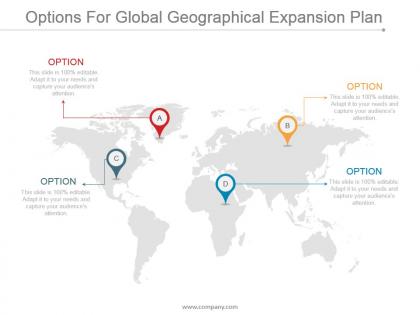
Built an empire through these means, include our, options for global geographical expansion plan PPT slide examples. Use this design to reflect your business expansion strategies. We have shown a high-quality image on the world map with location icons show here. Use this design to locate your trade centers or probable business centers. Use this global geographical example to locate your clients and display potential buyers. The graphics shown on these designs are entirely editable and you can even add individual notice and company logos in them by simply following some simple steps. So download our, options for global geographical expansion plan PPT slide examples and bygone with your worries. Build a flawless case with our Options For Global Geographical Expansion Plan Ppt Slide Examples. Make it difficult to counter your arguments.
People who downloaded this PowerPoint presentation also viewed the following :
Options for global geographical expansion plan ppt slide examples with all 5 slides:
Our Options For Global Geographical Expansion Plan Ppt Slide Examples ensure everyone happily comes on board. They excel at calming folks down.

FAQs for Options for global geographical expansion plan
Honestly, I'd focus on four main things first. Figure out if there's actual demand for your product there - don't just assume people want it. Check out who you're competing against locally. Regulatory stuff is where things get messy though, especially depending on your industry. I've watched companies get completely screwed by compliance costs they didn't budget for. Distribution channels matter too. How will you actually get your product to customers? Price it right for what locals can afford. Oh, and decide early if you need local partners or can handle everything yourself. Maybe start small with a pilot program instead of jumping in headfirst?
Dude, cultural differences will absolutely destroy your global campaigns if you're not careful. Values and buyer behavior are totally different everywhere. I've watched so many brands face-plant because they assumed what worked at home would work anywhere - major yikes. Don't just translate your copy and call it a day. Research local preferences first. Partner with regional teams who actually get the market. Test stuff small before going big. Colors, messaging, even product positioning needs tweaking for each region. It's way more work but you'll actually connect with people instead of looking clueless.
Honestly, tech is what makes expansion possible without going broke upfront. Cloud platforms let you scale instantly across regions - no need to build stuff everywhere. Payment systems handle local currencies, translation tools help you actually communicate with customers. CRM gives you real-time market insights so you're not just guessing what works. The cool part? You can test markets digitally first before throwing serious money at them. I'd focus on getting your payment processing and customer communication sorted before launching anywhere new though.
Start with a solid risk framework covering political stability and economic basics. Government stability, regulatory shifts, currency swings - all that stuff matters. Honestly, I'd mix third-party tools (Eurasia Group's pretty decent) with your own boots-on-the-ground research. Chat with local partners and other foreign companies already there. Government officials too if you can swing it. Risk reports miss weird nuances sometimes, so multiple perspectives help. Set up a scoring system to rank markets objectively. Oh, and definitely build contingency plans for your worst-case political and economic scenarios.
Honestly, you've gotta start with understanding the culture first - like really digging into how people shop and what they actually want. Translation is obvious but there's so much more. Payment methods are huge (some places barely use credit cards), plus you'll need different pricing and marketing that actually resonates. Oh and regulatory stuff - that can be a nightmare if you ignore it. I'd probably test one market first instead of going everywhere at once. Product features might need tweaking too depending on local habits. Each place is different so don't just copy-paste your existing strategy. Find local partners if you can - they know things you don't.
Market research is make-or-break stuff, seriously. Don't assume what works here will work there - I've watched companies blow millions on that mistake. You need the real deal on local customers, pricing, competition, regulations, all of it. Cultural stuff matters way more than people think. Start broad with secondary research to get your bearings, then dig deeper with primary research for the markets that actually look worth it. Payment preferences, distribution channels, customer behaviors - yeah it's a lot but skipping this step is basically gambling with your expansion budget.
Honestly, most companies mess up by thinking their home strategy will magically work everywhere else. Different countries = totally different customers, regulations, weird cultural stuff you'd never expect. Currency swings can destroy your budget projections too - learned that one the hard way at my last job. Remote management sounds cost-effective but it's usually a disaster. You really need local people who actually get the market. Start with serious research first, make friends with local partners early on, and triple whatever timeline you're thinking. Markets always take longer than expected.
Dude, partnerships are seriously clutch for new markets. You get instant street cred and local know-how that would take forever to build solo. Your partner already knows the regulations, cultural stuff, and has distribution lined up - saves you tons of money and headache. Sharing the risk is pretty sweet too, especially when you're gambling on unknown turf. Oh, and find partners who fill your gaps, not ones who do what you already do well. Map out what you desperately need vs what can wait, then go after the must-haves first. Trust me on this one.
Honestly, the legal stuff is a nightmare - every country has different rules for business registration, taxes, employment law, all of it. GDPR in Europe will make your head spin. Banking can be weirdly complicated too, like some places require tons of paperwork just to open an account. Your trademarks and patents don't automatically transfer either, so you'll need to file separately in each market. Labor laws are probably the biggest gotcha - what's totally fine here might get you sued there. Get local lawyers involved early, even if it feels premature. Trust me on this one.
Hey! So going global means basically rebuilding your whole supply chain from scratch - it's not just doing more of the same stuff. I'd spread out suppliers across different regions to cut costs and avoid getting screwed if one area has issues. Local sourcing is clutch for faster shipping and dealing with currency swings (customers dig the local angle too). Regional distribution centers beat shipping everything from home base. Oh, and compliance is a nightmare - every country has their own weird rules about imports and labeling. Honestly though? Pick one region first, nail it down, then move on. Don't try conquering the world at once.
Honestly, start with the obvious stuff - revenue growth and profit margins in your new markets. Margins will probably take a hit at first, which sucks but it's normal. Customer acquisition costs are brutal internationally, so definitely track those. Market share and compliance rates matter too. Supply chain efficiency can make or break you depending on the region. Don't sleep on customer satisfaction scores by location either - what works in one country might totally flop in another. The cultural stuff is hard to measure but... yeah, you'll figure that out as you go. Build from these basics first.
Honestly, you'll probably need to tweak some stuff but don't mess with your core values. Visual stuff and messaging tone should definitely adapt to local preferences - colors are huge too. Red screams "lucky!" in China but feels dangerous here in the West. Wild how much that matters, right? Research cultural meanings and how people actually shop in those markets first. Then figure out what you can change without losing what makes your brand... well, your brand. It's basically walking a tightrope between staying authentic and not accidentally offending anyone.
Oh man, going global changes everything HR-wise. Employment laws are totally different everywhere, plus you're juggling time zones and visa stuff constantly. The talent pool gets massive but also way more complicated - honestly it's kinda overwhelming at first. Company culture becomes this weird challenge when everyone's scattered across continents. Each country has their own hiring quirks too, which you'll learn the hard way. I'd definitely get cozy with local HR people early on. And seriously invest in cultural training for managers - that part's huge.
Dude, social media is perfect for testing international markets without blowing your budget. Different regions have their go-to platforms - like WhatsApp dominates in Latin America while China's all about WeChat. You gotta create content that actually fits the local culture though. What kills it in Texas will probably bomb hard in Tokyo, you know? Listen to what people are talking about in those markets first. Their engagement and comments will tell you everything about whether you're on the right track. Honestly, I'd rather start super small and figure out what works before going big.
Oh man, there's actually a bunch of ways to tackle this. Bank loans are the obvious choice, but export financing through places like the Export-Import Bank can be clutch if you're in the US. Government grants are everywhere too - tons of countries basically pay you to set up shop there. Venture debt is having a moment right now for growing companies. Honestly though, joint ventures might be your best bet since you get both cash AND someone who actually knows the local market. I'd probably start with your cash flow projections first, then just see what's out there. Don't limit yourself to one option either.
-
Unique design & color.
-
Best way of representation of the topic.