


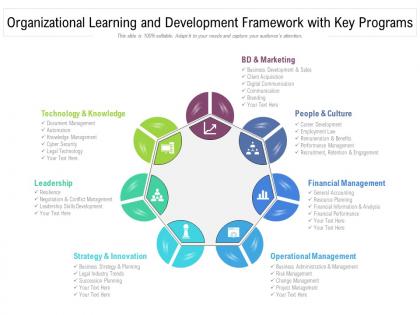
Organizational learning and development framework with key programs




Try Before you Buy Download Free Sample Product
 Impress Your
 Audience
 100%
100% Editable
 Save Hours
 of Time


Our Organizational Learning And Development Framework With Key Programs are topically designed to provide an attractive backdrop to any subject. Use them to look like a presentation pro.
People who downloaded this PowerPoint presentation also viewed the following :
Organizational learning and development framework with key programs with all 2 slides:
Use our Organizational Learning And Development Framework With Key Programs to effectively help you save your valuable time. They are readymade to fit into any presentation structure.
FAQs for Organizational learning and development framework
You need three main things: ways to capture knowledge, platforms where people actually share stuff (not some dusty wiki), and clear processes for using what you learn. Building a culture where people feel safe admitting screw-ups is honestly the hardest part. Also set up feedback loops so you can see what's working. I'd start by figuring out where knowledge disappears in your company right now - maybe it's when people quit or projects end badly. Then build systems to fix those specific problems first. Oh, and measure everything so you know if it's actually helping.
Honestly, I'd go with a mix of hard numbers and gut-check conversations. Performance data and skill assessments are great, but sometimes just asking people "what are you actually using from that training?" tells you way more. Track engagement scores and retention too - those matter. Oh, and see if people are teaching their teammates what they learned, that's always a good sign. Set your baseline first though, otherwise you're just guessing. Don't overthink it - pick like 2-3 things that actually matter for what you're trying to accomplish and track those consistently.
Honestly, people stick around way more when you actually invest in their growth. Makes them feel valued, you know? They're not constantly looking elsewhere if they can build skills and advance where they are. Plus there's this whole psychological safety thing - mistakes become learning moments instead of something to stress about. Way better work environment. Teams get tighter when they're learning together too. The trick though? Make sure the learning stuff is actually what people want to develop. Generic training sessions that nobody asked for are pretty much useless. Focus on what'll genuinely help their careers.
Look, tech is basically what holds all your company knowledge together. Learning systems handle training stuff, while Slack or Teams let people share info on the fly. Analytics help you spot where training's missing and track who's actually learning. Knowledge bases are honestly game-changers - suddenly everyone can search for answers instead of bugging the same three people. But here's the thing: don't just grab the shiniest software. Figure out where knowledge gets bottled up in your workflow first, then find tools that actually fix those specific problems. Your team will thank you.
Honestly? Your leaders will make or break the whole thing. I've watched so many learning programs crash because executives preached about growth but never actually showed it themselves. You need bosses who mess up publicly and own it. Who try new stuff even when it might flop. The moment your team sees leaders playing it safe while pushing everyone else to "be innovative" - yeah, that's when people check out. Smart risks that don't work should get celebrated just as much as wins. Creates that safety net where people actually want to experiment instead of just looking competent all the time.
Honestly, start with regular cross-team meetings and maybe rotate people between projects - gets them actually talking instead of hiding in their departments. Those knowledge-sharing sessions work pretty well too, though some people are way better presenters than others lol. Set up a shared wiki or internal forum where folks can dump insights and ask random questions. Lunch and learns are solid if you can get people to show up. Oh, and peer mentoring helps a ton. The trick is weaving this stuff into normal work so it doesn't feel like another annoying task everyone ignores.
Honestly, mixed teams just learn faster because everyone's coming from different places. You get way more creative solutions when people have varied backgrounds and experiences. The best part? They naturally call out each other's assumptions - yeah it gets awkward sometimes, but the results are worth it. Homogeneous groups miss obvious blind spots that diverse teams catch right away. Innovation happens quicker too since different viewpoints push everyone to think harder. Just make sure people feel safe speaking up, otherwise you won't actually get those unique insights that make it all worthwhile.
Honestly, it's mostly about people being territorial and scared to mess up. Everyone stays in their own bubble instead of sharing what they've learned - drives me crazy. Plus you get those leaders who say they want innovation but then freak out when something doesn't work perfectly. Knowledge systems are usually garbage too, so even good insights just disappear. What actually works? Start with small test projects where failing won't get anyone fired. Get different teams working together on stuff. Reward people for being honest about what went wrong, not just the wins. Cross-functional projects are your friend here.
Honestly, just bake feedback into every part of your process - grab insights from what you actually did, think about what bombed or worked well, then loop that back into planning next time. Make it regular though, not just when things go sideways. Most teams I know completely skip reflecting (classic mistake) and then act shocked when they repeat the same screwups. Quick retrospectives work great. Real-time feedback channels too. But here's the thing - you've gotta actually change stuff based on what you learn, otherwise it's pointless. Pick one thing you're working on and add some basic feedback loop this week.
Look, you'll want to track the obvious stuff first - completion rates, test scores, how satisfied people are with the training. But here's where it gets interesting: follow up later to see if they actually retained anything or changed how they work. That's honestly the hardest part to measure consistently, but whatever. The sweet spot is tying learning back to real business stuff like fewer mistakes, better productivity, or getting new hires up to speed faster. Don't go crazy with metrics though. Pick 3-4 that actually matter to your company and stick with those religiously.
Okay so here's the thing - when your training actually matches what your company's trying to do, the results are pretty wild. Higher engagement, people pick up skills faster, you get better at beating competitors. Like if you're pushing innovation but all your training is boring compliance stuff, you're just working against yourself (trust me, I've seen this mess up entire teams). Your people need to build skills that actually help the company win, right? Map out your current training against your top 3 priorities and you'll spot the gaps immediately. It's honestly one of those things that seems obvious once you do it.
So experiential learning is when your company gets smarter by doing stuff and then talking about what went down. Your teams jump into real projects, screw things up (which honestly happens more than anyone admits), then sit down afterward to figure out what actually worked. Way more effective than boring training sessions or reading those generic best practice guides. The trick is giving people room to mess around safely - oh, and then capturing all those lessons so everyone can benefit from the failures and wins. After big projects, try doing "learning retrospectives" where you all debrief together. Makes it way less random.
Honestly, just weave learning into stuff you're already doing instead of making it this whole separate thing. Weekly team check-ins where you actually talk about what went wrong? Perfect. Post-project reviews that don't suck? Even better. Pick one team to test a basic "lessons learned" thing first - see what actually works. Knowledge sharing sessions are solid too, but here's the thing: you've gotta reward people when they use what they learned, otherwise it's pointless. Cross-team collaboration helps tons. Start small though, because nobody wants more homework on top of everything else.
Honestly, storytelling sessions are huge for this. Get your veterans sharing war stories with the newer folks - people eat that stuff up. After-action reviews help too, plus mentoring and job shadowing. Video walkthroughs work surprisingly well, especially for processes that are hard to explain. Communities of practice are where the magic happens though - once people start talking shop, they don't stop. I'd probably start with whatever feels most natural for your team. Maybe just informal lunch-and-learns? Don't overthink it at first.
Honestly, just ask each team what they actually want first. Sales people need quick updates and competitive stuff. Engineering? They're all about technical deep-dives and coding together. HR (shocking) loves structured everything, but creative teams work better when they can mess around and experiment. Survey each department about how they like to learn and what skills they're missing. Then switch up your methods - same basic framework, but make it feel relevant to what they do every day. Different content, different metrics. The trick is not making it feel like generic corporate training, you know?
-
Best way of representation of the topic.
-
Content of slide is easy to understand and edit.
-
Attractive design and informative presentation.
-
Nice and innovative design.
-
Designs have enough space to add content.