


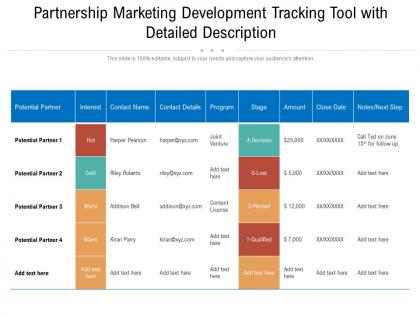
Partnership marketing development tracking tool with detailed description




Try Before you Buy Download Free Sample Product
 Impress Your
 Audience
 100%
100% Editable
 Save Hours
 of Time


Our Partnership Marketing Development Tracking Tool With Detailed Description are explicit and effective. They combine clarity and concise expression.
People who downloaded this PowerPoint presentation also viewed the following :
Partnership marketing development tracking tool with detailed description with all 2 slides:
Give your audience a fulfilling experience. They will find our Partnership Marketing Development Tracking Tool With Detailed Description elevating.
FAQs for Partnership marketing development tracking tool
Definitely start with revenue attribution - that's what actually matters for your bottom line. Track lead quality and conversion rates by partner, plus customer acquisition cost and lifetime value. Traffic is fine to monitor but honestly, clicks mean nothing if they're not converting into sales. Commission payouts and partner engagement levels are worth watching too. Time-to-conversion varies a lot between partnership types, so that's useful data. Oh and don't get caught up in vanity metrics early on - focus on partners who actually drive results first, then you can get fancy with the detailed tracking later.
Honestly, this is where so many people screw themselves over - they skip the boring setup stuff and then fight about who gets credit for months. Right from the start, give each partner their own UTM codes, landing pages, or promo codes. That way you can actually see where leads come from instead of guessing. Your CRM should talk to whatever partnership tool you're using, otherwise you're just creating more work for yourself. Oh and track multiple touchpoints, not just the final click - partnership deals usually take way longer than regular sales anyway.
Real-time attribution tracking is clutch - you need to see which partners actually convert, not just send traffic. Get something with automated commission calculations and fraud detection built in. Multi-touch attribution is where most people mess up honestly, they credit the wrong partners for sales and wonder why their budgets are screwed. Integration with your current analytics is obvious but worth mentioning. Different commission structures for different partner types? Yeah, you'll need that flexibility. Oh, and customizable dashboards so you can quickly spot your top performers and shift money around. That's where the real ROI happens.
So you get this shared dashboard where everyone sees the same live data - performance, leads, conversions, whatever. No more texting screenshots of random spreadsheets back and forth (which honestly drives me crazy). You can comment directly on campaigns and tag people when stuff breaks. Think project management but actually useful for partnerships. Oh, and definitely set up alerts for the big milestones. Trust me on this one - saves you from having to bug everyone with "hey did you see..." messages every day. Game changer for keeping everyone aligned without the constant check-ins.
Dude, visual dashboards are seriously a lifesaver for tracking partnerships. You know how you'd normally be staring at endless spreadsheet rows trying to figure out which partners are actually performing? Charts and graphs make it so obvious - like instantly seeing who's killing it vs who's dragging behind. Honestly makes partner reviews way less painful. I always tell people to set up those automated reports because pulling data manually every week gets old fast. You'll spot trends you'd totally miss otherwise. Also random tip - color coding performance levels is clutch for quick decisions.
Most tools connect to your CRM pretty easily through APIs or built-in connectors. Check your settings for pre-made integrations with Salesforce, HubSpot, Pipedrive - they're usually there. Once connected, it'll automatically sync partner referral data and track which partnerships actually bring in revenue. Custom fields can be a pain sometimes, honestly. I'd start basic first, then mess with the data mapping later once you see how it all works together. Oh, and it updates lead sources automatically so you don't have to guess where stuff came from.
Ugh, data integration is the worst part honestly. Your current systems won't talk to the new tracking stuff - I spent forever dealing with that mess. Partners hate changing their workflow too, even when it's obviously broken. Then you've got attribution problems when customers hit multiple touchpoints, plus some partners will straight up question if your data's right. Oh and privacy compliance depending on what industry you're in - forgot about that fun surprise initially. Just start small with whoever's most chill to work with, then scale up after you fix the inevitable disasters.
Dude, real-time reporting is a game changer for partnerships. You can instantly see which partners are killing it and which ones are duds - no more waiting weeks for data. Found out Partner A is driving 3x more conversions? Jump on that right away. The cool thing is you'll catch problems before they get expensive. I learned this the hard way last year, honestly. Set up alerts for your main metrics so you're not glued to dashboards all day. It's basically like having superpowers - you can shift budgets and strategies on the spot instead of flying blind.
Honestly, start with encryption - both for data sitting around and stuff being sent. Role-based permissions are huge too so random people can't peek at your partner details. SSL certs should be obvious but you'd be shocked how many companies cheaped out on this when I was looking last year. IP whitelisting is solid if you need it. Oh and definitely grill them about SOC 2 compliance upfront - saves you time later. Audit trails matter for tracking who accessed what. Ask about their data retention stuff before you waste hours on demos that go nowhere.
Dude, AI is a game-changer for partnership tracking. It automatically finds performance patterns you'd totally miss doing it by hand. Plus it predicts which partnerships will actually work out and catches weird anomalies right away. The cool part? Machine learning keeps getting better over time - basically like having a tireless data nerd on your team. You get fraud detection, personalized partner suggestions, automated scoring. Honestly though, start with ML for attribution modeling first. That's where you'll see the biggest jump in accuracy right off the bat.
Pull your last 6 months of partnership data - that's your goldmine right there. Check which partners actually brought quality leads vs just volume. Some results will probably shock you tbh. Content performance varies wildly between partners too, so see what messaging actually converted. Seasonal trends matter more than people think. Your tracking tools should show conversion rates and which touchpoints moved people to buy. Once you've got those insights, double down on your top 3 partnerships. Ditch the ones that aren't working. It's way better than throwing money at partnerships that sound good on paper but don't deliver.
Skip the slide decks - seriously, just throw people into the actual system with real partnership data. Way more effective. Keep training sessions super short, like 30-45 minutes tops, and focus only on stuff they'll actually use every day (tracking attribution, pulling reports, that kind of thing). Give them a sandbox environment where they can click around and break things without consequences. Pick someone from each team to be your go-to person for questions later - saves you from getting pinged constantly. Oh, and definitely create those little cheat sheets they can reference later, because let's be honest, everyone forgets half this stuff within a week anyway.
Partnership tracking tools are honestly game-changers for figuring out who's actually worth your time. Don't just look at traffic volume - that's misleading as hell. Focus on conversion rates and customer acquisition costs instead. The partners bringing quality customers will have higher lifetime values, which is what really matters. I always set up monthly reports to catch patterns early. Some partners might have random good months but suck overall, so look for consistent performers. Once you spot your winners, throw more resources their way and ditch the dead weight.
Your partners are gonna tell you way more than any data dashboard ever will. They know which metrics actually matter to them and what's missing from your tracking tool. I'd set up regular check-ins with your top partners - that's where you'll find the real issues. Maybe the interface is confusing or they can't find the data they need. Build based on their feedback, not what you think they want. Too many tools get built and then sit there unused because nobody asked the actual users what they needed. Their pain points = your feature roadmap.
So basically these tools create this whole audit trail for everything your partners do - super clutch for compliance stuff. You can track commission payments, make sure promotional content looks right, check if partners are following your brand rules. Honestly, it's like having someone watching everything without the awkward check-ins. The system logs all your communications automatically and flags weird activities. Plus you'll get reports that auditors actually want to see (thank god). Best part? Set up alerts when partners go off-script so you're not dealing with fires later.
No Reviews