

Poor Communication Leads To Workplace Conflict Training Ppt




Try Before you Buy Download Free Sample Product
 Impress Your
 Audience
 100%
100% Editable
 Save Hours
 of Time


These slides cover poor communication as a reason behind workplace conflict. It also provides information on what leads to poor communication at the workplace, which are unclear objectives, limited feedback, and inability to accept. Further, it discusses the impact of poor communication at the workplace, such as an unpredictable work environment, less collaboration, and low morale.
People who downloaded this PowerPoint presentation also viewed the following :
Content of this Powerpoint Presentation
Slide 1
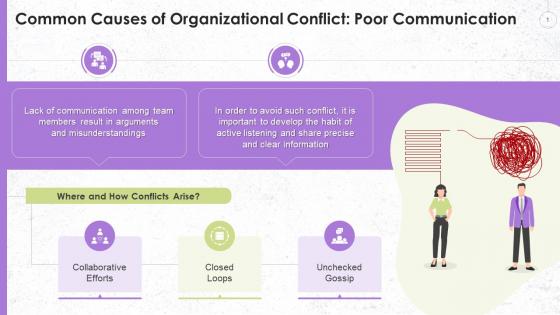
The purpose of this slide is to highlight how miscommunication can lead to conflicts in the workplace. It also includes details of areas where the dispute arises, such as collaborative efforts, closed loops, and unchecked gossip.
Instructor's Notes:
The areas where conflict arises are:
- Collaborative Efforts: When working on a team project, if a manager doesn't clearly define and communicate roles and timelines, it can lead to missed deadlines and subsequent finger-pointing and blame games
- Closed Loops: Lack of communication between departments leads to conflict. For example, employees from the sales department gave an extra discount on products to achieve their target, without communicating it to the finance department
- Unchecked Gossip: False information circulating through the office can create tension among employees, eventually leading to conflicts. Some common forms of unchecked gossip are:
- Concerns about job security
- Doubts about the company's plans/future
Slide 2
This slide showcases the importance of communication in minimizing conflict at the workplace. It explains that good communication helps avoid conflict and provides ideal conditions for improving productivity and growth.
Instructor’s Notes:
Good communication helps minimize conflict at the workplace as follows:
- Avoiding confusion
- Providing purpose
- Fostering a transparent company culture
- Creating accountability
- Enhancing productivity and growth
Slide 3
This slide lists multiple causes of poor communication at the workplace such as poor leadership, unclear objectives, limited feedback, demoralized employees, and inability to accept.
Instructor's Notes:
Different causes of poor communication at the workplace are:
Poor Leadership:
- In an organization, employees look for direction from their managers
- Good communication from top management helps motivate staff members to become more motivated and innovative
- Good leaders always communicate their objectives, goals, and future visions
- Poor communication starts when managers are unable to answer questions or clarify points
Unclear Objectives:
- In an organization, a clear understanding employees' objectives is necessary
- It requires focused, keyed-in employees who are aware about what their employee demands from them.
- If the manager fails to provide directions, this could lead to confusion and frustration among employees. This is a sure-shot way to create unnecessary conflict
Limited Feedback:
- Feedback is important in any organization for better performance from staff
- Poor communication, when giving feedback, hinders staff performance
Cultural Differences:
- In an organization, diversity of culture is important as it helps businesses get new ideas for greater creativity and innovation
- Diverse cultures can lead to poor communication, as people are reluctant to change or learn what the person actually means. For instance, some communication depends on symbols, which are easily misinterpreted
- Employees working in organizations comes from different cultures and backgrounds, and their way of communication differs
- Misunderstandings turn the conversation into a conflict
Slide 4
This slide lists the consequences of poor communication at the workplace such as unpredictable work environment, less effective collaboration, workplace conflict, and low morale.
Instructor's Notes:
Consequences of poor communication are:
Workplace Conflict:
- Poor communication can cause tension between employees, making conflict an inevitability
Unpredictable Work Environment:
- Unclear communication causes issues like the labelling of a company as an unstable organization. This has repercussions on sales and customer perception
- Employees lack clear understanding of the project, lowering productivity
Less Effective Collaboration:
- Collaboration and communication go hand-in-hand
- Collaboration helps in promoting self-analysis and effective problem-solving
Low Morale:
- It becomes difficult for employees to meet expectations due to poor when the communication is poor, this results in employees feeling embarrassed even developing a low self-esteem. It is ultimately, the business which pays the price in terms of lower productivity
Poor Communication Leads To Workplace Conflict Training Ppt with all 20 slides:
Use our Poor Communication Leads To Workplace Conflict Training Ppt to effectively help you save your valuable time. They are readymade to fit into any presentation structure.







FAQs for Poor Communication Leads To Workplace
Honestly? It's usually about talking past each other. Some people want it straight, others need you to be gentle - total mismatch there. Then nobody's clear on deadlines or who's doing what, so everyone just assumes different things. Email makes everything worse too - you think you sound normal but they're reading it like you're pissed off. Oh, and when people have competing priorities, forget about it. Best thing you can do is spell everything out from the start. Also just call them instead of going back and forth over email forever.
Honestly, active listening works because you're actually hearing what they mean instead of just planning your comeback. I do this thing where I repeat back what I heard - "so you're saying..." - and it catches so many miscommunications early. People get way more cooperative when they feel heard too, which is kinda obvious but we forget it. The trick is not formulating your response while they're talking (guilty of this constantly). Try summarizing their point first before you jump in with yours. Makes everything flow better.
Ugh body language is SO important during fights. Like, you can say all the right words but if you're rolling your eyes or crossing your arms, you're basically screaming "screw you" without opening your mouth. Your tone matters too - I've accidentally made "I understand" sound super sarcastic before lol. Eye contact helps though, and keeping your posture open instead of all closed off. Even leaning away sends the wrong message. It's wild how much our bodies talk for us. Definitely something I had to learn the hard way!
Okay so here's what I'd do - make a basic template that has separate spots for actual facts versus how you're feeling about stuff. Use "I" statements instead of pointing fingers at people. Most folks just dive into these conversations without any plan, which is honestly why they blow up half the time. Build in some pause moments where you can actually think before responding. Oh, and leave room to acknowledge what the other person is saying too - that part's huge. Focus on what someone did rather than attacking who they are as a person. Just start with one simple template for team stuff and try it out next time things get heated.
Okay so first thing - slow down and drop your voice lower. It seriously helps dial things back. Actually listen to what they're saying instead of planning your comeback (I'm terrible at this when I'm pissed but it works). You can acknowledge their point without agreeing: "I get why you'd see it that way." Stick to the real issue, not old drama or personal jabs. Ask questions instead of just stating your case - it gets you both thinking solutions rather than who's right. And honestly? If it's still getting heated, just call a 10-minute timeout.
Honestly, culture affects pretty much everything when it comes to communication and conflict. Germans tend to be super direct, while many Asian cultures are more about saving face and being indirect. So if you're someone who tackles problems head-on, a colleague might think you're being aggressive when you're just trying to help. Eye contact, pauses in conversation, how you build your arguments - it all varies. I learned this the hard way at my last job! Instead of assuming everyone communicates like you do, just ask people upfront what works best for them.
Dude, emotional intelligence is a game changer for this stuff. You start picking up on your own triggers - like when you're getting all defensive - plus you can actually read when the other person feels completely unheard. That's when you know to switch up your approach. I've literally caught myself about to say something stupid so many times just by pausing first instead of immediately reacting. You'll ask way better questions too. Finding common ground becomes easier when you're tuned into everyone's emotional state, not just bulldozing through the conversation. Try checking in with both your feelings and theirs next time things get tense.
Stop every 10-15 minutes and ask "what questions do you have so far?" Catches problems before they explode. I learned this after a presentation totally crashed and burned once - still cringe thinking about it! For tricky topics, try anonymous polls with Mentimeter. Sometimes I'll just say "I'm seeing some hesitation here, let's talk about it." Frame pushback positively: "what challenges do you see?" Don't wait until the end to ask for questions - that never works. Schedule specific feedback moments instead. Makes it feel normal, not awkward.
So there are five stages conflicts go through: latent tension, emergence, escalation, stalemate, then resolution. A flowchart would work great for your presentation - maybe use arrows showing it's not always linear since people bounce around between stages. Color coding could help too (red for escalation, green for resolution). Most conflicts get stuck in escalation or stalemate because nobody realizes what stage they're actually in. That's the key point to hammer home. Oh, and definitely throw in some workplace examples - makes it way more relatable than just theory.
So basically structure your whole presentation around conflict resolution steps. Open with "here's the tension we're dealing with" then dig into different viewpoints before jumping to solutions. DESC method is clutch - Describe what's happening, Express the impact, Specify what you want, then talk through consequences. Used it in my Q4 review and nobody lost their shit! Oh and build in spots for questions throughout. Don't just tackle surface stuff - get at the real underlying issues. Wrap up with who's doing what by when.
Honestly, Slack or Teams are solid for chat and sharing files. Asana's pretty good for keeping track of who's doing what - way better than endless email chains. Recording your Zoom calls is actually super helpful for people who miss meetings. Google Docs work great when you need to edit stuff together. Oh, and Loom's clutch for those moments when explaining something over text would take forever. Don't go crazy picking like 10 different tools though. Stick with 2-3 max, otherwise nobody'll use them consistently. Start with whatever your team already knows.
So here's what works - tell a story that mirrors their situation instead of jumping straight into the drama. People get way less defensive when you're talking about "another team" or "this company I heard about." Honestly, I've watched entire hostile meetings flip once someone shares a relatable case study. It's weird how effective it is. Your audience stops feeling attacked and starts thinking solutions. Quick example: instead of saying "our numbers suck," open with how Company X faced similar challenges and what they discovered. Boom - you're collaborating, not pointing fingers. Worth trying next time things get heated.
Ugh yeah, remote work definitely makes conflicts messier. You can't pick up on body language or tone, so things get misunderstood way easier. The worst part? Issues just sit there in email threads getting worse while nobody realizes how heated it's getting. I've seen stupid arguments drag on for days through Slack when they could've been solved in like 2 minutes face-to-face. People also get way more blunt over text than they'd ever be in person - it's weird how that works. My advice? The second you feel any tension brewing, just hop on a quick video call. Don't let it fester.
Look for programs that teach de-escalation and active listening - the role-playing part feels super cringey but it actually helps. You'll want training that shows you your own triggers too, since half the battle is knowing what sets you off. The good ones give you actual conversation scripts instead of just theory. I went through one last year and honestly? Having those templates saved my butt during a heated client call. Don't pick anything too corporate-speak heavy. Find something practical where you can practice handling real workplace drama.
Look, your leadership style basically becomes your team's playbook for handling conflict. When you're collaborative and open about problems, they'll tackle issues directly instead of dancing around them. Authoritative leaders? Their teams usually wait for marching orders or just ignore problems entirely - both options suck, tbh. I've noticed democratic leaders create those environments where people actually feel safe bringing up disagreements early, which is huge. The thing is, whatever conflict resolution approach you model is what you'll get back from your team.
-
Wide collection of templates available. SlideTeam has made it easier to create presentations in just a few minutes.
-
The service is fast, and I could access any presentation after buying the subscription. I don’t think I’ll ever have to worry about a presentation in my life.