


Porters five forces analysis existing ppt icon introduction





Try Before you Buy Download Free Sample Product
 Impress Your
 Audience
 100%
100% Editable
 Save Hours
 of Time


Our Porters Five Forces Analysis Existing Ppt Icon Introduction are topically designed to provide an attractive backdrop to any subject. Use them to look like a presentation pro.
People who downloaded this PowerPoint presentation also viewed the following :
Porters five forces analysis existing ppt icon introduction with all 2 slides:
Use our Porters Five Forces Analysis Existing Ppt Icon Introduction to effectively help you save your valuable time. They are readymade to fit into any presentation structure.
FAQs for Porters five forces analysis existing
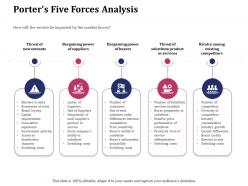
So Porter's Five Forces breaks down like this: competitive rivalry (how cutthroat your industry is), supplier power (can they squeeze you on prices?), buyer power (do customers call all the shots), threat of substitutes (other products that could kill yours), and threat of new entrants (how easy it is for fresh competition to jump in). Honestly, it's just a fancy way to map out everything that could tank your profits. You rate each one as high, medium, or low based on your situation. Focus on the high-impact forces first - that's where you'll get the biggest bang for your strategic buck.
So basically, new entrants are all about how easy it is for competitors to jump into your space. Low barriers mean anyone can start up cheap and mess with your prices - super annoying honestly. High barriers though? That's your friend. Think huge startup costs or crazy regulations that keep people out. Airlines are a good example - you can't just decide to start one tomorrow, right? Keep an eye on what's protecting you in your industry. If barriers are weak, you'll constantly deal with new players trying to steal customers. Strong barriers give you room to actually make decent profits without someone undercutting you every week.
Suppliers can really screw you over if you're not careful. Price hikes are the obvious one - especially when you're stuck with limited options or it'd cost a fortune to switch. Watch out for concentrated industries too (Intel comes to mind). Some suppliers will even threaten to go direct and compete with you, which is honestly such a dick move. The worst part? When you've only got one or two suppliers, they basically own you. I learned this the hard way with a previous project. Map out who you depend on and definitely line up backups before things go sideways.
So basically, powerful buyers can crush your margins by demanding cheaper prices or better deals without paying extra. Walmart's the perfect example - they strong-arm suppliers because they buy huge volumes and suppliers don't have many other options that big. You'll see this happening when there aren't many buyers around, when they can easily switch to competitors, or honestly when your product isn't that special compared to what else is out there. The more power these buyers have, the less you can charge what you want. Profits get squeezed hard. Look at who's calling the shots in those relationships - tells you everything about whether an industry can actually make decent money.
So basically substitutes cap your pricing power and push you to keep improving. Customers will bail if your prices get crazy or quality drops - they've got options. Look at Netflix vs Blockbuster, perfect example right there. The more substitute options exist, the harder you have to work to stand out. You can't just watch direct competitors either, which is honestly kind of exhausting. Someone might solve your customers' problems in a totally different way. New tech especially screws things up fast. Monitor anything that could replace what you do, even if it seems unrelated at first glance.
Honestly, differentiate your product or find a niche where there's less competition breathing down your neck. Customer loyalty is huge - make switching to competitors such a pain that people won't bother. I've watched companies crush it by going low-cost, but man, that's exhausting to keep up. Geographic expansion helps spread your bets too. Whatever you do, don't get sucked into price wars. Nobody wins those bloody things. Pick one approach and stick with it - companies that try being everything usually end up being nothing special.
Airlines and restaurants are perfect examples - customers can switch super easily, so competition gets nasty. Same with grocery stores and telecom companies. When switching costs are basically zero, businesses have to fight tooth and nail for every customer. Mature industries are rough too since there's no real growth happening, just companies stealing each other's market share. Hotels always seem to be in pricing wars because they've got all these fixed costs and empty rooms to fill. Honestly, retail is probably the worst offender here. If you're looking at any of these sectors, focus on how companies actually set themselves apart.
So Porter's Five Forces is basically your early warning system for industry changes. Run through each force to spot what's shifting - like if suppliers are getting too much control, start shopping around for alternatives or maybe bring some stuff in-house. Tons of competition? Find your unique angle or carve out a specific niche. The trick is doing this regularly, not just once and forgetting about it (I learned this the hard way). Check your analysis every few months and let it drive your big calls - pricing, new markets, where to put your money. Think of it as your strategic GPS.
Look at supplier concentration first - fewer suppliers means they've got you by the throat. Then check switching costs for both sides. If it's a nightmare to change suppliers or your customers can't easily bail, that shows who's really in control here. Buyer power's about concentration too, plus how price-sensitive they are. I'd honestly just start simple though - map your top 5 suppliers and customers with these numbers. Switching costs will probably tell you more than the other stuff combined. It's wild how much that one metric reveals about the whole power dynamic.
Disruptive tech hits all five competitive forces at once - it's pretty wild when you think about it. Barriers to entry drop fast, substitutes pop up everywhere, and buyer power shifts completely. Netflix destroying Blockbuster is the classic example, or how Uber basically said "screw traditional taxis." New players can suddenly compete using cheaper, faster tech while established companies panic and try to catch up. The rivalry gets brutal because market share moves so quickly. Oh, and supplier relationships? Those get flipped too. You should definitely keep scanning for emerging tech in your space - could threaten you or create opportunities.
So regulation is basically like a sixth force that messes with Porter's whole framework. It creates entry barriers - pharma patents are a perfect example. Antitrust laws can weaken suppliers too. Price controls hit buyer power. Environmental rules? They'll make entire technologies irrelevant overnight, which is honestly pretty wild when you think about it. Competitive rivalry changes when everyone has to meet the same standards or can't use certain tactics. Here's what I'd do: map out the major regulations first since they're basically controlling how strong the other five forces can actually be.
Yeah totally, Porter's Five Forces works for startups too. You just gotta flip your mindset - instead of analyzing what's already there, you're predicting what might emerge. The competitive landscape is probably messy and unclear right now. Suppliers and buyers are still figuring out their roles. Entry barriers? Usually pretty low, which is why you're thinking about jumping in anyway, right? I'd focus on spotting early trends rather than hunting for hard data that doesn't exist yet. Think of it more like strategic fortune-telling to prep for future headaches.
Location totally changes the game with Porter's Five Forces. Remote areas? Your suppliers basically have you over a barrel since shipping costs more and you've got limited options. But your customers can't really shop around much either, so that balances out. New competitors won't bother with tiny markets - honestly, why would they? You'll see less cutthroat competition too since there aren't many local players. Here's the thing though: don't analyze your whole industry when doing this exercise. Focus on what's actually happening in your specific area instead.
Look, most people think Porter's Five Forces only works for boring old-school industries, but honestly? It's super useful for tech and startups too. You just can't do it once and forget about it - markets change fast, so you gotta revisit it regularly. Here's the thing though - not all five forces matter equally. Some will be way more relevant to your situation than others. Don't expect it to predict the future perfectly either. It's more like... a really good way to wrap your head around who you're actually competing against and what dynamics are at play. Solid starting point, but definitely not the whole story.
Okay so first, be brutally honest about where you actually stand with those five forces - supplier power, buyer power, competitive rivalry, substitutes, and barriers to entry. Check out your suppliers and how much control they have over you. Same thing with customers. The competitor analysis is usually the most brutal part honestly. Then figure out how easily someone could just waltz in and replace your product or steal your market. I'd make a basic scorecard - rate each force as low, medium, or high impact. Once you see everything laid out like that, you'll know exactly which areas are screwing you over the most.
-
I discovered this website through a google search, the services matched my needs perfectly and the pricing was very reasonable. I was thrilled with the product and the customer service. I will definitely use their slides again for my presentations and recommend them to other colleagues.
-
Easily Editable.
-
Great experience, I would definitely use your services further.