


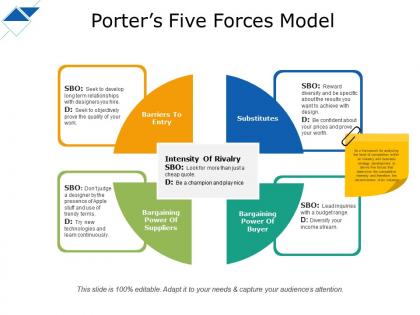
Porters five forces model intensity of rivalry sbo





Try Before you Buy Download Free Sample Product
 Impress Your
 Audience
 100%
100% Editable
 Save Hours
 of Time


Our Porters Five Forces Model Intensity Of Rivalry Sbo give it their full force. They avoid half hearted attempts.
People who downloaded this PowerPoint presentation also viewed the following :
Porters five forces model intensity of rivalry sbo with all 5 slides:
Inform folks about falsehoods being generated with our Porters Five Forces Model Intensity Of Rivalry Sbo. Enable them to guard against being instigated.

FAQs for Porters five forces model intensity
So Porter's Five Forces breaks down like this: competitive rivalry (how cutthroat your market is), supplier power, buyer power, threat of substitutes, and threat of new entrants. The supplier/buyer ones are about how much control they have over your pricing - honestly, suppliers can be brutal when they know you need them. Substitutes are products that could replace yours entirely. New entrants? That's how easy it is for fresh competitors to waltz into your space. I'd focus on whichever force hits your business hardest first.
So basically, new entrants is about how easy it is for someone to waltz into your industry and start competing. Low barriers? Anyone can jump in - like how every strip mall now has three froyo places fighting each other. High barriers mean you're safer. Think expensive equipment, patents, or customers who won't switch brands easily. That stuff keeps newcomers away and protects your profits. I always tell people to ask themselves: what's really stopping some random startup from copying what you do next month? Because if the answer is "not much," you've got a problem.
Yeah so basically when buyers have tons of power, they can pressure you into cutting prices or giving them better deals. Walmart's the classic example - they just steamroll suppliers. You lose pricing flexibility because customers can easily jump ship or they're buying massive volumes. Honestly, it's rough out there. Your best bet? Focus on making your product stand out somehow, or create reasons why switching away from you would suck for them. Oh, and niche markets can be goldmines since you've got more room to maneuver there. Really depends on figuring out how much muscle your specific customers actually have.
Basically, suppliers get all the power when they're your only option for something you really need. Few alternatives? They'll jack up prices or mess with payment terms - maybe even threaten to cut you off completely. It's like they've got your business by the throat, honestly. Gets even messier when switching suppliers costs a fortune or when they might decide to compete against you directly. Look at Intel back in the day - PC makers were totally at their mercy because chips were so specialized and technical. My advice? Don't put all your eggs in one basket. Build good relationships with multiple suppliers way before you're in a bind.
So basically, substitutes tell you how screwed you are on pricing and whether customers will bail when something better shows up. Easy substitutes = you're stuck in price wars forever. Look at Netflix destroying cable - streaming wasn't even the same product but solved the same problem way better. That's the tricky part - substitutes don't have to be direct competitors, just different ways to fix what your customers need. I always think about Uber vs. taxis vs. just walking somewhere, you know? Bottom line: ask yourself what else people could use instead and how fast they'd jump ship.
So Porter's Five Forces is like getting a reality check on your business situation. You'll see right away if suppliers are squeezing your costs too hard or if customers can bail on you easily. New competitors trying to muscle in? You'll spot that too. Honestly, the substitute threat thing is huge right now - everything's getting disrupted by some app or platform. Map out all five and you get this clear picture of where you're actually strong versus where you're toast. Then you can focus on fixing the weak spots first instead of just hoping for the best.
Pharma, aerospace, telecom, and utilities have the craziest barriers to entry. The capital requirements alone are insane - like hundreds of millions just to get one drug through FDA trials, and most fail anyway. Aerospace isn't much better with all the regulations. These barriers basically create moats around existing companies, so they can charge higher prices without worrying about new competitors swooping in. Honestly, it's why these industries have such stable players, but they can get pretty lazy too since nobody's really threatening them. The whole system kind of protects the big guys.
So basically, when people's tastes change, buyers get way more power. They become super picky and won't hesitate to switch brands or suppliers. Look at streaming - people dumped cable the second they found something better, no loyalty whatsoever. Shifting preferences mean customers aren't tied down to one company anymore, so they can demand better deals. Companies have to actually compete for them now. When you're looking at any industry, check how fast consumer preferences are moving. That's usually a dead giveaway for strong buyer power. Makes total sense when you think about it.
So competitors get really nasty when the industry isn't growing much, fixed costs are crazy high, or everyone's selling basically the same thing. Airlines are perfect example - they're always slashing prices because honestly, what else can they do? When companies can't easily bail out of the market, they fight even harder for whatever's left. Similar-sized competitors make it worse too. Oh, and excess capacity is brutal - too many players chasing the same customers. I'd say just look at whether your industry has these red flags, then you'll know if you need to get scrappy or if you can play nice.
Tech flips Porter's five forces on their head constantly. Barriers to entry? Gone - just look at how Shopify let anyone start selling online. Suppliers get way more power when they control the tech everyone needs. Netflix straight-up murdered Blockbuster by making DVDs obsolete, which shows how substitutes can appear out of nowhere. Buyers have all the info now, so they're pickier. Competition gets brutal because everyone can see your prices instantly. Here's what's wild though - this stuff changes so fast that your analysis from six months ago might be useless. I'd check this quarterly, honestly.
Think about how Netflix killed Blockbuster - that's the perfect example. Streaming just made DVD rentals feel outdated overnight. Uber did the same thing to taxis, and honestly, most cab companies saw it coming but couldn't adapt fast enough. Smartphones are probably the craziest case though. They wiped out cameras, iPods, and GPS units all in one shot. Same thing happened when email made fax machines look ancient. The really scary substitutes aren't just cheaper - they're way more convenient. Free online news destroyed newspapers the same way. You've gotta watch for anything that solves your customers' problems through a totally different method.
Regulations are honestly such a wild card - they mess with every part of Porter's Five Forces differently. Like in pharma, all those FDA hoops make it crazy hard for new companies to break in. But then consumers get more protection and can push back harder on pricing. Sometimes regulations cap what suppliers can charge, other times the compliance costs just help bigger suppliers crush the little guys. The weirdest part? Everyone in the industry ends up fighting harder because you're all stuck playing by the same annoying rules. Just map out your industry's key regulations first - they'll probably shift everything else way more than you'd expect.
Honestly, Porter's Five Forces is perfect for figuring out if you're walking into a bloodbath. Check if competitors will steamroll you right away. See how much power suppliers have over your costs - that can kill margins fast. Also look at customer loyalty. Can they easily jump ship? Substitutes are brutal for startups too. I've seen companies get wiped out by one platform update. Don't forget other new players might have deeper pockets than you. Find a spot where at least 2-3 of these forces aren't working against you. Makes the whole thing way less painful.
So Porter's Five Forces is actually pretty useful for this. Map out all five forces in your industry first - then figure out which ones are screwing with your margins the most. High supplier power? Maybe look into vertical integration or hunt for backup sources. Brutal competition (ugh, been there)? Focus on standing out instead of getting stuck in price wars. The trick is identifying your biggest threats, then building strategies around those specific weak spots. Honestly, just do a quick assessment using the framework and you'll start seeing where to focus your energy.
Porter's Five Forces gets weird in tech - disruption moves too fast and those neat competitive boxes just don't exist anymore. Social media companies? Total different game with network effects creating these massive winner-take-all situations. The framework assumes competition stays pretty static, which... yeah right. Works fine for boring mature industries though! It misses how companies actually cooperate now and completely whiffs on digital platforms. Honestly, I'd start there but definitely pile on other tools if you're dealing with anything remotely digital or fast-moving.
-
Really like the color and design of the presentation.
-
Out of the box and creative design.