


Price optimization powerpoint presentation slides




Try Before you Buy Download Free Sample Product
 Impress Your
 Audience
 100%
100% Editable
 Save Hours
 of Time


Select our Price Optimization PowerPoint Presentation Slides to make pricing decisions for your business. Product cost management PowerPoint complete deck contains slides such as key levers to cost management, levers to achieve successful cost optimization, strategic cost optimization framework, prioritizing, three steps approach, initiatives and benefits, cost optimization techniques, planning, stages in cost reduction, cost-cutting and management, cost design and positioning, comparison of stages, etc. The goal of price optimization is to adjust consumer prices without putting profits at a risk. These templates are completely editable. The presenter can change font, text, and color. Pricing and revenue optimization PPT presentation also contains additional slides like mission, puzzle, timeline, target, idea pie chart, bar graph, area chart can help you elaborate cost optimization plans. Download this cost optimization presentation graphics to present pricing research and optimization. Create infrastructure for a health existence with our Price Optimization Powerpoint Presentation Slides. Be able to address inhuman conditions.
People who downloaded this PowerPoint presentation also viewed the following :
Content of this Powerpoint Presentation
Slide 1: This slide introduces Price Optimization. State Your Company Name and get started.
Slide 2: This slide presents Agenda. Add the agenda's of your company and use it.
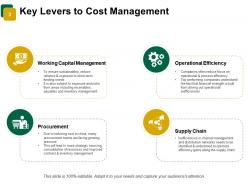
Slide 3: This slide showcases Key Levers to Cost Management with these of the four factors- Working Capital Management, Operational Efficiency, Procurement, Supply Chain.
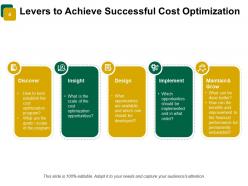
Slide 4: This slide shows Levers to Achieve Successful Cost Optimization with these four factors- Discover, Maintain & Grow, Insight, Design.
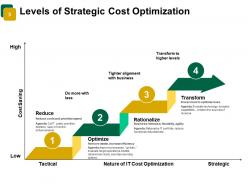
Slide 5: This slide showcases Levels of Strategic Cost Optimization.
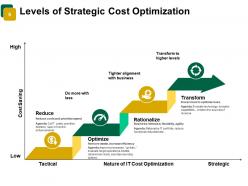
Slide 6: This slide showcases Levels of Strategic Cost Optimization.
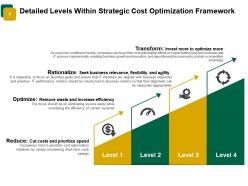
Slide 7: This slide presents Detailed Levels Within Strategic Cost levels- Optimization Framework, Reduce: Cut costs and prioritize spend, Optimize: Remove waste and increase efficiency, Rationalize: Seek business relevance, flexibility and agility, Transform: Invest more to optimize more.
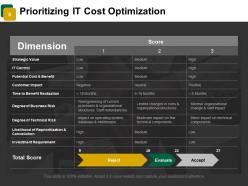
Slide 8: This slide shows Prioritizing IT Cost Optimization with these three of the main categories- Reject, Evaluate, Accept.
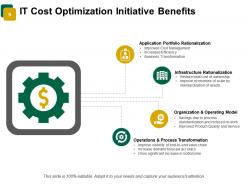
Slide 9: This slide IT Cost Optimization Initiative Benefits with these four benefits- Application Portfolio Rationalization, Infrastructure Rationalization, Organization & Operating Model, Operations & Process Transformation.
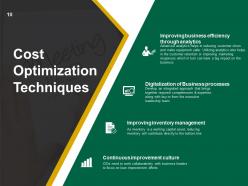
Slide 10: This slide showcases Cost Optimization Techniques with four of the main categories- Improving business efficiency through analytics, Digitalization of Business processes, Improving inventory management, Continuous improvement culture.
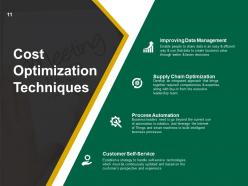
Slide 11: This slide presents Improving Data Management
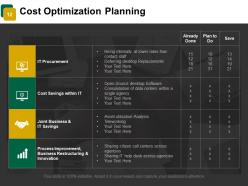
Slide 12: This slide shows Cost Optimization Planning. You can add the different planning as we have listed.
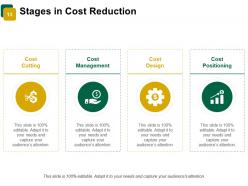
Slide 13: This slide presents Stages in Cost Reduction with four of the mainly category- Cost Management, Cost Design, Cost Positioning, Cost Cutting.
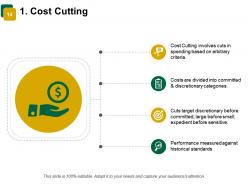
Slide 14: This slide showcases Cost Cutting with these four of the parameters- Cost Cutting involves cuts in spending based on arbitrary criteria, Costs are divided into committed & discretionary categories, Cuts target discretionary before committed; large before small; expedient before sensitive, Performance measured against historical standards.
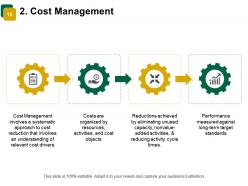
Slide 15: This slide shows Cost Management.
Slide 16: This slide presents Cost Design. Add you data for the designing cost and evaluate as per your need.
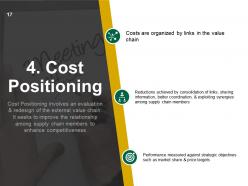
Slide 17: This slide displays Cost Positioning with these of the the three fields we have put it, you can use it for your own use.
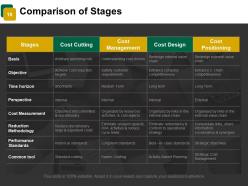
Slide 18: This slide showcases Comparison of Stages. Add the stages as you want and use it for your own requirement.
Slide 19: This slide presents Price Optimization Icons Slide.
Slide 20: This is a Coffee Break slide to halt. You may change it as per requirement.
Slide 21: This slide is titled Additional Slides to move forward.
Slide 22: This is an About Us slide showing Our Company, Value Client, and Premium services as examples.
Slide 23: This slide showcases Our Team with Name and Designation to fill.
Slide 24: This slide displays Our Target with a background image.
Slide 25: This is a Puzzle slide with the following subheadings- PPC Advertising, Media Marketing, Print Marketing, E-mail Campaigns.
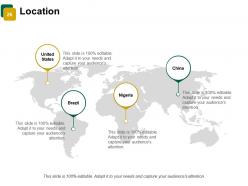
Slide 26: This is a Location slide to show global growth, presence etc. on world map.
Slide 27: This is a Timelines slide to show- Plan, Budget, Schedule, Review.
Slide 28: This is a Bulb Or Idea image slide to show information, innovative aspects etc.
Slide 29: This is a Magnifying glass image slide to show information, scoping aspects etc.
Slide 30: This slide displays the title Charts & Graphs.
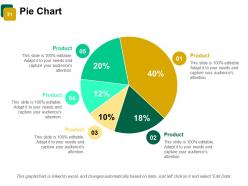
Slide 31: This slide presents Pie Chart.
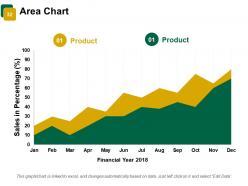
Slide 32: This slide showcases Area Chart. You can add or edit as per you want.
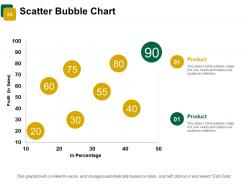
Slide 33: This slide presents Scatter Bubble Chart.
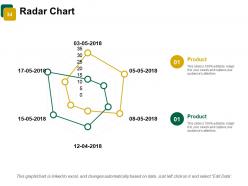
Slide 34: This is a Radar Chart slide for product/entity comparison.
Slide 35: This is a Thank You slide with Address# street number, city, state, Contact Numbers, Email Address.
Price optimization powerpoint presentation slides with all 35 slides:
Get to the business end with our Price Optimization Powerpoint Presentation Slides. Implement decisions with alacrity.




FAQs for Price optimization
Honestly, just focus on three big things first - what your competitors are charging, how much your customers freak out over price changes, and your actual costs. Seasonal stuff matters tons if you're in retail or whatever. I'd start by stalking your top 3 competitors' pricing for a few weeks, then test small bumps on products that aren't your bread and butter. Brand positioning is key too - like, are you the premium option or the budget choice? Also think about customer lifetime value instead of just individual sales. Supply chain chaos has made everything weird lately, but that's probably obvious to you already.
Honestly, start by grabbing all your current pricing data plus what competitors are charging. Customer behavior stuff too. Then use analytics to figure out price elasticity - how much your customers freak out when prices change. A/B testing is where the magic happens though. Test different price points and see what actually makes money, not what sounds good on paper. Historical sales data will show you patterns you missed. I'd say pick one product line first - don't go crazy trying to optimize everything at once. Oh, and predictive models help forecast demand changes, but measure everything as you go.
Dude, customer psychology is everything when it comes to pricing. People don't think logically about money - they're weird about it. Like, $9.99 feels way cheaper than $10 even though it's literally one cent. Anchoring is wild too - show them a high price first and suddenly your regular price looks like a steal. I actually helped a buddy restructure his pricing tiers last year and he saw a solid bump in sales just from changing the presentation. Worth testing different approaches with real customers since everyone's different. Your brain plays tricks on you with money stuff, might as well use that to your advantage.
Honestly, dynamic pricing changes everything about how people shop, but it totally depends on what you're buying. Like with Uber or flights, everyone's used to it now - you'll see people refreshing the app during surge pricing waiting for it to drop. Online shopping gets tricky though because people start comparing prices way more and just abandon their carts when they think something's fishy. But groceries? Whole different story. People get genuinely pissed when food prices jump around because they expect that stuff to stay consistent. The real trick is being upfront about why prices change - otherwise it just feels like you're getting screwed over.
So there's a few main ways to price stuff. Cost-plus is just adding your markup on top of what it costs you. Value-based means you price it based on what customers think it's worth - which honestly makes way more sense but is harder to figure out. Then there's competitive pricing where you just match what everyone else is doing. Dynamic pricing adjusts based on demand in real-time (think Uber surge pricing). Oh and penetration pricing for new products, but that's tricky because raising prices later is awkward. Most companies mix these approaches instead of picking just one. I'd start by seeing what competitors charge, then add some value-based thinking on top.
Pricing's really just figuring out what your customers think they're getting, you know? Don't just add markup to your costs - that's lazy honestly. Start with understanding what they actually value. Quality? Convenience? The whole status thing? Then test different price points and see what happens. If people are buying but bitching about quality, you're probably too cheap. Love your stuff but won't buy? Price is scaring them off. Survey them about what they'd pay for specific features - that's where you get real data. Oh and watch their behavior more than what they say they'll do.
So for price optimization tools, you've got a bunch of options depending on your budget. PROS, Zilliant, and Vendavo are solid for complex B2B stuff, but they're pricey. Pricefx is more accessible, or honestly you could start with Excel if you're bootstrapping it. DataRobot's machine learning is powerful but yeah, expect a learning curve there. For e-commerce, Prisync and RepricerExpress are decent for watching competitors. I'd probably start small with whatever matches your current setup and budget. Once you show some ROI, then you can justify the fancier tools.
Look at revenue per customer and profit margins first - those show if it's actually working. Conversion rates matter too because higher prices mean nothing if people just bounce. I'd also track customer retention since that's where you really see if your pricing makes sense long-term. Competitive positioning is huge (honestly more than most people realize). Set your baseline numbers before changing anything, then check monthly or quarterly depending on your business. Oh, and watch how price elasticity shifts over time - that can surprise you.
Watch out for price discrimination that screws over vulnerable people - like charging elderly folks more just because they're less tech-savvy. Dynamic pricing can backfire too if customers feel tricked by it. Don't use people's data without permission, obviously. Hurricane pricing is the classic example of what NOT to do. Predatory stuff targeting desperate people is gross and will bite you later. Be upfront about how your pricing actually works. Honestly, just think about whether you'd be pissed if someone used your strategy on your mom.
Look, you can't just guess at pricing without knowing what everyone else is doing. Track 3-5 competitors weekly - their prices, when they run sales, what they're promising customers. This shows you where to undercut or when you can charge more (if your stuff's actually better). Honestly, it's like having insider info on the whole market. You'll catch pricing gaps, figure out seasonal patterns, and stop either losing money or scaring customers away with crazy high prices. I'd match their moves against your conversion rates too - sometimes lower prices don't even help.
Retail and airlines are killing it with price optimization - they've got massive datasets and demand changes constantly. E-commerce is obvious too. SaaS companies are all over this lately because testing subscription tiers is so easy. Hospitality sees huge gains as well. Honestly, any business with flexible pricing can win, but those industries? They're hitting double-digit revenue bumps regularly. My advice - start with your most price-sensitive stuff first. That's where you'll see results fastest. Oh, and make sure you actually have decent customer data before diving in, otherwise you're just guessing.
So timing is everything with pricing, right? Your customers will totally pay more for winter coats in November, but come March they're already thinking sundresses and you're stuck discounting. Market trends do the same thing just over longer periods. When there's crazy demand for your stuff, you can basically charge whatever you want. Demand drops? You'll probably need to cut prices to keep selling. I always tell people to look at their sales patterns from last year - it's honestly the best predictor. Then just build your pricing calendar around those cycles.
Think of promos as your lab for testing what customers will actually pay. Drop prices 15% and see how much demand spikes - that tells you tons about price sensitivity. They're perfect for moving old inventory and figuring out who your bargain hunters are. But here's the thing - if you discount constantly, people just wait for sales and your regular prices become fake. I learned this the hard way with a client who basically trained customers to never buy full price. Each promotion should teach you something new about what your market can handle, then use that info for your real pricing strategy.
Just try basic A/B testing first - split your email list or website traffic between two different prices and see what converts better. Google Analytics is free and will show you which one actually makes more money. Most people skip this step entirely, which is honestly pretty dumb since it's so easy. Check what competitors are charging every week or two. Also, just ask your current customers straight up what they'd pay for new stuff - send a quick survey or even just reply to this email with your thoughts. Yeah, it's that simple. Track everything though, even the small tests. You'd be surprised how much you can learn from tweaking one price point.
Honestly, pricing is such a headache but it totally shapes how people see your brand. Go too high? You'll lose customers to competitors. Too low and people think your stuff is cheap quality - which is weird but true. I'd survey your current customers first about what they'd actually pay before changing anything major. Consistent pricing builds trust, but if you're constantly switching prices around, people get annoyed. The goal is finding that sweet spot where it feels fair for the value you're giving. Way easier said than done though.
-
Easy to edit slides with easy to understand instructions.
-
Helpful product design for delivering presentation.