


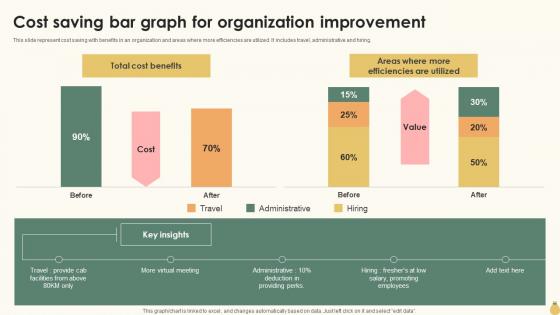
Cost Saving Bar Graph For Organization Improvement




Try Before you Buy Download Free Sample Product
 Impress Your
 Audience
 100%
100% Editable
 Save Hours
 of Time


This slide represent cost saving with benefits in an organization and areas where more efficiencies are utilized. It includes travel, administrative and hiring.
People who downloaded this PowerPoint presentation also viewed the following :
Cost Saving Bar Graph For Organization Improvement with all 7 slides:
Use our Cost Saving Bar Graph For Organization Improvement to effectively help you save your valuable time. They are readymade to fit into any presentation structure.





FAQs for Cost Saving Bar Graph
Honestly, start with your biggest expenses first - anything over $500/month. Call up your insurance company, utilities, suppliers, whoever. Half the time they'll give you a better deal just to avoid losing you. Remote work is a game-changer too if you can swing it, office rent is insane these days. Those little subscriptions are sneaky though, like $30 here and $50 there for software you barely use. I'd audit last quarter's spending and pick your top 3-5 categories to tackle. Don't try fixing everything at once or you'll burn out. Focus on the repetitive stuff you can automate first.
Honestly, start with whatever's eating up the most hours - usually payroll or inventory stuff. Automate that first. Moving to cloud services saves a ton since you're not dealing with server costs anymore. Remote work tools cut your office overhead way down too. Data analytics is where it gets interesting though - you'll find waste you had no clue about. AI handles the boring stuff like scheduling and basic customer questions without you touching it. Oh, and chatbots for customer support actually work pretty well now. Pick one thing that's driving you crazy with manual work - that's where you'll see money back fastest.
Look, training employees upfront saves you serious cash later. You'll avoid expensive mistakes and safety incidents that can wreck your budget. Plus people actually stick around when they feel prepared - and constantly hiring new people gets old fast, not to mention pricey. Honestly, the supervision thing alone makes it worth it. Trained workers need way less hand-holding. Yeah, it costs money initially, but you'll save like 3x that by not dealing with errors and turnover. Figure out what's bleeding you money most and see if training could fix it.
Go through your last 6 months of spending and sort everything into categories - you'll spot patterns pretty quick. I bet you're paying for subscriptions you totally forgot about (guilty as charged on that one). Hit the recurring stuff first since that's where money really bleeds out. Check if you're overpaying vendors too. Monthly budget check-ins with department heads work way better than trying to fix everything once a year. Trust me, making it regular prevents those "how did we spend THAT much?" moments.
Do your research first - check what competitors are charging so you're not going in blind. Don't just look at unit prices either. Those delivery fees and weird payment terms can kill you (learned that one the hard way with our office supplier). Volume discounts are your friend, especially if you can commit to longer contracts. Set up performance metrics with actual penalties - missed deadlines hurt. Honestly, walking away is sometimes your best move. There's always another vendor out there who wants your business more.
Energy audits are honestly a great starting point - you can spot the easy wins right away. LEDs and better equipment will drop your power bills fast. Going paperless cuts those disposal fees too, which adds up more than you'd think. Yeah, the initial investment sucks (your CFO will probably grumble), but most places see payback in 6-18 months. Water conservation helps with utilities as well. Don't forget about tax rebates - they actually offset a decent chunk of startup costs. Track your monthly bills so you can see the real impact happening.
Dude, cloud stuff can actually save you a ton of money. Hardware costs disappear since you're not buying servers anymore. IT staffing gets way cheaper too - no more paying people to babysit systems 24/7. You only pay for what you use instead of buying extra "just in case." The scalability thing is clutch during busy seasons. Honestly, less downtime probably covers the cost right there. Oh, and calculate what you spend on hardware upgrades every few years - I bet cloud pricing will shock you in a good way. Most businesses don't realize how much they're overspending on the old setup.
Look, inventory management is basically about not screwing yourself over with too much or too little stock. Overstocking eats your warehouse budget and ties up cash in products just sitting there. Understocking means you're losing sales and paying crazy fees for rush orders. Track everything properly so you catch theft, expired stuff, and damaged goods before they wreck your numbers. Honestly, most businesses just guess at what they need - huge mistake. Use your actual sales data to predict demand instead. Start by checking your turnover rates first. That'll show you exactly where your money's getting stuck and you can fix it from there.
Here's the thing - outsourcing hits your fixed costs way harder than variable ones. You're cutting salaries, benefits, office space, all that expensive overhead stuff. Variable costs? They might even go up a bit since you're paying per service now. But here's what's cool - you're basically turning those brutal monthly fixed expenses into flexible variable ones. Makes your cash flow so much better when you're not stuck with huge commitments every month. Oh, and don't just look at hourly rates - calculate the total cost difference or you'll miss the real picture.
Look at your spending patterns first - that's where the gold is. Most companies are literally throwing money away on duplicate services or paying wildly different rates for identical stuff. It's honestly ridiculous how common this is. Dig into your procurement data and operational processes to find the bottlenecks eating up resources. Focus on your biggest expense categories since those changes will actually move the needle. Oh, and don't forget to check if you're overpaying vendors - happens more than you'd think. The inefficiencies are there, you just gotta know where to look.
Dude, remote work is usually a win-win money-wise. Companies slash their office costs by like 30-50% (rent, utilities, all that stuff), and you'll save big on gas and commuting. No more buying overpriced work clothes or grabbing $6 lattes every day - though yeah, your electric bill will probably go up a bit. I'd say transportation is where you'll see the biggest difference, easily thousands per year. The productivity boost from not getting interrupted constantly is honestly just a bonus. Track what you're actually spending for a few months so you can see how the home office setup costs stack up against your savings.
So basically, going energy-efficient hits your wallet in two spots - cuts those monthly bills and your gear lasts way longer. The utility savings are immediate and can be huge if your setup's ancient. Tax breaks and rebates are nice too, though honestly the paperwork's annoying. Long-term though? You're protecting yourself from energy prices going crazy. Do an energy audit first - sounds fancy but it just shows where you're bleeding money. Focus on your biggest energy hogs. That's where you'll actually see results worth the effort.
Dude, competitive pricing actually makes you way more creative with cost-cutting. You can't just cheap out on quality anymore - customers will bail instantly. Instead you gotta get smart about it. Like streamlining your processes, hammering out better deals with suppliers, or just eliminating straight-up waste. Honestly? It's kind of brilliant because it forces you into cuts that actually make sense long-term. The trick is putting your quality budget toward stuff that really sets you apart, then finding ways to be more efficient literally everywhere else.
So basically track what you saved vs what you spent getting there. The formula is (total savings - costs) / costs x 100. Like if you saved $50k but spent $10k, that's 400% ROI which is awesome. Hard savings are easy - actual budget cuts and stuff. Soft savings though? Way trickier since you're measuring things like avoided costs or productivity gains that are kinda theoretical. I'd set up your tracking system before you even start so you have decent baseline data. Oh and give it time - some benefits don't show up for months.
Honestly, companies usually screw up by cutting stuff that actually makes them money - like customer service or their best people. Yeah you'll save cash now, but then customers bail and you're scrambling to hire back talent at way higher salaries. I've watched businesses gut their marketing budget and then act shocked when sales tank. Speed kills here too - slash too fast and your good employees will jump ship, taking all their knowledge with them. My advice? Figure out what directly affects your customers first, protect that stuff, then trim the actual waste.
-
“I required a slide for a board meeting and was so satisfied with the final result !! So much went into designing the slide and the communication was amazing! Can’t wait to have my next slide!”
-
Perfect template with attractive color combination.