

Process alignment steps powerpoint presentation





Try Before you Buy Download Free Sample Product
 Impress Your
 Audience
 100%
100% Editable
 Save Hours
 of Time


We are presenting our process alignment steps PowerPoint presentation template. The PPT slide would be useful to outline steps to achieve strategic alignment for your business. If you want to showcase project management process, this professionally drafted steps to success PowerPoint template could give you an edge. Our efficient presentation template can help you align objectives, strategies, processes and people in the most effective way. The key highlights in PPT template are intended to present subjects like analysis, training and orientation, transformation, audits and deployment etc. You can also use this template to define the steps to business and IT alignment in an attractive manner. PPT template is useful for product and process managers, sales and business professionals to align work-related roles to their internal team members. The design layout is attractive and perfect for process alignment. So, without any further ado, download this powerful PPT template and use it to align objectives, strategies, processes and people to achieve your business goals. No presentation is trivial. Make your important presentations say more with high quality Process Alignment Steps Powerpoint Presentation design.
People who downloaded this PowerPoint presentation also viewed the following :
Content of this Powerpoint Presentation
Description:
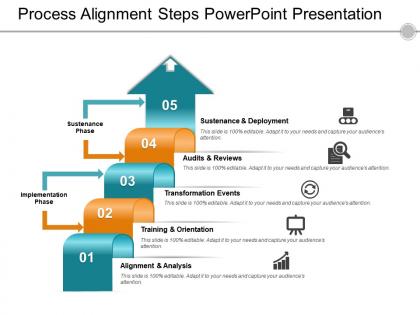
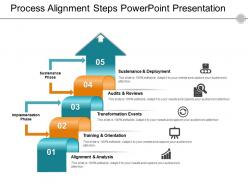
The image presents a PowerPoint slide titled Process Alignment Steps PowerPoint Presentation which outlines a five-step process designed for business or organizational alignment. Each step is numbered and captured within a block that connects to the next, illustrating a progression.
1. Alignment & Analysis:
This is step one, represented with the number 01, where the initial alignment and analysis of the current situation take place. Notably, an icon of two gears is associated with this step, symbolizing the process of fine-tuning or aligning mechanisms in a system.
2. Training & Orientation:
Displayed as step two, this phase involves educating and orienting personnel or stakeholders about the new process or changes.
3. Transformation Events:
The third step indicates the actual events or actions that transform the process or organization.
4. Audits & Reviews:
As step four, this emphasizes the importance of evaluating and reviewing the changes that have been implemented, which is depicted with a magnifying glass icon, signifying scrutiny or detailed examination.
5. Sustenance & Deployment:
The final and fifth step, featuring a printer icon, focuses on maintaining and deploying the new processes in a sustainable manner.
Use Cases:
These slides can be applied across multiple industries:
1. Consulting:
Use: To guide clients through a structured change management process.
Presenter: Management consultant.
Audience: Client organization's leadership team.
2. Information Technology:
Use: For illustrating the workflow of system upgrades or software implementation.
Presenter: IT project manager.
Audience: Project stakeholders or team members.
3. Manufacturing:
Use: Outlining the procedures for aligning production processes with new industry standards.
Presenter: Operations manager.
Audience: Manufacturing staff and quality assurance teams.
4. Healthcare:
Use: Demonstrating the steps for aligning clinical practices to new healthcare regulations.
Presenter: Healthcare administrator.
Audience: Medical staff and hospital management.
5. Education:
Use: To present a framework for aligning curriculums with educational standards and analysis.
Presenter: Academic director.
Audience: Faculty and education stakeholders.
6. Retail:
Use: Showcasing the process for aligning retail operations with market trends and customer expectations.
Presenter: Retail operations manager.
Audience: Store managers and retail teams.
7. Financial Services:
Use: Explaining the process of aligning financial products and services with regulatory changes.
Presenter: Compliance officer.
Audience: Financial advisors and bank staff.
Process alignment steps powerpoint presentation with all 5 slides:
Elaborate on cutting cost with our Process Alignment Steps Powerpoint Presentation. Explain how to establish a grip on expenses.
FAQs for Process alignment
Key indicators include declining performance metrics, increased customer complaints, duplicated efforts across departments, inconsistent quality standards, and rising operational costs. These warning signs typically manifest in organizations experiencing rapid growth or structural changes, with many companies finding that addressing misalignment early prevents more significant efficiency losses and enhances competitive positioning.
Stakeholder feedback can be incorporated through structured consultation phases, regular review sessions, feedback integration workshops, and iterative refinement cycles throughout alignment initiatives. Organizations like healthcare systems and financial institutions enhance process effectiveness by establishing formal feedback loops, conducting cross-departmental reviews, and implementing suggestion tracking systems, ultimately delivering improved stakeholder buy-in and more robust operational outcomes.
**INPUT**: What methods are most effective for mapping existing processes before alignment? **OUTPUT**: Effective process mapping methods include workflow analysis, stakeholder interviews, system documentation reviews, value stream mapping, and direct process observation. These approaches streamline alignment by identifying bottlenecks, redundancies, and integration points, with many organizations finding that combining multiple mapping techniques delivers comprehensive visibility and faster implementation of strategic process improvements. [Word count: 54 words]
Technology streamlines process alignment by automating workflow mapping, enabling real-time collaboration, and providing data-driven insights for optimization. Through cloud-based platforms and integration tools, organizations enhance cross-departmental visibility, reduce manual coordination efforts, and accelerate alignment initiatives, with many companies finding that digital solutions ultimately deliver faster implementation and sustained operational efficiency.
Organizations can measure process alignment success through key performance indicators like cycle time reduction, error rates, customer satisfaction scores, employee productivity metrics, and cost efficiency improvements. These measurements enable companies to track operational performance, identify bottlenecks across departments, and demonstrate tangible ROI, with many finding that regular alignment assessments ultimately deliver enhanced competitive advantage and streamlined organizational effectiveness.
Common challenges during process alignment include resistance to change, inadequate communication across departments, conflicting priorities between teams, lack of clear accountability structures, and insufficient technology integration. Organizations overcome these obstacles by establishing cross-functional governance committees, implementing transparent communication protocols, providing comprehensive change management training, and utilizing collaborative technologies that enable real-time visibility, with many finding that early stakeholder engagement and phased implementation approaches ultimately deliver smoother transitions and sustained operational improvements.
Communication is critical in process alignment steps, serving as the foundation for successful coordination, stakeholder buy-in, and change management throughout the implementation. Effective communication ensures teams understand their roles, objectives, and interdependencies, while facilitating feedback loops and issue resolution, with many organizations finding that transparent communication ultimately delivers smoother transitions and sustained operational efficiency.
**INPUT**: What factors should be considered when prioritizing processes for alignment? **OUTPUT**: Critical factors include business impact, resource requirements, implementation complexity, stakeholder involvement, and regulatory compliance needs. Organizations typically prioritize customer-facing processes first, followed by revenue-generating operations, with many finding that strategic alignment delivers enhanced efficiency, reduced operational costs, and improved competitive positioning across departments.
Leadership supports process alignment through clear communication of strategic vision, active participation in change initiatives, and resource allocation for training and implementation. By modeling aligned behaviors, establishing accountability frameworks, and regularly recognizing teams that embrace new processes, executives create organizational momentum, with many companies finding that visible leadership commitment accelerates adoption and delivers sustainable operational improvements.
Popular frameworks for process alignment include Lean Six Sigma, Business Process Management (BPM), Value Stream Mapping, TOGAF enterprise architecture, and Balanced Scorecard methodology. These frameworks streamline alignment efforts by standardizing documentation, eliminating redundancies, and establishing clear governance structures, with many organizations finding that combining multiple approaches delivers enhanced operational efficiency and sustainable competitive advantage.
Employee training enhances process alignment outcomes by building competency in new workflows, reducing resistance through understanding, improving adoption rates, and ensuring consistent execution across teams. Through targeted skills development and change management education, organizations streamline implementation timelines, minimize operational disruptions, and achieve higher compliance rates, with many companies finding that well-trained employees become process champions who drive sustained improvements.
Cultural differences within organizations can significantly impact process alignment by creating varying communication styles, decision-making approaches, work pace expectations, and collaboration preferences across teams. These cultural variations present both challenges and opportunities, with many organizations finding that strategic cultural integration through inclusive process design, cross-cultural training, and adaptive frameworks ultimately delivers enhanced innovation and competitive advantage.
Successful process alignment delivers enhanced operational efficiency, improved cross-departmental collaboration, reduced redundancies, faster decision-making, and increased customer satisfaction. These strategic improvements streamline resource allocation and minimize workflow bottlenecks, with many organizations finding that aligned processes ultimately reduce operational costs by 15-30% while significantly accelerating service delivery and competitive responsiveness.
Continuous improvement integrates into process alignment through regular performance monitoring, feedback loops, data-driven analysis, stakeholder input collection, and systematic review cycles. Organizations embed improvement mechanisms by establishing key performance indicators, conducting quarterly alignment assessments, and implementing agile adjustment protocols, ultimately enabling processes to evolve with changing business needs and market conditions.
**INPUT**: What specific tools can be leveraged for process documentation during alignment? **OUTPUT**: Process documentation tools include workflow mapping software, collaborative platforms like Microsoft Visio, process mining applications, digital documentation systems, and automated reporting tools. These technologies streamline alignment efforts by enabling real-time collaboration, standardizing documentation formats, and providing visual process representations, with many organizations finding that integrated documentation platforms significantly enhance transparency and accelerate implementation timelines. [Word count: 60 words]
-
Much better than the original! Thanks for the quick turnaround.
-
Use of icon with content is very relateable, informative and appealing.
-
Understandable and informative presentation.
-
Unique design & color.