


Process Diagram For Project Human Resource Management




Try Before you Buy Download Free Sample Product
 Impress Your
 Audience
 100%
100% Editable
 Save Hours
 of Time


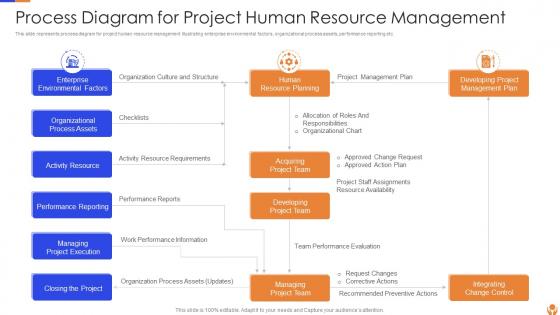
This slide represents process diagram for project human resource management illustrating enterprise environmental factors, organizational process assets, performance reporting etc.
People who downloaded this PowerPoint presentation also viewed the following :
Process Diagram For Project Human Resource Management with all 6 slides:
Use our Process Diagram For Project Human Resource Management to effectively help you save your valuable time. They are readymade to fit into any presentation structure.





FAQs for Process Diagram For Project
Project Human Resource Management includes resource planning, team acquisition, team development, and performance management throughout the project lifecycle. These processes enhance project success by identifying required skills, recruiting qualified personnel, and fostering collaborative team dynamics, with many organizations finding that strategic human resource management ultimately delivers improved project outcomes and competitive advantage.
Project managers effectively identify stakeholders through stakeholder mapping, analyzing project documentation, conducting interviews with key personnel, reviewing organizational charts, and assessing impact-influence matrices. These approaches streamline engagement by establishing clear communication channels, tailoring messaging to specific interests, and implementing regular feedback loops, with many organizations finding that proactive stakeholder involvement significantly reduces project risks while accelerating decision-making processes.
Communication skills serve as the foundation for successful project human resource management, enabling clear expectations, conflict resolution, stakeholder alignment, and team coordination across all project phases. Through effective communication, project managers build trust, facilitate collaboration, and ensure team members understand their roles, ultimately delivering improved project outcomes, reduced misunderstandings, and enhanced team performance.
Project teams can effectively resolve conflicts through open communication, active listening, collaborative problem-solving, and establishing clear roles and expectations from project initiation. These approaches streamline team dynamics by addressing issues early, fostering mutual understanding, and creating structured frameworks for decision-making, with many organizations finding that proactive conflict resolution ultimately delivers improved project outcomes and stronger team cohesion.
Optimizing team performance requires clear role definition, regular performance feedback, skills development programs, effective communication protocols, and strategic resource allocation. Through collaborative project management tools and structured team dynamics, organizations streamline workflows, enhance productivity, and minimize bottlenecks, with many finding that these approaches ultimately deliver faster project completion and improved stakeholder satisfaction.
Project-based recruitment emphasizes specific technical skills, immediate availability, and proven track records in similar projects, while traditional hiring focuses on cultural fit, long-term potential, and broad competencies. Organizations increasingly use specialized recruiters, contract platforms, and rapid assessment methods for project roles, ultimately delivering faster onboarding and targeted expertise acquisition.
Project team performance metrics include productivity rates, quality deliverables, milestone adherence, resource utilization, and stakeholder satisfaction scores. These measurements enable project managers to identify bottlenecks, optimize workflows, and enhance team collaboration, with many organizations finding that balanced scorecards combining quantitative and qualitative assessments ultimately deliver better project outcomes and strategic alignment.
Project managers ensure alignment by establishing clear role definitions, implementing regular performance reviews, creating transparent communication channels, and linking individual contributions to project milestones. Through structured goal-setting frameworks and consistent feedback loops, teams in sectors like IT development and construction streamline collaboration, enhance accountability, and ultimately deliver improved project outcomes while maintaining team motivation and organizational efficiency.
Managing virtual teams in project settings presents challenges including communication barriers, time zone coordination difficulties, reduced team cohesion, technology dependency issues, and performance monitoring complexities. These obstacles can impact project timelines and deliverables, yet many organizations find that implementing structured communication protocols, leveraging collaborative platforms, and establishing clear accountability frameworks ultimately enhances remote team effectiveness while reducing operational costs.
Tools for managing project human resources include resource management software, skills tracking databases, workload balancing platforms, performance analytics dashboards, and automated scheduling systems. These technologies streamline resource allocation by matching skills to tasks, optimizing team utilization, and providing real-time visibility into capacity, with many organizations finding that integrated platforms ultimately deliver faster project delivery and enhanced team productivity.
Onboarding processes can be tailored through role-specific training modules, project methodology orientation, stakeholder mapping, and customized resource access protocols. These approaches streamline integration by aligning team members with project objectives, deliverables, and communication standards, while many organizations find that tailored onboarding reduces ramp-up time and enhances overall project performance significantly.
Organizational culture significantly influences project human resource practices through communication styles, decision-making processes, team collaboration approaches, performance evaluation methods, and conflict resolution mechanisms. These cultural factors shape how project managers recruit team members, assign roles, manage stakeholder relationships, and deliver outcomes, with many organizations finding that aligning HR practices with cultural values enhances project success rates and team productivity.
Feedback mechanisms improve team dynamics by establishing regular check-ins, implementing peer reviews, and creating transparent communication channels that address conflicts early. These systems enable project managers to identify collaboration gaps, enhance individual performance, and foster trust among team members, with many organizations finding that structured feedback processes reduce project delays and ultimately deliver stronger team cohesion.
Strategies include establishing diverse recruitment practices, implementing inclusive leadership training, creating psychological safety environments, setting measurable diversity targets, and fostering cross-cultural communication protocols. These approaches streamline team dynamics by leveraging varied perspectives, enhancing creative problem-solving, and improving stakeholder engagement, with many organizations finding that diverse project teams deliver superior outcomes and innovation.
Project managers can develop leadership skills among team members through mentoring, delegation of critical responsibilities, cross-functional project assignments, leadership training programs, and collaborative decision-making opportunities. These approaches enhance team capabilities by building strategic thinking, communication skills, and problem-solving abilities, with many organizations finding that empowered teams deliver improved project outcomes and increased innovation.
-
Innovative and Colorful designs.
-
You guys are life-saver when it comes to presentations. Honestly I cannot do much without your services. Thank you!!!