

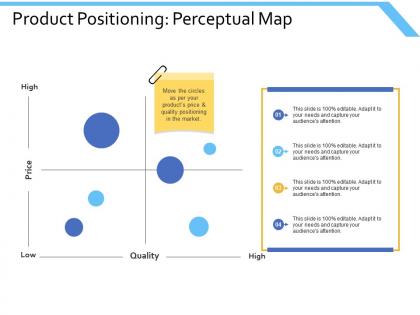
Product positioning perceptual map quality ppt powerpoint presentation file display




Try Before you Buy Download Free Sample Product
 Impress Your
 Audience
 100%
100% Editable
 Save Hours
 of Time


Our Product Positioning Perceptual Map Quality Ppt Powerpoint Presentation File Display ensure eyeballs are glued. Their attractive designs are fascinating.
People who downloaded this PowerPoint presentation also viewed the following :
Product positioning perceptual map quality ppt powerpoint presentation file display with all 5 slides:
Achieve the correct ambiance with our Product Positioning Perceptual Map Quality Ppt Powerpoint Presentation File Display. Create the exact atmosphere you desire.
FAQs for Product positioning perceptual map quality ppt powerpoint
Key components of effective product positioning include target audience definition, competitive differentiation, value proposition articulation, brand messaging consistency, and market positioning framework development. These elements work together by clearly defining customer needs, highlighting unique benefits, and creating compelling narratives, with many successful brands finding that strategic positioning ultimately drives market share growth and sustainable competitive advantage.
Customer segmentation influences product positioning by enabling businesses to tailor messaging, features, and value propositions to specific audience needs, preferences, and pain points. Through targeted segmentation, companies can position products differently across demographics, industries, or behavioral groups, ultimately delivering more relevant customer experiences and stronger market differentiation that drives competitive advantage.
Competitive analysis enhances product positioning by identifying market gaps, revealing competitor weaknesses, understanding pricing strategies, and uncovering unmet customer needs. Through comprehensive competitor research, companies can differentiate their offerings more effectively, refine messaging strategies, and position products in underserved market segments, ultimately delivering stronger value propositions and competitive advantage.
Brand values and identity fundamentally shape product positioning by defining the emotional connection, target audience, and competitive differentiation strategies that guide market placement. These core elements determine how companies communicate benefits, price products, and select distribution channels, with brands like Patagonia leveraging environmental values and Apple emphasizing innovation to create distinct market positions that resonate with specific consumer segments.
Market research provides critical insights into customer preferences, competitor strategies, pricing expectations, and market gaps that directly inform positioning decisions. Through surveys, focus groups, and competitive analysis, businesses can identify unmet needs, validate messaging resonance, and optimize their value propositions, ultimately delivering more targeted positioning that enhances market penetration and competitive advantage.
Visual presentation templates aid in conveying product positioning by standardizing messaging, ensuring design consistency, and structuring competitive comparisons through clear frameworks. These templates streamline market positioning communications by incorporating compelling graphics, strategic color schemes, and organized content hierarchies, with many marketing teams finding that standardized visual approaches ultimately deliver stronger brand recognition and more persuasive stakeholder presentations.
Common pitfalls in product positioning include unclear value propositions, targeting too broad an audience, ignoring competitor differentiation, inconsistent messaging across channels, and positioning based on features rather than benefits. These mistakes often result from insufficient market research and internal assumptions, with many businesses finding that successful positioning requires deep customer understanding, competitive analysis, and consistent execution across all touchpoints to deliver meaningful market differentiation.
B2B positioning emphasizes rational benefits like ROI, efficiency, and operational impact, targeting decision-making committees through detailed value propositions and industry-specific solutions. B2C positioning focuses on emotional connections, lifestyle benefits, and individual consumer needs, with messaging that's more accessible and aspirational, ultimately delivering faster purchase decisions while B2B requires longer relationship-building cycles.
Digital marketing revolutionizes product positioning by enabling real-time audience targeting, data-driven messaging refinement, personalized content delivery, and multi-channel brand consistency. Through social media analytics, SEO optimization, and programmatic advertising, companies can precisely position products across customer segments, adapt messaging based on performance metrics, and maintain competitive positioning in increasingly crowded digital marketplaces.
Storytelling enhances product positioning by creating emotional connections, differentiating from competitors, and making complex benefits memorable through relatable narratives. Through compelling brand stories, companies transform features into meaningful experiences, with organizations like Nike and Apple finding that narrative-driven positioning builds stronger customer loyalty, drives premium pricing, and ultimately delivers sustainable competitive advantage in crowded markets.
**INPUT**: What metrics should be used to evaluate the effectiveness of product positioning? **OUTPUT**: Key metrics include brand awareness scores, market share growth, customer acquisition costs, pricing premium sustainability, and competitive differentiation ratings. These indicators work together by measuring perception shifts, purchase intent changes, and revenue impact, with many companies finding that tracking customer sentiment alongside conversion rates ultimately delivers the clearest picture of positioning success. [Word count: 56 words]
Customer feedback can be incorporated into product positioning through surveys, focus groups, social media monitoring, customer interviews, and sales team insights. These methods help identify customer pain points, preferences, and perceptions, while many companies find that direct feedback reveals gaps between intended positioning and actual market reception, ultimately enabling more targeted messaging and competitive differentiation.
**INPUT**: What are the best practices for repositioning an existing product? **OUTPUT**: Best practices for repositioning include comprehensive market research, clear value proposition redefinition, strategic messaging updates, stakeholder alignment, and phased implementation across all touchpoints. These approaches streamline the transition by maintaining customer trust, minimizing market confusion, and ensuring consistent brand communication, with many organizations finding that systematic repositioning ultimately delivers enhanced competitive advantage and stronger market differentiation. [Word count: 55 words]
Cultural differences significantly affect product positioning through varying consumer values, communication styles, purchasing behaviors, color symbolism, and social hierarchies across global markets. Companies must adapt their messaging, visual elements, and value propositions accordingly, with brands like McDonald's emphasizing family dining in Asia while highlighting convenience in Western markets, ultimately ensuring cultural relevance and competitive advantage.
Successful product positioning examples include Apple's premium innovation focus, Volvo's safety leadership, Tesla's sustainable luxury approach, Southwest Airlines' affordable convenience strategy, and Nike's athletic performance inspiration. These brands streamline their market identity by consistently delivering targeted messaging, aligning product features with customer values, and maintaining clear differentiation, ultimately creating strong competitive advantages and customer loyalty across their respective industries.
No Reviews