


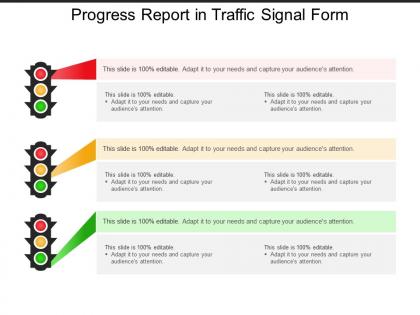
Progress report in traffic signal form




Try Before you Buy Download Free Sample Product
 Impress Your
 Audience
 100%
100% Editable
 Save Hours
 of Time


Our Progress Report In Traffic Signal Form are empowering contributors. They enable achievement of dreams.
People who downloaded this PowerPoint presentation also viewed the following :
Progress report in traffic signal form with all 5 slides:
Enable folks to have a good break with our Progress Report In Traffic Signal Form. Brief them on good holiday destinations.

FAQs for Progress report in
For your report, I'd look at average delay per vehicle and queue lengths - that's the stuff that actually matters to drivers. Cycle time optimization shows how well you're timing things, and stops per trip is huge because honestly, hitting every red light makes people lose their minds. Oh, and definitely track intersection capacity utilization. Green wave coordination between signals can make or break traffic flow. Before/after delay comparisons work great for showing impact. Peak hour capacity data tells you if your changes actually did anything useful - sometimes the numbers look good but rush hour still sucks.
Oh smart signals are actually a game changer! Basically they use cameras and sensors to read actual traffic instead of just running on those ancient timers. Wait times drop big time because they adjust on the fly. The coolest part is how they talk to each other - you get these "green waves" where you can cruise through like 5 intersections without stopping. I've seen studies showing 15-25% faster commutes, which is honestly pretty impressive for city traffic. If you're doing any route planning stuff, definitely check if those corridors have the smart signals first. Changes everything.
Honestly, data analytics totally changed how we do traffic signals. You can spot patterns in vehicle counts, peak hours, pedestrian timing - stuff you'd never catch just standing there watching. Weather impacts too, which is kinda interesting. Real-time data beats those old traffic studies every time. No more guessing if your timing actually works. Pull your last six months of intersection data first - look for the obvious patterns before diving deeper. Short bursts during lunch, morning rushes, that sort of thing. Makes a huge difference for delays and safety once you start making evidence-based tweaks instead of just winging it.
Pedestrian signals are a game changer for reducing crashes between cars and people walking. Drivers get predictable timing so they know when to expect crossers. Walkers get their own phase without dodging turning vehicles - unsignalized crossings are honestly a nightmare. You'll cut down on rear-end crashes too since drivers aren't hitting the brakes for surprise pedestrians. The trick is timing signals long enough for everyone to actually make it across. My neighbor uses a walker and she's constantly rushing because the signals are too short. Check your current crossings for real pedestrian counts and walking speeds first.
Honestly, LED upgrades are worth it - they use like 75-80% less energy than old incandescent bulbs. That's massive carbon savings when you think about thousands of intersections running 24/7. The bulbs also last way longer, maybe 5-7 years instead of just one year. Less manufacturing waste, fewer maintenance trips. Yeah the upfront cost sucks but environmentally it pays off within a year. I'd hit the busiest intersections first - that's where you'll see the biggest impact. My city finally switched over last year and the difference is actually noticeable.
Oh man, traffic lights can totally screw with emergency response times. Like, we're talking 2-4 extra minutes per call when the timing's off - and that's genuinely life or death. Fire trucks and ambulances just get stuck at every red light instead of catching those nice green waves. The preemption systems help (those sensors that turn lights green for emergency vehicles), but honestly the basic timing patterns still matter for getting back into regular traffic afterward. I'd definitely track your response times before and after any big signal changes - the data tells the real story about whether it's actually working.
Ugh, the money situation is brutal - you're talking major cash for all new equipment and software. Your existing infrastructure is probably ancient and won't play nice with modern systems, so that's a whole integration mess. Training your team is gonna be rough too since most people don't know this tech. Plus everyone freaks out about privacy when you start tracking traffic data in real time. Honestly though, I'd say test it at just a few intersections first. Way smarter than going all-in citywide and potentially screwing up your budget if it doesn't work out like you hoped.
So you're gonna track travel times and vehicle speeds using GPS data and those detection systems at intersections. The big thing is progression quality - how smoothly cars move signal to signal without getting stuck at reds. Honestly, all that data gets crazy overwhelming fast. Focus on before/after travel time comparisons first. Bandwidth efficiency matters too - basically how wide your green wave windows are. I usually look at what percentage of vehicles hit greens vs reds, that tells you everything. Oh and definitely pull like a week of peak hour data to start with a solid baseline.
Honestly, AI-powered adaptive signals are where it's at right now. Machine learning adjusts timing based on live traffic, weather, events - the works. Some systems even predict jams before they happen, which is pretty wild. Connected vehicles are the other big thing since cars can actually talk to traffic lights directly. Siemens and Econolite are probably your best starting points for vendors - though I'd definitely pilot just one corridor first. Going city-wide right away seems like asking for headaches. The tech's solid but you'll want to work out the kinks on a smaller scale.
Definitely set up surveys and hit those neighborhood meetings - people love feeling heard. Create online portals where residents can report stuff directly too. The key thing is actually showing how their feedback changed things, like "we got 15 complaints about School St timing so we added 5 seconds to the pedestrian phase." Some cities I've seen do quarterly town halls just for traffic issues and it works pretty well. Don't just collect feedback and disappear though - that's how you lose people. Always circle back so they know their input actually mattered. Makes a huge difference in keeping folks engaged long-term.
Hardware's gonna be your biggest hit upfront - signal heads, controllers, detection stuff runs like $200-300K per intersection depending on how fancy you go. Installation labor and permits always end up costing more than you think (seriously, always). Plus there's ongoing maintenance contracts and software licensing that'll nibble at your budget every year. Getting quotes from three vendors minimum is smart for baseline costs. Oh, and timeline matters big time - rush jobs get expensive fast. Definitely keep some contingency money around because you'll hit underground surprises. Trust me on that one.
So basically, longer signal phases mean fewer crashes - makes sense when you think about it. The yellow timing is critical though, mess that up and you get either rear-endings or people blasting through reds. Protected left turns are your friend here, way safer than those sketchy permissive ones where you're just hoping for a gap. Don't forget pedestrian timing either, rushing people across creates problems. Honestly I'd start with analyzing left-turn movements first since that's where you'll see the biggest safety wins. The data on this stuff is pretty solid too.
Peak hour traffic? Ugh, been there. Start with signal timing - stretch those green lights on busy roads during rush hour. Adaptive signals are game changers since they actually respond to what's happening. Sync up signals along main corridors too so you get those sweet green waves. Turn restrictions during peak times help, plus use those digital signs to push people toward alternate routes. Oh, and you'll want to track how changes perform afterward - traffic's always shifting so you can't just set it and forget it. Data really does make or break these adjustments.
So they use a few different methods to track this stuff. Surveys are the main thing - they ask residents about traffic rules knowledge annually. Citation data helps too since violation patterns show where people are confused about the rules. Then there's the old-school approach where traffic engineers actually stand at intersections and count how many people follow signals properly (kind of tedious but it works). Social media monitoring gives them another angle on public understanding. Honestly, your best shot at getting current data is checking their latest quarterly report or just calling the traffic education coordinator directly.
Look at what Seattle and Austin are doing - they're crushing it with real-time data instead of those outdated static timings. Three things work best: smart timing based on actual traffic patterns, linking up signals along busy routes (this one's a game changer honestly), and having crews who fix stuff before it breaks. Oh and definitely start with your worst corridors first - get some baseline traffic counts there. The cities that nail the connected signal thing? Their commuters actually don't hate driving downtown as much.
-
Innovative and attractive designs.
-
Thanks for all your great templates they have saved me lots of time and accelerate my presentations. Great product, keep them up!