


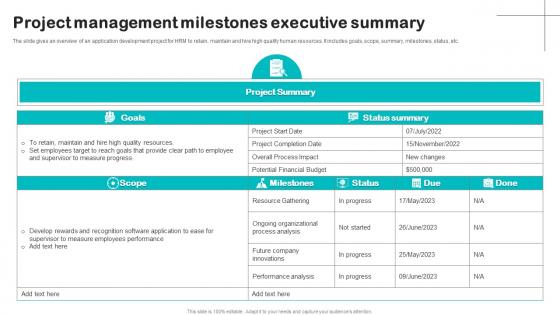
Project Management Milestones Executive Summary




Try Before you Buy Download Free Sample Product
 Impress Your
 Audience
 100%
100% Editable
 Save Hours
 of Time


The slide gives an overview of an application development project for HRM to retain, maintain and hire high quality human resources. It includes goals, scope, summary, milestones, status, etc.
People who downloaded this PowerPoint presentation also viewed the following :
Project Management Milestones Executive Summary with all 6 slides:
Use our Project Management Milestones Executive Summary to effectively help you save your valuable time. They are readymade to fit into any presentation structure.





FAQs for Project Management
Project milestones are characterized by zero duration, representing specific achievements rather than ongoing work, clearly defined deliverables or outcomes, and strategic significance to project success. These checkpoint events enable project managers to track progress, communicate status to stakeholders, and make critical decisions, with many organizations finding that well-defined milestones enhance accountability and maintain project momentum.
Milestones contribute to effective project scheduling by providing clear checkpoints for progress tracking, enabling better resource allocation, and facilitating stakeholder communication throughout the project lifecycle. These strategic markers help project managers identify potential delays early, adjust timelines proactively, and maintain accountability across teams, ultimately delivering improved project outcomes and enhanced organizational efficiency.
Project milestones are significant checkpoints marking key achievements or decision points, while deliverables are tangible outputs or products that must be completed and delivered. Milestones serve as progress markers for stakeholders and help track project timelines, whereas deliverables represent actual work products like reports, software features, or completed installations that contribute to the project's final outcome, with many organizations finding that clearly distinguishing these elements enhances project transparency and accountability.
Project managers effectively communicate milestones by creating visual dashboards, scheduling regular status meetings, and providing clear progress reports with specific dates and deliverables. Through stakeholder-specific updates, automated notifications, and milestone celebration events, organizations enhance transparency, maintain accountability, and ensure alignment across teams, while building confidence and momentum that ultimately drives project success and stakeholder engagement.
Milestone identification techniques include work breakdown structure analysis, stakeholder requirement mapping, deliverable-based planning, critical path analysis, and phase gate methodology. These approaches streamline project tracking by establishing clear checkpoints, defining measurable outcomes, and creating accountability frameworks, with many organizations finding that strategic milestone placement enhances team coordination and ultimately delivers improved project success rates.
Milestones help track project progress by providing clear checkpoints for measuring completion, identifying potential delays, and assessing resource allocation against planned timelines. These strategic markers enable project managers to evaluate team performance, communicate status updates to stakeholders, and make data-driven adjustments, ultimately delivering enhanced visibility and improved project outcomes across organizations.
Common software development milestones include project initiation completion, requirements finalization, system design approval, development phase completion, testing phase conclusion, user acceptance testing sign-off, and deployment readiness. These milestones streamline project tracking by providing clear checkpoints, enabling better resource allocation, and facilitating stakeholder communication, with many development teams finding that structured milestone frameworks ultimately deliver faster time-to-market and enhanced project predictability.
Milestones create structured checkpoints that enable project managers to evaluate resource performance, reallocate underutilized assets, and adjust team assignments based on upcoming deliverables and changing priorities. These strategic markers help organizations optimize workforce deployment, budget distribution, and equipment utilization across project phases, with many teams finding that milestone-driven allocation reduces waste while ensuring critical resources are available when needed most.
Technology assists through project management software, automated progress tracking, real-time dashboards, milestone alerts, and integrated communication tools. These platforms streamline scheduling by providing instant visibility into task completion, automatically updating timelines, and sending proactive notifications, with many organizations finding that digital milestone tracking reduces project delays by up to 30% while enhancing team coordination.
Milestones serve as critical risk checkpoints by enabling early issue identification, facilitating timely corrective actions, and providing structured evaluation points for project health assessment. These strategic markers help project managers proactively address potential problems, reallocate resources when needed, and maintain stakeholder confidence through transparent progress tracking, ultimately minimizing project failure risks.
Project milestone celebrations include team recognition events, performance bonuses, public acknowledgments, milestone certificates, and dedicated team outings or meals. These strategies enhance team morale, reinforce project momentum, and strengthen collaboration, with many organizations finding that consistent milestone recognition significantly improves project engagement, reduces turnover, and ultimately delivers higher project success rates across departments.
Milestone achievements enhance team motivation by providing clear progress markers, celebrating incremental wins, maintaining project momentum, and creating shared accomplishment experiences. These checkpoints enable teams to visualize tangible outcomes, recognize individual contributions, and build confidence for upcoming phases, with many organizations finding that regular milestone celebrations significantly boost engagement and productivity throughout complex projects.
Project managers face challenges including unrealistic timeline expectations, unclear stakeholder requirements, resource allocation conflicts, scope creep, and inadequate milestone definition during initial planning phases. These obstacles can derail progress through poor communication, insufficient risk assessment, and competing priorities, with many organizations finding that proactive milestone reviews and stakeholder alignment ultimately streamline project delivery and enhance team accountability.
Project milestones differ significantly across industries based on regulatory requirements, project complexity, and deliverable types. In construction, milestones center on physical completion stages like foundation pouring, structural framing, and final inspections, while IT projects focus on software releases, user acceptance testing, and system deployments, with construction emphasizing safety compliance and IT prioritizing functionality validation.
Project milestone success metrics include schedule adherence, budget variance, deliverable quality scores, stakeholder satisfaction ratings, and resource utilization efficiency. These measurements enable project managers to assess performance across timeline, financial, and quality dimensions, with many organizations finding that combining quantitative metrics like cost performance index with qualitative feedback ultimately delivers comprehensive project visibility and strategic decision-making capabilities.
-
Good research work and creative work done on every template.
-
Best Representation of topics, really appreciable.