

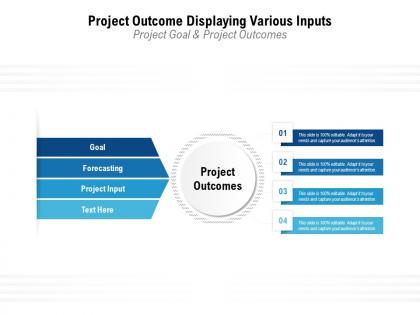
Project outcome displaying various inputs project goal and project outcomes




Try Before you Buy Download Free Sample Product
 Impress Your
 Audience
 100%
100% Editable
 Save Hours
 of Time


Function cohesively with our Project Outcome Displaying Various Inputs Project Goal And Project Outcomes. You will benefit from acting in harmony.
People who downloaded this PowerPoint presentation also viewed the following :
Project outcome displaying various inputs project goal and project outcomes with all 5 slides:
Benefit from cohesive action with our Project Outcome Displaying Various Inputs Project Goal And Project Outcomes. Enjoy the fruits of acting in harmony.




FAQs for Project outcome displaying various inputs project goal
Key performance indicators for measuring project outcomes effectively include schedule adherence, budget variance, quality metrics, stakeholder satisfaction scores, and return on investment calculations. These KPIs enable project managers to track progress comprehensively, with many organizations finding that combining financial metrics with operational measures delivers enhanced transparency and accountability, ultimately streamlining future resource allocation and strategic planning.
Project outcomes vary significantly across industries due to differing regulatory environments, stakeholder complexity, technological requirements, and market dynamics, with healthcare and financial services facing stricter compliance demands while manufacturing prioritizes operational efficiency. These variations reveal that successful project management requires industry-specific approaches, with healthcare organizations finding value in risk mitigation strategies, financial institutions emphasizing regulatory alignment, and retail companies focusing on customer experience optimization, ultimately delivering competitive advantage through tailored methodologies.
Stakeholder feedback provides critical insights into project success by evaluating user satisfaction, identifying performance gaps, and measuring alignment with business objectives. Through surveys, interviews, and focus groups, organizations gather comprehensive perspectives that reveal both tangible deliverable quality and intangible factors like usability, ultimately enabling continuous improvement and strategic refinement for future projects.
Team dynamics significantly impact project outcomes through communication effectiveness, decision-making speed, conflict resolution approaches, knowledge sharing practices, and collective problem-solving capabilities. Poor collaboration can lead to missed deadlines, scope creep, and reduced quality, while strong team synergy enhances innovation, accelerates delivery timelines, and improves stakeholder satisfaction, ultimately delivering competitive advantage and operational efficiency.
Risk management strategies significantly influence project outcomes by identifying potential threats early, establishing contingency plans, and allocating resources strategically to prevent disruptions. Through proactive risk assessment and mitigation protocols, organizations streamline project delivery, minimize cost overruns, and maintain timeline adherence, ultimately delivering enhanced stakeholder confidence and competitive advantage in project execution.
Methods for evaluating qualitative project outcomes include stakeholder interviews, focus groups, case study analysis, observational assessments, and thematic content analysis. These approaches enable organizations to capture nuanced insights about user satisfaction, behavioral changes, and strategic alignment that quantitative metrics often miss, with many project teams finding that combining multiple qualitative methods delivers deeper understanding and more actionable improvement strategies.
Timelines significantly influence project outcome measurement by determining evaluation frequency, stakeholder expectations, and success criteria alignment throughout different project phases. Short-term assessments may miss strategic benefits while long-term evaluations can overlook immediate operational improvements, with many organizations finding that balanced milestone-based measurements deliver more accurate outcome perception and enable better resource allocation decisions.
Technologies that enhance project outcome tracking include AI-powered analytics platforms, real-time dashboard systems, automated reporting tools, blockchain for transparency, and integrated project management software. These solutions streamline data collection, provide predictive insights, and enable stakeholder visibility, with organizations across manufacturing and financial services finding significantly improved decision-making capabilities and faster project delivery.
Aligning project outcomes with organizational objectives is critical for strategic success, resource optimization, and measurable value delivery. This alignment ensures projects contribute directly to business goals, enhance operational efficiency, and maximize return on investment, with many organizations finding that strategically aligned initiatives deliver significantly better results and competitive advantage.
Common pitfalls include setting vague objectives, focusing solely on budget and timeline metrics, ignoring stakeholder expectations, and failing to establish measurable outcomes upfront. These oversights often derail projects across industries, with many organizations finding that clearly defined success criteria, regular stakeholder alignment, and balanced scorecards ultimately deliver better project outcomes and strategic value.
Lessons learned from previous projects enhance future outcomes by identifying successful strategies, avoiding repeated mistakes, and refining processes based on real-world experience. Through systematic documentation and analysis, organizations streamline resource allocation, improve risk management, and accelerate project timelines, with many finding that structured knowledge transfer ultimately delivers better stakeholder satisfaction and competitive advantage.
Leadership plays a pivotal role in shaping project outcomes through strategic vision setting, resource allocation, stakeholder alignment, and risk management throughout project lifecycles. Effective leaders establish clear objectives, facilitate cross-functional collaboration, and maintain momentum during challenges, with many organizations finding that strong leadership governance ultimately delivers faster project completion, improved quality standards, and enhanced team performance across complex initiatives.
Cultural factors significantly influence project outcome interpretation through varying communication styles, success metrics, risk tolerance levels, and stakeholder expectations across different regions. While Western cultures may emphasize individual accountability and quantitative results, Asian markets often prioritize collective harmony and long-term relationships, with many multinational organizations finding that adapting evaluation frameworks to local cultural contexts ultimately delivers more accurate assessments and sustainable project success.
Sustainable project outcomes require comprehensive stakeholder engagement, robust risk management frameworks, continuous monitoring systems, and adaptive resource allocation strategies. These approaches streamline long-term value delivery by embedding flexibility into project structures, establishing clear success metrics, and creating feedback loops, with many organizations finding that proactive sustainability planning ultimately delivers enhanced operational efficiency and competitive advantage.
Project outcomes can be communicated effectively through clear visual dashboards, regular status reports, stakeholder-specific presentations, interactive meetings, and comprehensive summary documents. These communication methods enhance transparency and engagement by tailoring information to each audience's needs, ensuring alignment across teams, and ultimately delivering stronger stakeholder buy-in and project success.
No Reviews