


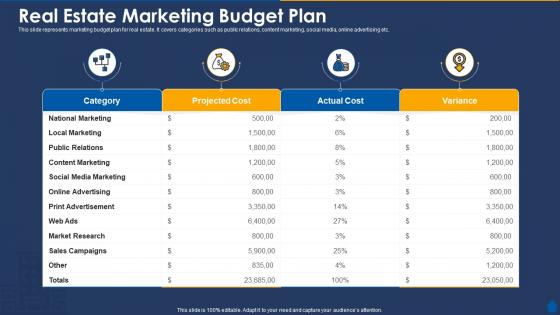
Real estate marketing budget plan




Try Before you Buy Download Free Sample Product
 Impress Your
 Audience
 100%
100% Editable
 Save Hours
 of Time


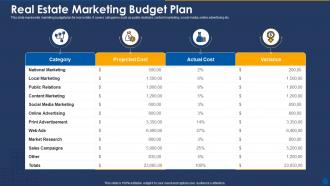
This slide represents marketing budget plan for real estate. It covers categories such as public relations, content marketing, social media, online advertising etc.
People who downloaded this PowerPoint presentation also viewed the following :
Real estate marketing budget plan with all 6 slides:
Use our Real Estate Marketing Budget Plan to effectively help you save your valuable time. They are readymade to fit into any presentation structure.





FAQs for Real estate
Key components include digital advertising costs, professional photography and staging expenses, print marketing materials, social media management fees, and lead generation platform subscriptions. These elements work together by maximizing property visibility, attracting qualified buyers through multiple channels, and streamlining sales processes, with many real estate professionals finding that strategic budget allocation across these areas ultimately delivers faster sales cycles and higher property values.
Real estate agents can allocate funds effectively by prioritizing digital marketing channels like social media advertising, search engine optimization, and email campaigns, while balancing traditional methods such as print materials and networking events. Through strategic budget distribution, with approximately 60% allocated to digital channels and 40% to traditional approaches, agents streamline lead generation, enhance client engagement, and ultimately deliver measurable ROI while building sustainable market presence.
Real estate marketing budgets typically range from 5-15% of total sales, with new agents often investing 10-15% while established professionals may allocate 5-10%. This percentage varies based on market conditions, business maturity, and growth objectives, with many successful agents finding that consistent investment in digital marketing, lead generation, and client retention strategies ultimately delivers higher conversion rates and sustainable business growth.
Market research influences real estate marketing budget by identifying target demographics, optimal channels, and competitive pricing strategies, enabling data-driven allocation decisions. Through demographic analysis and competitor research, real estate professionals can strategically distribute resources across digital advertising, local campaigns, and high-impact channels, ultimately maximizing ROI while minimizing wasteful spending on ineffective marketing approaches.
Digital marketing fundamentally reshapes real estate marketing budgets by prioritizing online channels, social media advertising, virtual tours, search engine optimization, and targeted lead generation platforms. These digital strategies enable agents and firms to reach broader audiences more cost-effectively than traditional methods, with many brokerages finding that digital investments deliver higher ROI, faster client engagement, and measurable results that optimize budget allocation.
Agents can measure marketing ROI by tracking lead generation costs, conversion rates from each channel, commission revenue per campaign, and client acquisition expenses against total marketing spend. Through CRM analytics and attribution tracking, real estate professionals monitor website conversions, social media engagement rates, and referral sources, ultimately determining which strategies deliver the highest revenue per dollar invested.
Cost-effective real estate marketing strategies include social media advertising, email campaigns, content marketing, local networking events, and referral programs. These approaches streamline lead generation by targeting specific demographics, nurturing existing client relationships, and leveraging community connections, with many real estate professionals finding that strategic combination of digital and personal outreach ultimately delivers higher conversion rates.
Seasonal trends significantly impact real estate marketing budgets through fluctuating demand patterns, with spring and summer typically requiring increased investment in digital advertising, staging, and promotional materials to capitalize on peak buying seasons. Many real estate firms adjust their budget allocation accordingly, reducing winter marketing spend while intensifying campaigns during high-activity months, ultimately optimizing resource allocation and maximizing competitive advantage.
Budget management tools include CRM platforms like HubSpot, accounting software like QuickBooks, marketing analytics dashboards, spreadsheet templates, and specialized real estate solutions like Chime or CINC. These technologies streamline expense tracking, ROI analysis, and campaign performance monitoring, with many agencies finding that integrated platforms ultimately deliver better resource allocation and measurable marketing outcomes.
Social media advertising integrates into real estate marketing budgets through targeted Facebook and Instagram campaigns, LinkedIn networking for commercial properties, and YouTube virtual tours. These platforms enable agents to reach specific demographics, showcase listings through visual content, and generate qualified leads at lower costs than traditional advertising, while tracking ROI through detailed analytics and conversion metrics.
Adjusting real estate marketing budgets based on market performance and competition ensures optimal resource allocation, competitive positioning, and maximum ROI across changing conditions. This strategic approach enables agents and firms to capitalize on emerging opportunities, respond to competitor activities, and reallocate spending toward high-performing channels, ultimately delivering sustained market share and improved lead generation efficiency.
Real estate marketing budgets can be optimized by allocating 60-70% to digital channels like social media advertising, SEO, and virtual tours, while reserving 30-40% for traditional methods such as print materials and networking events. Through data analytics and A/B testing, agencies streamline campaign performance, reduce cost-per-lead, and enhance client acquisition, ultimately delivering measurable ROI and competitive market positioning.
Common pitfalls include underestimating digital marketing costs, failing to track ROI metrics, allocating too much to traditional advertising, neglecting seasonal market fluctuations, and setting unrealistic lead conversion expectations. These oversights often result in wasted resources and missed opportunities, with many agencies finding that strategic budget diversification across multiple channels delivers better client acquisition and sustainable growth.
Real estate professionals can justify marketing expenses by demonstrating clear ROI through metrics like lead generation costs, conversion rates, property viewing increases, and average days on market reductions. By presenting data showing how targeted digital campaigns, professional photography, and strategic advertising directly correlate to faster sales, higher property values, and expanded client portfolios, agents build compelling cases for continued investment.
**INPUT**: What innovative tactics can help stretch a limited real estate marketing budget further? **OUTPUT**: Innovative budget-stretching tactics include virtual staging, social media micro-targeting, neighborhood-specific content marketing, strategic partnership collaborations, and user-generated testimonial campaigns. These approaches streamline costs by leveraging digital tools, community connections, and organic reach, with many real estate professionals finding that strategic combinations deliver enhanced visibility and lead generation while significantly reducing traditional advertising expenses. [Word count: 56 words]
-
Best way of representation of the topic.
-
Understandable and informative presentation.