

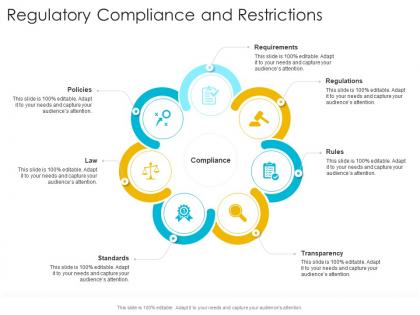
Regulatory compliance and restrictions startup company strategy ppt infographics




Try Before you Buy Download Free Sample Product
 Impress Your
 Audience
 100%
100% Editable
 Save Hours
 of Time


Our Regulatory Compliance And Restrictions Startup Company Strategy Ppt Infographics are topically designed to provide an attractive backdrop to any subject. Use them to look like a presentation pro.
People who downloaded this PowerPoint presentation also viewed the following :
Regulatory compliance and restrictions startup company strategy ppt infographics with all 2 slides:
Use our Regulatory Compliance And Restrictions Startup Company Strategy Ppt Infographics to effectively help you save your valuable time. They are readymade to fit into any presentation structure.

FAQs for Regulatory compliance and restrictions startup company
So basically you need four main things: solid policies, training your people, monitoring stuff, and keeping good records. Don't just copy-paste some generic policy though - make sure it actually matches what regulations you're dealing with. Training's pretty straightforward but do it regularly so people don't forget. Monitoring catches problems early which saves you headaches later. Documentation is annoying but regulators are obsessed with it, so whatever. The hardest part? Regulations change all the time. First figure out which ones actually apply to you, then build everything around those specific rules.
So here's the thing - every industry handles compliance totally differently depending on their risk levels. Healthcare and finance get hit the hardest with regulations like HIPAA and SOX, so they bake it into everything from the start. Manufacturing's all about safety standards, mostly OSHA stuff. Tech companies? They're honestly still scrambling to figure out data privacy rules - it's kinda messy right now. Energy and pharma have their own weird specialized requirements too. You can't just copy what another industry does and expect it to work. Trust me, trying a generic approach will blow up in your face pretty quickly.
Dude, non-compliance will absolutely wreck you. Financial penalties are brutal - we're talking massive fines. Legal trouble follows, sometimes even criminal charges. Your reputation? Gone. Customers bail, partners ghost you. I know companies that are still recovering from compliance disasters years later, it's wild. Operations get shut down, licenses pulled, and regulators will be watching your every move forever. The crazy part is fixing everything afterward costs way more than just doing it right initially. Honestly, just bake compliance into everything from the start instead of scrambling later.
Honestly, tech is a game-changer for compliance stuff. Automated reporting cuts out so much tedious work, and those real-time dashboards actually show you what's happening instead of guessing. Set up alerts to catch issues early - trust me, way better than scrambling later. Digital audit trails are cleaner too since everything gets tracked automatically. Document management keeps your files organized instead of... well, wherever they usually end up lol. Best part? Less time buried in paperwork means you can focus on bigger picture compliance strategy. I'd start by looking at whatever manual process takes forever - that's probably your best bet for automation.
Honestly, risk management is like having a good alarm system - but for compliance stuff instead of break-ins. You're basically trying to catch problems before they actually happen. Map out where you're most vulnerable first, then build some safeguards around those spots. The trick is making this part of what you do regularly, not just scrambling when audit season rolls around. Figure out what could realistically go wrong and how bad it'd be. Then put controls in place to either stop it or at least minimize the damage. Way better than playing defense after you're already in trouble.
Dude, this stuff can sneak up on you even if you never cross borders. Got European website visitors? GDPR applies to you. Working with overseas suppliers or customers? You're probably already dealing with their compliance rules without realizing it. Supply chain regs, anti-corruption laws, trade sanctions - they all have ways of reaching into domestic operations. Honestly, it's kind of wild how interconnected everything is now. I'd start by mapping out anywhere your business touches international stuff, then figure out what foreign rules might actually affect you. Sounds boring but better than getting blindsided later.
Okay so three big things are happening right now. Regulators are getting super tech-savvy - they want real-time data and automated monitoring systems. ESG stuff is exploding too, especially climate reporting and supply chain transparency (honestly feels overwhelming sometimes). Plus there's literally a new privacy law every month somewhere in the world. The tricky part? Cross-border coordination is tightening, so rules in one place affect your whole operation. I'd definitely do a tech audit of your compliance setup soon. Also map out where you're weak on ESG reporting before it becomes required - trust me on this one.
Honestly, ditch those boring generic training modules nobody cares about. Focus on stuff that actually matters for their specific jobs - real scenarios they'll face, not random compliance nonsense. Interactive case studies work way better than those awful e-learning marathons. Oh, and do short refreshers throughout the year instead of one giant annual thing that everyone forgets immediately. Create quick reference guides people can actually use when they're stuck. The biggest thing though? Make sure your managers know their stuff and people feel comfortable asking questions without seeming dumb.
Track both leading stuff (like training completion rates, audit findings) and lagging indicators - regulatory fines, compliance violations, how long it takes to fix problems. Incident response times matter too. The soft metrics are honestly just as important though - culture surveys, whistleblower reports, that kind of thing. They'll give you early warning signs before everything hits the fan. Oh and don't go crazy tracking everything at once. Pick 3-4 that actually matter for your specific industry first, then add more as you figure out what's useful.
So compliance is basically your legal baseline - like, you HAVE to do this stuff or you're screwed. Ethics goes way beyond that though. You can totally follow every rule and still make decisions that are kinda shitty for people or your reputation. The trick is having ethical standards that are already higher than what's legally required. Makes compliance super easy since you're not even tempted to cut corners. I always think of it like - compliance keeps you out of court, ethics keeps you sleeping well at night. When they work together, you don't have those cringey moments explaining why you technically did nothing wrong but everyone's still mad.
Honestly, it's way better to catch problems before the regulators do - saves you from scrambling later. Your team won't be confused about what they're supposed to do mid-project (trust me, that's the worst). Fewer surprise audits and penalties too. Regulators actually appreciate when you're making a real effort to stay on top of things. The best part? You get to focus on actually running your business instead of constantly dealing with compliance drama. I'd start by figuring out where your biggest risks are, then just build some basic monitoring into whatever you're already doing.
Honestly, don't try to tackle every regulation at once - you'll go crazy. Pick the major ones first: taxes, employment stuff, whatever's specific to your industry. I made the mistake of trying to understand everything upfront and it was brutal. Break it into smaller pieces you can actually handle. For the complex legal stuff, just hire someone who knows what they're doing. Industry groups are super helpful too - they'll keep you updated on changes. Oh, and definitely set up some kind of system to track deadlines. Maybe it's just a calendar reminder, but trust me, you don't want to miss renewals.
Set up quarterly audits instead of scrambling last minute - trust me on this one. We once had to dig through three years of records in two weeks and it was brutal! Keep your docs organized year-round, not just when auditors show up. Make checklists for each area you need to cover and assign someone to own each piece. Automated reminders are your friend here. Previous audit findings? That's basically your cheat sheet for what to fix next time. Track everything religiously because those same issues will bite you again if you don't.
Ok so basically you're keeping tabs on new rules coming down the pipeline and figuring out what'll break when they hit. Your team watches regulatory sites, legal databases, all that stuff for updates. Then you map the changes against your current setup - honestly this part's kind of a nightmare but whatever. Priority goes to stuff with hard deadlines or major business impact. Roll out training, update policies, fix systems. Oh and definitely set up regular check-ins with your legal and compliance people so nothing falls through the cracks later.
So there are a bunch of ways to stay on top of this stuff. Government sites like SEC or FDA post updates directly, but honestly those are pretty dry to read through all the time. Industry associations usually break it down better and send alerts. You've got legal databases like Thomson Reuters too - those are solid for tracking everything. Oh and compliance software platforms that auto-monitor regulations, though they can get pricey. I'd probably mix it up - grab an industry newsletter for quick hits and maybe one robust platform for the detailed stuff. That way you're not drowning in updates but still covered.
-
Topic best represented with attractive design.
-
Amazing product with appealing content and design.