


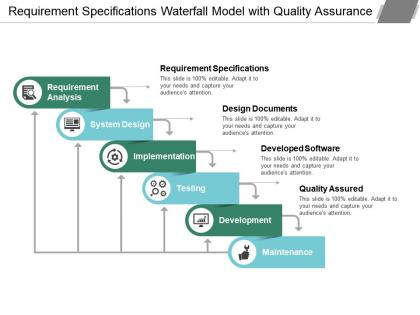
Requirement specifications waterfall model with quality assurance




Try Before you Buy Download Free Sample Product
 Impress Your
 Audience
 100%
100% Editable
 Save Hours
 of Time


Click through the options at your leisure. Copy the best onto our Requirement Specifications Waterfall Model With Quality Assurance.
People who downloaded this PowerPoint presentation also viewed the following :
Requirement specifications waterfall model with quality assurance with all 5 slides:
Fashion every detail with our Requirement Specifications Waterfall Model With Quality Assurance. They allow you to get it customized.

FAQs for Requirement specifications waterfall model
You need functional requirements first - basically what the system actually does. Then non-functional stuff like performance and security. Don't forget user requirements from stakeholders and technical system specs. Waterfall's brutal because you can't pivot easily later, so getting this right upfront is everything. Business rules, data requirements, interface specs - document all of it clearly. Just don't go overboard and get stuck analyzing forever. Oh, and definitely get stakeholder sign-off before moving to design. Trust me on that one - it'll save you so much drama later.
Honestly, Waterfall's pretty solid for QA work. You get all the requirements laid out from day one - no surprises or scope creep messing with your test plans. Everything's documented upfront, so you actually know what you're supposed to be testing. Each phase has these built-in checkpoints where nothing moves forward until it passes QA review. Yeah, it's not as trendy as agile, but that structure really works if you're dealing with compliance stuff or projects where the requirements won't change. Way less stressful than constantly chasing moving targets, tbh.
Oh man, stakeholders are everything in Waterfall's requirements phase. You'll basically live in interviews during that first stage, getting all their needs documented and signed off. Once you move past requirements, changes get super expensive - like, painfully expensive. The whole model banks on nailing complete requirements upfront from business users, end users, sponsors, whoever. I'd honestly spend extra time being thorough here because your entire project lives or dies by this phase. Document everything clearly too. It's intense but worth it since you only get one real shot at getting it right.
Dude, good requirement specs are literally your lifesaver. They catch all the messy problems before they turn into expensive nightmares later. Write down exactly what the system should do from the start - this stops scope creep and prevents teams from talking past each other. Your QA people can actually write decent test cases early too. And honestly? When stakeholders try changing everything mid-project (because they always do), you've got documentation to wave at them. Trust me, spending time upfront getting requirements nailed down will save you so many headaches down the road.
So basically you've got a few solid ways to validate requirements in Waterfall. Start with stakeholder reviews - cheapest way to catch big problems before they cost you later. Peer reviews and walkthroughs are clutch for spotting gaps early. Prototyping works great too, especially with those clients who can't articulate what they want until they see it (we all know the type). Create traceability matrices so stuff doesn't fall through the cracks between phases. Oh, and write test cases straight from your requirements - if you can't test it, the requirement probably sucks anyway. Formal inspections help too but honestly, nail the stakeholder piece first.
Oh man, requirement changes are honestly the worst. Everything just falls apart - you're redoing test cases, trashing old test data, basically starting over half the time. Waterfall projects get hit hardest since you can't really pivot easily. Your whole team ends up in this mad scramble trying to catch up while deadlines are breathing down your neck. I learned the hard way to always pad your timeline for this stuff. Also set up some kind of change control process early on, even if it feels like overkill at first. Trust me on that one.
Start tracking changes in a living doc with version control right away - trust me on this one. Create a traceability matrix so you can follow each requirement from start to testing. Write down WHY each requirement exists and who asked for it, because I guarantee you'll blank on this stuff later. Your acceptance criteria need to be super specific and measurable, not vague nonsense. Oh, and use consistent naming conventions or you'll hate yourself. The whole thing turns into chaos if you wait - I've seen people try to piece together requirement history months later and it's basically impossible.
So with Waterfall, your requirements basically ARE your testing blueprint. You can't really go back and tweak things once you're moving forward - kinda annoying but that's how it works. Test cases have to trace directly back to those original specs, every single one of them. Design all your test scenarios and acceptance criteria based on what got documented at the start. Here's the thing though - if your requirements suck from day one, you're gonna hate life during testing. Always build that traceability matrix early or you'll regret it later.
Start with completeness - how many requirements are actually finished vs still sitting there as "TBD." Traceability is clutch too, making sure everything maps back to actual business needs. Count ambiguous words like "user-friendly" or "fast" because those will bite you later (trust me on this one). Track how many defects reviewers catch per page and how often requirements change after you baseline them. Honestly, requirements volatility is probably the most telling metric - constantly changing specs usually mean the upfront work was rushed. Don't go overboard though. Pick 2-3 that actually matter for your project instead of tracking everything.
Okay so first thing - give every requirement a unique ID. Then you'll want to track how each one moves through your design docs, code, test cases, all that stuff. Jira or Azure DevOps work great for this (way better than trying to manage it in Excel, trust me on that one). Update your links whenever requirements change - and they always do. Oh, and definitely do regular check-ins with QA to spot any gaps. Missing these early is such a pain later.
Honestly, the worst thing is when requirements are super vague - like "make it user-friendly" or "needs to be fast." QA will hate you later because how do you even test that? Stakeholders also love sneaking in extra features mid-project without updating anything official. Missing edge cases always bite you during testing too. Oh, and people forget about the boring stuff - security requirements, actual performance numbers, error handling. Pretty much you want everything measurable and testable from the start. Get stakeholders to agree on specific acceptance criteria before anyone writes code. Trust me on this one.
Dude, get QA looking at your requirements early - seriously saves so much headache later. They think totally different than us devs. While we're figuring out what to build, they're already going "wait, how do we even test this?" Forces you to nail down acceptance criteria and edge cases upfront. They'll catch vague requirements that would bite you during testing when fixes cost way more. Also spot missing stuff you didn't think of. Honestly, QA reviews should happen before sign-off, not after you've started coding. Trust me on this one.
DOORS is probably your best bet if you've got the budget - that thing's basically made for waterfall traceability. But honestly? Most teams do fine with Jira + Confluence, especially if you're already using Atlassian stuff. Azure DevOps works too, plays nice with Microsoft everything. Hell, I've seen teams make SharePoint work as long as they're disciplined about naming and workflows. The real trick is sticking with whatever your team already knows how to use. Don't go learning some fancy new tool halfway through - that's just asking for headaches. Version control and review gates matter more than the platform itself.
Honestly, just pretend you're explaining it to someone who doesn't live and breathe this stuff. Skip the fancy tech terms - use simple words instead. Visual diagrams help a ton too, way better than trying to describe everything in paragraphs. Break it into small chunks with headers because nobody reads massive walls of text (learned that the hard way). Real user stories work great - like "Sarah the marketing manager needs to..." You know what I mean? Always spell out acronyms first time around. Get people to look at drafts early - saves you from rewriting everything later. Maybe start with your worst spec and just fix one section first.
Think of acceptance criteria as your "what counts as finished" checklist - without them you'll be going in circles forever arguing if something actually works. Trust me, I've wasted weeks on that nonsense. Waterfall makes this even more critical since you can't just hop back and fix vague requirements later like you can in agile. Write them super specific and testable - "handles 100 transactions per minute" instead of something useless like "good performance." They also force you to think about weird edge cases upfront, which honestly saves your butt during testing.
No Reviews