

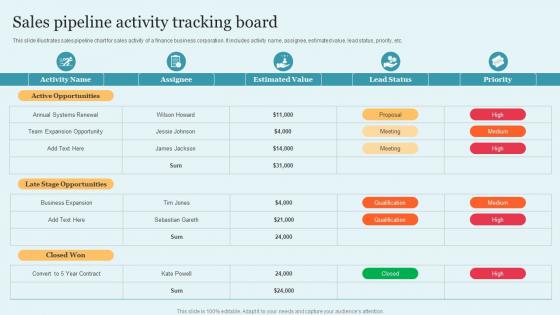
Sales Pipeline Activity Tracking Board




Try Before you Buy Download Free Sample Product
 Impress Your
 Audience
 100%
100% Editable
 Save Hours
 of Time


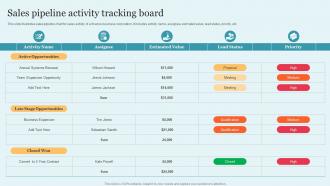
This slide illustrates sales pipeline chart for sales activity of a finance business corporation. It includes activity name, assignee, estimated value, lead status, priority, etc.
People who downloaded this PowerPoint presentation also viewed the following :
Sales Pipeline Activity Tracking Board with all 6 slides:
Use our Sales Pipeline Activity Tracking Board to effectively help you save your valuable time. They are readymade to fit into any presentation structure.





FAQs for Sales Pipeline
Key sales pipeline stages include lead generation, qualification, needs assessment, proposal presentation, negotiation, and deal closure, with each stage featuring specific criteria and expected outcomes. These stages enhance sales forecasting accuracy, streamline resource allocation, and improve conversion tracking, with many organizations finding that clearly defined pipeline stages ultimately deliver better sales performance and more predictable revenue growth.
Sales pipeline tracking improves forecasting accuracy by providing real-time visibility into deal progression, conversion rates at each stage, and historical performance patterns. This data-driven approach enables sales managers to identify bottlenecks, predict revenue timing more precisely, and adjust strategies proactively, with many organizations finding that systematic pipeline analysis delivers significantly more reliable forecasts and enhanced resource allocation.
CRM platforms like Salesforce, HubSpot, Pipedrive, and Zoho, along with specialized tools like Monday.com and Freshsales, excel at real-time pipeline tracking. These systems streamline lead management, automate follow-ups, and provide instant visibility into deal progression, with many sales teams finding that integrated analytics and mobile accessibility ultimately enhance forecasting accuracy and accelerate conversion rates.
Sales teams should review pipeline metrics weekly for tactical adjustments and monthly for strategic analysis, with daily monitoring of key indicators like conversion rates, deal velocity, and pipeline health. This regular cadence enables sales managers to identify bottlenecks quickly, optimize resource allocation, and maintain forecast accuracy, while quarterly deep-dives help refine processes and ultimately deliver improved close rates and revenue predictability.
Common sales pipeline tracking challenges include inconsistent data entry, lack of real-time visibility, poor lead qualification, inadequate follow-up processes, and insufficient analytics capabilities. These obstacles can be overcome by implementing automated CRM systems, establishing standardized data protocols, and providing comprehensive team training, with many organizations finding that strategic combination of technology and process optimization ultimately delivers improved conversion rates and enhanced sales forecasting accuracy.
Visual representations of sales pipelines enhance team communication by providing clear, shared visibility into deal progression, bottlenecks, and forecasting accuracy across all stages. These visual tools streamline strategy discussions through real-time data visualization, enable faster identification of at-risk opportunities, and facilitate collaborative decision-making, with many sales organizations finding that dashboard-driven approaches ultimately deliver improved alignment and accelerated deal closure rates.
CRM software serves as the central hub for sales pipeline tracking, consolidating lead data, monitoring prospect interactions, automating follow-up sequences, and providing real-time visibility into deal progression. These systems streamline sales processes by eliminating manual data entry, enhancing collaboration between teams, and delivering predictive analytics, with many organizations finding that integrated CRM platforms ultimately accelerate deal closure rates.
Sales pipeline tracking helps identify bottlenecks by analyzing conversion rates between stages, measuring deal velocity, and highlighting where prospects consistently stall or drop off. Through detailed stage-by-stage analytics, sales teams can pinpoint specific friction points like lengthy approval processes or inadequate follow-up, ultimately enabling targeted improvements that accelerate deal closure and enhance overall sales efficiency.
Key metrics include conversion rates between pipeline stages, average deal size, sales cycle length, pipeline velocity, and lead source performance. These measurements enable sales teams to identify bottlenecks, optimize resource allocation, and forecast revenue more accurately, with many organizations finding that tracking stage-specific metrics ultimately delivers improved closing rates and predictable growth.
Sales pipeline tracking contributes to better lead conversion rates by identifying bottlenecks, optimizing follow-up timing, and enabling data-driven decision making throughout the sales process. This systematic approach allows sales teams to prioritize high-value prospects, personalize outreach strategies, and address conversion obstacles proactively, with many organizations finding that consistent pipeline monitoring ultimately delivers higher close rates and improved revenue predictability.
Sales teams can effectively collaborate through shared CRM systems, regular pipeline review meetings, standardized data entry protocols, cross-functional communication tools, and transparent deal visibility across all team members. These collaborative approaches streamline coordination by eliminating information silos, accelerating decision-making, and ensuring consistent follow-up strategies, with many organizations finding that unified pipeline management delivers faster deal closures and improved revenue forecasting.
Strategies to shorten sales cycles include lead qualification automation, predictive analytics for priority scoring, streamlined approval workflows, real-time pipeline visibility, and targeted nurturing sequences. Through advanced CRM integration and data-driven insights, sales teams accelerate decision-making, eliminate bottlenecks, and focus resources on high-conversion prospects, ultimately delivering faster deal closure and improved revenue velocity.
Predictive analytics integrates into sales pipeline tracking through machine learning algorithms, historical data analysis, lead scoring models, and behavioral pattern recognition. These technologies enable sales teams to forecast deal closure probability, identify high-value prospects, and optimize resource allocation, with many organizations finding that predictive insights ultimately accelerate sales cycles and improve conversion rates significantly.
Best practices for training sales teams on pipeline tracking include establishing consistent data entry standards, implementing regular pipeline review sessions, providing hands-on CRM training, setting clear stage definitions, and creating accountability metrics. Through role-playing exercises and real-time coaching, sales managers can enhance team accuracy and forecasting precision, while regular training refreshers ensure sustained adoption, ultimately delivering improved conversion rates and more predictable revenue outcomes.
Feedback from sales pipeline tracking reveals which features prospects value most, common objections, and market demand patterns, directly informing product roadmaps and positioning strategies. This data enables companies to prioritize development resources on high-impact features, refine messaging around proven value propositions, and identify new market segments, ultimately delivering products that better match customer needs and competitive advantages.
-
I want to thank SlideTeam for the work that they do, especially their customer service.
-
The quality of the templates is as fine as it could get. It was a purchase well made!