


SEO For Healthcare Industry Detailed Strategy And Action Plan Edu Ppt




Try Before you Buy Download Free Sample Product
 Impress Your
 Audience
 100%
100% Editable
 Save Hours
 of Time


These slides contain the customized SEO approach for the healthcare industry. These include information on medical sector-specific techniques such as Medical Keyword Research, Local SEO, Website Speed and Mobile Use Optimization, Images and Video Optimization, etc. These also contain the healthcare SEO checklist and common dos and donts.
People who downloaded this PowerPoint presentation also viewed the following :
Content of this Powerpoint Presentation
Slide 3
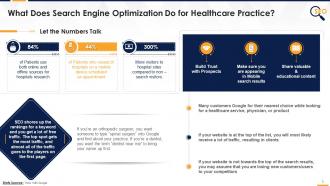
This slide covers details on what SEO does for healthcare practice. It depicts that SEO shores up the rankings for a keyword and you get a lot of free traffic. The top spot gets the most traffic, and almost all of the traffic goes to the players on the first page.
Instructor's Notes:
What’s involved in healthcare SEO.
- Setting up your local listings in Google My Business, Bing Places, and Yahoo Local
- Wisely-targeted, natural keyword usage
- An optimized URL for individual pages
- Earning backlinks from other sites
- Creating quality content consistently
- Ensuring backend things like title tags and image tags are optimized as well
Slide 4
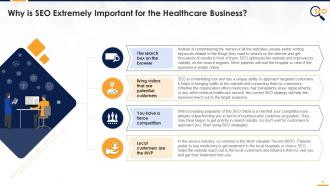
This slide covers details on why SEO is important for the healthcare businesses. There are reasons such as the search box on the browser brings visitors that are potential customers, growing competition, and local SEO.
Slide 5
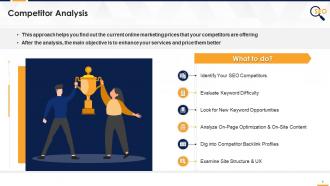
This slide covers competitor analysis as SEO strategy for healthcare industry. It also depicts that this research will assist businesses in better identifying opportunities and preparing for potential threats
Instructor's Notes:
- A competitor analysis will evaluate the strengths and weaknesses of your competitors
- The results of this research will assist you in better identifying opportunities and preparing for potential threats
- Use the findings of this analysis to develop practical goals, like enhancing the website's user interface, adjusting the scheduling of campaigns to better match with peak search hours, or developing keyword-rich content to answer popular search questions
Slide 6
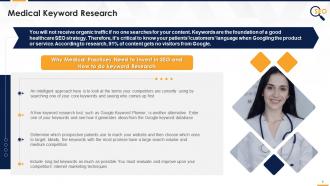
This slide covers medical keyword research as SEO strategy for healthcare industry. It also depicts that businesses should evaluate and improve upon their competitors' internet marketing techniques.
Instructor's Notes:
Consider the following metrics to have a better idea of the average number of times a term is searched and the number of clicks it receives from potential customers:
- Search volume (starting from 1K)
- Keyword difficulty
- Cost-per-click (CPC)
- Clicks volume
Steps for Keyword Research
- Your own insights
- Google related search results and ‘smart’ search results or ‘featured snippets’
- See what other people are talking about in comments
- Wikipedia page
Slide 7
This slide covers creating high-quality content as SEO strategy for healthcare industry. It also depicts that creating relevant content that generates leads means building a solid brand that improves credibility, strengthens your brand image, and expands the market presence.
Instructor's Notes:
Write new and update old content based on keywords
By continuously improving your content, you may leverage SEO for physicians, medical practices, or digital health goods in three ways:
- Only write things that matter. If your content solves your readers’ inquiries while being SEO-friendly, it will beat your competitors’ content
- Update your old content. Update and revise your blog posts at least every six months following new keywords and trends
- Make content update a cycle, not a single activity. Search engines love when content is regularly updated, resulting in better rankings
Slide 8
This slide covers link building and quality backlinks as SEO strategy for healthcare industry. It also depicts that getting quality backlinks is an important task as low quality links can lower the domain authority and website rank in SERP
Instructor's Notes:
Backlinks are the inverse of internal links since they connect pages to other domains. For instance, if Wikipedia links to your website, then you have a Wikipedia backlink.
Link building helps you to:
- Improve your rankings because Google considers backlinks to be votes of confidence
- Increase the discoverability of your website because crawlers love to revisit popular pages
- Drive referral traffic by directing readers to your website and projecting you as a subject matter expert
To make the most of your backlinks, consider the following steps:
- Include your website with free healthcare listings and ratings
- Republish your content on additional platforms like as ClinicAll, Healthcare in America, and Tincture
- Submit your articles or op-eds to local healthcare authorities, including digital publications, newsletters, and blogs
Slide 9
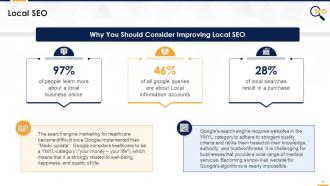
This slide covers as local SEO strategy for healthcare industry. It also depicts that Google's search engine requires websites in the YMYL category to adhere to stringent quality criteria and ranks them based on their knowledge, authority, and trustworthiness.
Instructor's Notes:
Nearly half of all Google searches are local services. Furthermore, many healthcare companies fail to claim their Google My Business (GMB) page.
It enables landing pages or out-of-date websites to continue receiving traffic from potential customers. Consider the following questions as a fast way to fine-tune your GMB section:
- What are our keywords? Why do they send us the most traffic? What is the search volume for our most important keywords?
- What queries did our consumers look up this month on Google? Can we provide clear answers in our Q&A section?
- How soon do we respond to comments on our local page? Can we make this procedure better?
Slide 10
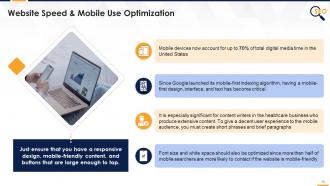
This slide covers website speed & mobile use optimization as SEO strategy for healthcare industry. It depicts that websites should ensure that they have a responsive design, mobile-friendly content, and buttons that are large enough to tap.
Slide 11
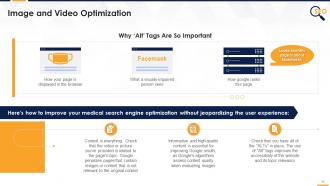
This slide covers image and video optimization as SEO strategy for healthcare industry. It also depicts that use of "Alt" tags improves the accessibility of the website and its topic relevancy.
Instructor's Notes:
Google's search ranking guidelines state that content should be optimized for humans rather than robot crawlers. However, by including additional information about the media you post, search results may become far more relevant, resulting in higher-quality traffic to your website.
Slide 12
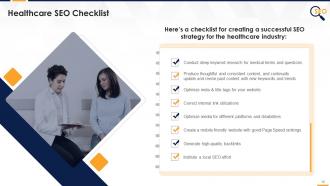
This slide covers healthcare SEO strategy checklist. It includes optimization of meta & title tags, correct internal link utilizations, optimization of media, generating high-quality backlinks, etc.
Slide 13
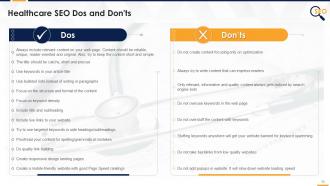
This slide covers dos and don’ts of the healthcare SEO such as creating landing pages with responsive design, optimizing for mobile, not taking backlinks from low quality websites, etc.
Additional Slide 1
This slide contains icons related to Search Engine Optimization (SEO). The slide uses the same color theme and similar design elements as the main deck.
Additional Slide 2
This slide can be edited to provide information about one's organization. The slide uses the same color theme and similar design elements as the main deck.
Additional Slide 3
This editable slide can be used to share the organization's vision, mission, and goals. The slide uses the same color theme and similar design elements as the main deck.
Additional Slide 4
This slide can be edited to provide information about the organization's core team. The slide uses the same color theme and similar design elements as the main deck.
Additional Slide 5
This slide can be used to present multiple discussion ideas to the stakeholders concerned.
Additional Slide 6
This slide contains an editable 30-60-90-day plan to suit the presenter's needs.
Additional Slide 7
This slide contains a timeline to showcase multiple milestones of the organization.
Additional Slide 8
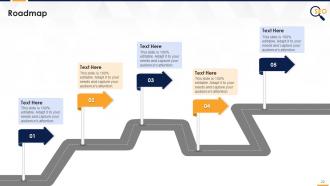
This slide contains a roadmap template for effective strategic planning. The slide uses the same color theme and similar design elements as the main deck.
Additional Slide 9
This fully editable training certificate template can be presented to attendees post the successful completion of training.
SEO For Healthcare Industry Detailed Strategy And Action Plan Edu Ppt with all 28 slides:
Use our SEO For Healthcare Industry Detailed Strategy And Action Plan Edu Ppt to effectively help you save your valuable time. They are readymade to fit into any presentation structure.















FAQs for SEO For Healthcare Industry Detailed Strategy And Action
Ugh, healthcare SEO is brutal honestly. Google has these YMYL rules that basically mean they're way pickier about medical content than anything else. You'll need legit medical credentials and proper author bios - none of that fake expert stuff works here. HIPAA makes patient reviews super complicated too, which sucks because testimonials are gold for other businesses. Can't do the pushy marketing tactics that work elsewhere either. Your best bet? Focus on writing genuinely helpful content and getting other doctors to link to you. That's what actually moves the needle with Google for medical sites.
Yeah totally doable! Just stick to educational stuff instead of patient details. Blog about conditions, treatments, general health topics people google. Skip patient stories unless you've got proper consent (duh). But you can write things like "diabetes warning signs" or "what happens in physical therapy" - that kind of content works great. Research what health questions your community's searching for first. Then optimize around those keywords while keeping everything general. It's honestly pretty straightforward once you get the hang of it. Educational content performs really well for medical practices anyway.
Start with local stuff - "pediatrician near me" or "urgent care downtown Seattle." That's where the money is, honestly. Service-specific keywords work great too: "mammogram appointment," "physical therapy," whatever you do. Long-tail ones like "best dermatologist for acne treatment" crush generic terms like just "dermatologist." Don't forget condition keywords your patients actually use - "lower back pain treatment" or "anxiety counseling." Oh, and Google Keyword Planner will show you what people are really searching for. Way better than guessing.
Dude, local SEO is HUGE for healthcare practices. Think about it - when's the last time you searched for a doctor without typing "near me"? People aren't gonna drive 2 hours for a regular appointment. Start with your Google Business Profile - that's where most patients find you anyway. Keep your hours and phone number updated, because nothing's more annoying than showing up to a closed office. Push for patient reviews (nicely), and sprinkle your city name throughout your website content. Oh, and don't sleep on Healthgrades and those other medical directories. They actually matter in healthcare.
Dude, you NEED mobile optimization for healthcare SEO. Most people are googling symptoms on their phones - like when they're freaking out at 2am about chest pain or whatever. Google ranks mobile-friendly sites higher, so without it you're basically invisible. Fast loading is key. Make buttons big enough to actually tap without hitting three other things. Oh and forms that don't make people want to throw their phone - super important when someone's already stressed about health stuff. Honestly, just run Google's mobile test first to see where you stand.
Focus on speed and mobile experience first - Google's obsessed with that stuff. People searching health info at weird hours get impatient fast, so quick loading is crucial. Clean navigation matters too. Don't make appointment booking a total pain (I've seen some truly awful ones). Throw in useful tools like symptom checkers or patient portals. When visitors actually stick around and use your features, Google notices. That engagement time tells them your site's worth ranking higher. Oh, and use clear headings to break up content - makes everything more scannable.
Google's crazy strict with health stuff - people's lives depend on it, so they don't mess around. Get medical professionals to write or review everything you publish. Your author bios need real credentials listed out. Citations are huge too - link to legit medical sources. Write like you're talking to actual patients, not other doctors. Ditch the fancy medical terms unless you break them down first. Always throw in those disclaimers about seeing their doctor. Honestly, I'd start by going through what you already have and adding author info plus sources to everything. It's boring work but it'll make a difference.
Dude, E-A-T is huge for health SEO - like, Google doesn't mess around with medical stuff. You absolutely need real doctors writing or at least reviewing everything, not just random content people. Bad health info can seriously hurt someone, so the algorithm is crazy strict about this. Your author bios better show off those medical credentials. Also link to legit sources like Mayo Clinic or actual research studies. Oh, and definitely audit whoever's writing your health content right now - you might be surprised what you find. Get proper medical oversight before Google tanks your rankings.
Honestly, start with Google Analytics and Search Console since they're free and give you most of what you need. Track your organic traffic and how you're ranking for medical keywords - that's your bread and butter. Local search is huge too because patients want doctors nearby, so keep an eye on your Google My Business stats. Those reviews can seriously make or break you. Click-through rates from search results matter, but conversion stuff like appointment bookings is what really counts. Oh, and don't sleep on mobile - everyone's googling symptoms on their phone these days. Page speed matters more than you'd think.
Yeah so SEO is huge for telehealth right now. Patients are constantly googling stuff like "telehealth doctor near me" or "online therapy sessions" - that's where you want to show up. Competition's brutal though, everyone's doing virtual now. Write content answering telehealth FAQs since people are still weird about virtual appointments (my mom still doesn't trust video calls with doctors lol). Your website needs to clearly spell out what virtual services you offer. Don't forget local SEO too - update your Google Business Profile to mention telehealth availability. Target condition-specific keywords while you're at it.
Honestly, local SEO is everything for urgent care - people are literally searching "urgent care near me" when they're panicking about something. First thing, claim your Google Business listing and make sure all your info is spot-on. Reviews are huge too, Google basically treats them like popularity votes. Target keywords like "walk-in clinic open now" since that's what stressed people actually type. Oh, and your website better load crazy fast on phones - nobody's got patience when they think they broke their wrist or whatever. Patient reviews keep coming back as the biggest factor I've seen. Start with that Google listing though, it'll give you the most bang for your buck.
Dude, reviews are like magic for getting found online. Google basically treats them as fresh content that builds trust - and healthcare is all about trust, right? When patients write about your services or mention conditions they had treated, you're getting keyword juice without doing anything. More reviews = higher rankings in those "dentist near me" searches. I've seen practices with tons of good reviews crush their competition just because of this. The trick is actually asking happy patients to leave reviews (most won't unless you ask). Oh, and reply to them! Even just "thanks" shows Google someone's managing the page. Sounds simple but it works.
So basically, social media helps your healthcare SEO by sending traffic back to your website. Google notices when people click from your Facebook or LinkedIn posts to your site - that's huge for rankings. Share health tips, blog posts, maybe some patient success stories (following HIPAA obviously). The engagement also makes you look more credible online. Honestly, I think a lot of healthcare practices miss this connection. Educational content works best because people actually want to click and learn more. Just stay compliant with all the medical posting rules. But yeah, consistent social posts that drive clicks? That's your SEO goldmine right there.
Voice search is totally flipping how people find doctors. Instead of typing "pediatrician Denver," patients are literally asking "Hey Google, what's the best kids' doctor around here?" Way more natural, you know? You'll want to target those longer question-style searches since that's how people actually talk. Local stuff is huge too - most healthcare searches are super location-based. Build content that answers real questions your patients ask during visits. Oh, and definitely grab your Google Business Profile if you haven't already. Honestly, just think about how you'd ask Siri for a doctor recommendation - that's your keyword goldmine right there.
Focus on what patients actually Google - stuff like "weird rash symptoms" or "should I go to urgent care for this." Most healthcare websites way overthink it and sound like textbooks. Write guides that answer real questions, but keep the language simple. Like, 8th grade level simple. People don't want to decode medical jargon when they're worried about their health. Break up your content with clear headings so it's scannable. Oh, and if you're a local practice, definitely claim your Google Business listing - patient reviews are gold for showing up in searches.
-
Out of the box and creative design.
-
Great experience, I would definitely use your services further.