

Financial Analysis In Healthcare Industry Powerpoint Presentation Slides





Try Before you Buy Download Free Sample Product
 Impress Your
 Audience
 100%
100% Editable
 Save Hours
 of Time


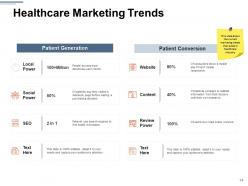
Analyze your expenditure and revenue effectively using these Financial Analysis in Healthcare Industry PowerPoint Presentation Slides. Take advantage of these accounting analysis PowerPoint visuals to depict the healthcare financing models, industry key statistics, healthcare marketing trends, etc. Take the assistance of this financial management PPT slideshow to demonstrate the two healthcare marketing trends namely the patient generation and patient conversion. Employ these healthcare analytics PowerPoint infographics to showcase the healthcare financing models such as social health insurance, voluntary health insurance amongst others. Facilitate comparison of healthcare expenditure across the globe using this financial analysis PowerPoint deck. Download these amazing PPT slides and increase your revenue. Portray the direct costs and indirect costs of your company using these accounting analysis PPT templates. Moreover, you can also show the components of the healthcare revenue cycle like claims submission, the start of a claim, A/R management, etc.
People who downloaded this PowerPoint presentation also viewed the following :
Content of this Powerpoint Presentation
Slide 1: This slide introduces Financial Analysis in Healthcare Industry. State Your Company Name and begin.
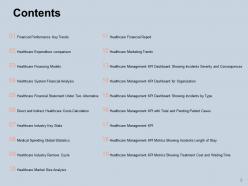
Slide 2: This slide shows Content of the presentation.
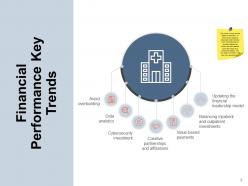
Slide 3: This slide presents Financial Performance Key Trends describing the current financial trends in healthcare industry.
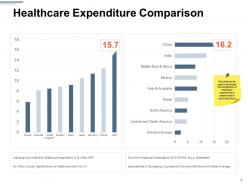
Slide 4: This slide represents Healthcare Expenditure Comparison describing the sources of revenue and finance available with the healthcare industries.
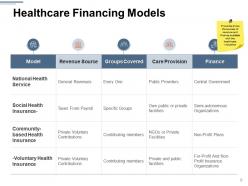
Slide 5: This slide displays Healthcare Financing Models used to show the financial system analysis in a healthcare industry.
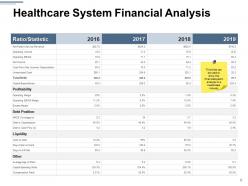
Slide 6: This slide showcases Healthcare System Financial Analysis comparing healthcare financial system on the basis of 2 alternatives i.e. equity and debt.
Slide 7: This slide shows Healthcare Financial Statement Under Two Alternatives i.e. direct and indirect costs.
Slide 8: This slide presents Direct and Indirect Healthcare Costs Calculation.
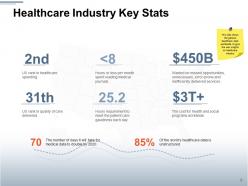
Slide 9: This slide displays Healthcare Industry Key Stats describing the general healthcare stats worldwide to give the user insights on healthcare industry.
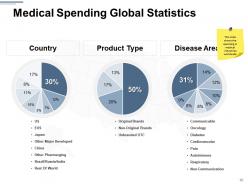
Slide 10: This slide represents Medical Spending Global Statistics of medical industries worldwide.
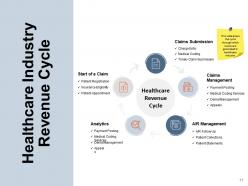
Slide 11: This slide showcases Healthcare Industry Revenue Cycle through which revenue is generated in healthcare industry.
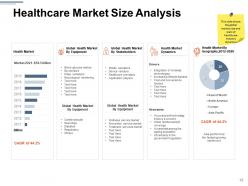
Slide 12: This slide shows Healthcare Market Size Analysis of healthcare industry dynamics.
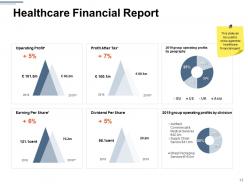
Slide 13: This slide presents Healthcare Financial Report.
Slide 14: This slide displays Healthcare Marketing Trends that exists in healthcare industry.
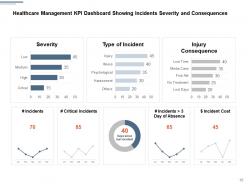
Slide 15: This slide represents Healthcare Management KPI Dashboard Showing Incidents Severity and Consequences.
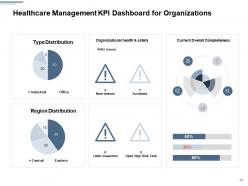
Slide 16: This slide showcases Healthcare Management KPI Dashboard for Organizations.
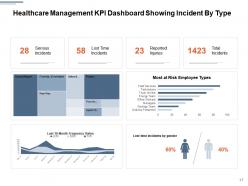
Slide 17: This slide shows Healthcare Management KPI Dashboard Showing Incident by Type.
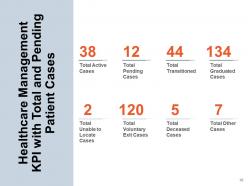
Slide 18: This slide presents Healthcare Management KPI with Total and Pending Patient Cases.
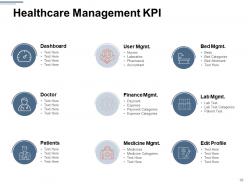
Slide 19: This slide displays Healthcare Management KPI with additional text boxes.
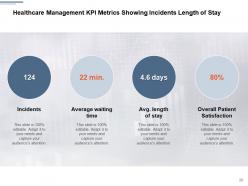
Slide 20: This slide represents Healthcare Management KPI Metrics Showing Incidents Length of Stay.
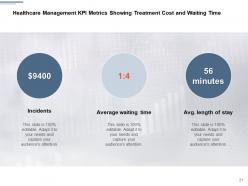
Slide 21: This slide showcases Healthcare Management KPI Metrics Showing Treatment Cost and Waiting Time.
Slide 22: This slide displays Financial Analysis in Healthcare Industry Icons.
Slide 23: This slide reminds about 15 minutes coffee break.
Slide 24: This slide is titled as Additional Slides for moving forward.
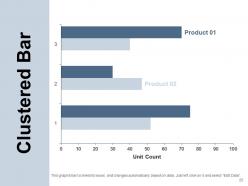
Slide 25: This slide displays Clustered Bar chart with two products comparison.
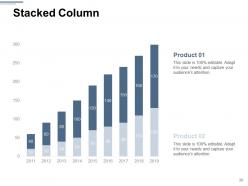
Slide 26: This slide shows Stacked Column with two products comparison.
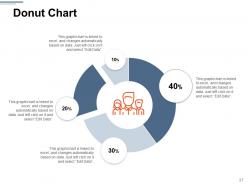
Slide 27: This slide showcases Donut Chart with data in percentage.
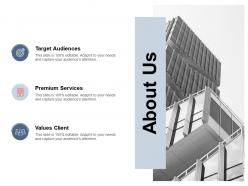
Slide 28: This is About us slide to show company specifications etc.
Slide 29: This is Meet Our Team slide with names and designation.
Slide 30: This is Our Mission slide with related imagery and text.
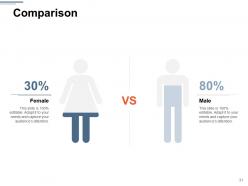
Slide 31: This is a Comparison slide to state comparison between commodities, entities etc.
Slide 32: This is a Timeline slide to show information related with time period.
Slide 33: This is another slide continuing timeline.
Slide 34: This is a Quotes slide to convey message, beliefs etc.
Slide 35: This slide shows Mind Map for representing entities.
Slide 36: This is a Target slide. State your targets here.
Slide 37: This is a Bulb or Idea slide to state a new idea or highlight information, specifications etc.
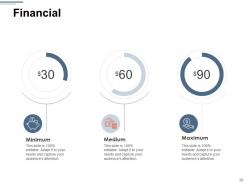
Slide 38: This is a Financial slide. Show your finance related stuff here.
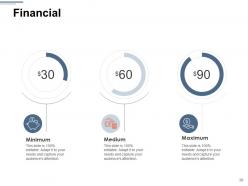
Slide 39: This is an optional Financial slide.
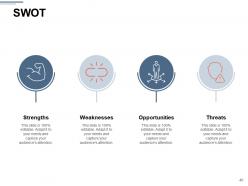
Slide 40: This is a SWOT slide. Describe your firm's Strengths, Weaknesses, Opportunities and Threats here.
Slide 41: This is a Venn slide with text boxes to show information.
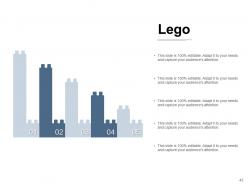
Slide 42: This is a Lego slide with additional text boxes.
Slide 43: This is a Puzzle slide with text boxes.
Slide 44: This is a Thank You slide with address, contact numbers and email address.
Financial Analysis In Healthcare Industry Powerpoint Presentation Slides with all 44 slides:
Use our Financial Analysis In Healthcare Industry Powerpoint Presentation Slides to effectively help you save your valuable time. They are readymade to fit into any presentation structure.












FAQs for Financial Analysis In Healthcare Industry
Honestly, I'd focus on five key ones. Operating margin shows if they're actually profitable from patient care - not just breaking even. Days cash on hand is huge because healthcare reimbursements are so unpredictable. Current ratio covers short-term liquidity basics. Then debt-to-equity and accounts receivable turnover, since medical organizations notoriously suck at collections. Those five will give you a really solid picture without getting overwhelmed by every metric out there.
So cost-effectiveness analysis is basically comparing healthcare options by looking at outcomes per dollar - like QALYs or patient results versus what you're spending. Super useful for figuring out which programs will actually give you the most impact with limited money. Honestly, it's a lifesaver when you're stuck choosing between good options but can't afford everything (story of healthcare, right?). The whole point is making those resource decisions less subjective by forcing you to put real numbers on costs and benefits. I'd start by nailing down your key metrics, then calculate incremental ratios for each option you're considering.
Think of financial forecasting as your crystal ball for hospital cash flow - where's money coming in and going out over the next few years? You'll need these numbers to make the big calls: can we buy that new MRI, expand cardiology, add more nursing staff? Honestly, it's like personal budgeting but with millions at stake and patient lives in the mix. The forecasts help you catch cash problems early and spot chances to grow. Oh, and check if your current forecasting actually drives decisions or just collects dust - I've seen too many hospitals where it's the latter.
You're basically throwing out everything you know about healthcare finance. No more counting visits and procedures - now you're tracking patient outcomes and quality scores across whole populations. Honestly, it's way messier than traditional models. Think risk-sharing deals, bundled payments, that kind of stuff instead of straightforward fee-for-service. Your models have to factor in shared savings and quality bonuses (plus penalties if things go south). I'd start building dashboards that show financial and clinical data side by side. They're tied together now whether we like it or not.
Honestly, the volume swings will drive you crazy - one month you're slammed, next month crickets. Patient demand is impossible to predict. Equipment costs are brutal too (when did everything medical get so expensive??). Then you've got insurance reimbursements changing constantly, which throws off all your numbers. Regulatory stuff shifts around a lot and messes with your projections. Build way bigger contingency funds than feels comfortable. Track your patterns obsessively so you can spot trends before they hit. Trust me on the buffer thing - you'll thank yourself later.
So here's the thing - financial analysis basically shows you where you're hemorrhaging money. Start by comparing your departments to industry benchmarks. You'll probably find some shocking stuff, like one unit mysteriously using double the supplies of everyone else (seriously, this happens more than you'd think). Look at cost per patient, overtime patterns, and how long people are staying. Equipment sitting unused? That's money down the drain. Supply chain mess-ups are usually hiding in plain sight too. Don't spread yourself thin though - hit your biggest cost centers first. Even shaving 5% there makes a real difference.
Look, revenue cycle management matters because it's literally how you track your money flow - from when patients book appointments until you actually get paid. Insurance companies love to delay and deny claims, so things get complicated quick. I'd start by checking your days in A/R and denial rates first. Those numbers will tell you exactly where you're hemorrhaging cash. Once you spot the bottlenecks, you can see which insurance companies are the worst offenders and fix the biggest problems. It's honestly one of those things that can make or break your practice's financial health.
Healthcare regs are a nightmare for financial reporting, honestly. HIPAA blocks patient data sharing, Stark Law messes with how you report referral revenue, and don't get me started on Medicare documentation requirements. The whole transparency thing is weird too - new price transparency rules want everything public, but privacy laws say the opposite. It's like they can't make up their minds. Start with your most restrictive regs first when building reports. That way you won't have to backtrack later. Then add transparency stuff where it's actually legal to do so.
Okay so for healthcare break-even, contribution margin analysis is definitely what you want. First thing - separate your fixed costs (rent, equipment, salaries) from variable costs per patient. Then figure out your contribution margin per service. I swear everyone screws up this calculation at first, but you'll get the hang of it. The tricky part is those semi-variable costs like staffing that changes with patient volume. Build different scenarios in Excel testing various patient loads and payer mixes - reimbursement rates are all over the place. Make sure your assumptions are easy to tweak when things inevitably change.
Here's the thing about healthcare tech decisions - you've gotta follow the money. Start tracking your current operational costs first, then use that as your baseline when vendors come knocking. Financial modeling shows you the real ROI on stuff like EHR upgrades or telemedicine platforms. Compare what you'll spend against actual savings from better efficiency and fewer errors. Honestly, some vendor pitches are total BS, but the numbers don't lie. Look at cash flows, payback periods, and total ownership costs. That way you're not just chasing the latest shiny object but actually investing in tech that helps patients AND your bottom line.
So healthcare finance is getting flipped upside down with value-based care. Instead of counting patient visits, you're now tracking quality scores and patient satisfaction - that's what drives reimbursement now. Digital stuff is exploding too. The ROI numbers on telehealth and AI are honestly getting crazy good. Population health is big - you'll be measuring cost per member and preventive care metrics. Oh, and dashboards are key. Build ones that mix your traditional financial KPIs with these newer outcome measures, because that's definitely where everything's moving.
Honestly, your whole KPI system needs an overhaul. Bed occupancy rates? Totally useless now. Instead you're tracking virtual visit volumes and tech infrastructure costs - which get expensive fast between cameras, software licenses, and IT support. Revenue gets messy too since you're dealing with subscription models and weird insurance reimbursement schedules. The real shift is going from physical asset stuff to measuring digital engagement and whether your tech investment is actually paying off. Oh, and definitely set up separate dashboards for telehealth vs in-person - trust me, you'll want to see those differences clearly.
Dude, demographics are everything for financial forecasting. Age hits hardest - older patients need way more expensive care. Where you're located changes your payer mix and what insurance actually pays you. Income levels? That's how much people can cover out-of-pocket. I learned this the hard way when our forecasts were completely off because we treated all patients the same. Geographic stuff matters more than you'd think too. Break your patients into demographic chunks and build separate models for each group. You'll actually get predictions that make sense instead of just guessing.
Basically, you're trying to figure out if this healthcare program will actually make money before you blow a bunch of resources on it. Run some cost-benefit analyses and forecast patient volumes - the usual stuff. Healthcare's tricky though because insurance reimbursements are unpredictable, plus regulations change constantly. I'd create three scenarios: conservative, optimistic, and pessimistic projections. Honestly, leadership loves seeing those options laid out. Better to catch red flags now than realize six months in that the whole thing's bleeding money. At least you'll have solid numbers to back up whatever decision you make.
Honestly, just start with Excel or Google Sheets - I know it's boring but you'll be using spreadsheets forever anyway. Most healthcare places I've worked at still run on them for budgets and basic modeling. PowerBI and Tableau are solid for the fancy visual stuff when you need to show revenue trends to executives. If you're already on Epic or Cerner, their financial modules work pretty well too. QuickBooks handles daily accounting tasks fine. Oh, and don't sleep on mastering Excel shortcuts - seriously saves so much time. Build from there once you know what specific analytics your place actually needs.
-
Unique research projects to present in meeting.
-
Qualitative and comprehensive slides.