


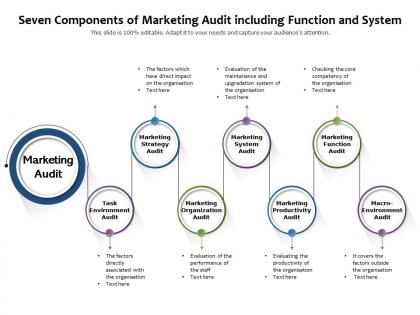
Seven components of marketing audit including function and system




Try Before you Buy Download Free Sample Product
 Impress Your
 Audience
 100%
100% Editable
 Save Hours
 of Time


Declare incentives for a good job with our Seven Components Of Marketing Audit Including Function And System. Entice folks into giving their best.
People who downloaded this PowerPoint presentation also viewed the following :
Seven components of marketing audit including function and system with all 2 slides:
Entice folks into giving their best with our Seven Components Of Marketing Audit Including Function And System. Declare incentives for a good job.
FAQs for Seven components of marketing audit including
Key marketing audit components include market analysis, competitive positioning, customer segmentation, brand performance, digital presence evaluation, and campaign effectiveness measurement. These comprehensive assessments enable organizations to identify strategic gaps, optimize resource allocation, and enhance customer targeting, with many businesses finding that regular audits streamline marketing operations while delivering improved ROI and competitive advantage.
A marketing audit helps assess brand performance by analyzing brand positioning, market perception, competitive differentiation, customer loyalty metrics, and messaging consistency across all touchpoints. Through comprehensive evaluation of brand equity, awareness levels, and customer sentiment, companies can identify positioning gaps, optimize marketing strategies, and strengthen brand recognition, ultimately delivering improved market share and enhanced customer engagement in an increasingly competitive landscape.
Competitor analyses provide critical benchmarking data for marketing strategy, pricing positioning, customer targeting approaches, and competitive differentiation opportunities within comprehensive marketing audits. These assessments reveal market gaps, successful tactics used by industry leaders, and strategic positioning weaknesses, enabling organizations to refine their marketing mix, optimize resource allocation, and ultimately deliver stronger competitive advantage in increasingly crowded marketplaces.
Businesses measure marketing effectiveness through ROI analysis, conversion tracking, customer acquisition costs, brand awareness metrics, and campaign performance data. These measurement approaches enable organizations to identify high-performing channels, optimize resource allocation, and enhance targeting strategies, with many companies finding that systematic auditing delivers improved conversion rates and competitive advantage.
Effective digital marketing audit tools include Google Analytics, SEMrush, Ahrefs, social media analytics platforms, and conversion tracking systems, alongside metrics like traffic sources, engagement rates, conversion funnels, and ROI calculations. These technologies streamline performance assessment by identifying content gaps, tracking competitor strategies, and measuring campaign effectiveness, with many organizations finding that comprehensive auditing ultimately delivers improved targeting and enhanced marketing spend efficiency.
**INPUT**: How does an internal/external SWOT analysis fit into the marketing audit process? **OUTPUT**: SWOT analysis serves as the strategic foundation of marketing audits by systematically evaluating internal strengths and weaknesses alongside external opportunities and threats. This comprehensive assessment enables organizations to identify competitive advantages, uncover market gaps, and align resources with strategic priorities, ultimately delivering data-driven insights that enhance marketing effectiveness and operational efficiency across diverse business environments. [Word count: 56 words]
Customer feedback provides critical insights into brand perception, customer satisfaction levels, product performance, and service quality gaps that internal metrics often miss. This external perspective enables organizations to identify disconnect between marketing messages and actual customer experiences, ultimately revealing opportunities to enhance customer retention, refine targeting strategies, and gain competitive advantage in increasingly customer-centric markets.
Businesses should conduct comprehensive marketing audits annually, with quarterly mini-audits focusing on performance metrics, campaign effectiveness, and competitive positioning changes. In rapidly evolving sectors like technology, retail, and financial services, more frequent assessments help organizations adapt strategies quickly, optimize resource allocation, and maintain competitive advantage in increasingly dynamic market conditions.
Social media performance can be evaluated through engagement metrics, reach and impressions, conversion tracking, audience growth rates, and content performance analysis. These assessments enable organizations to measure ROI across platforms like Facebook, Instagram, and LinkedIn, while identifying high-performing content strategies, optimizing posting schedules, and enhancing customer interaction quality, ultimately delivering improved brand visibility and stronger digital marketing outcomes.
Common pitfalls include relying on outdated data, focusing solely on metrics without strategic context, ignoring competitor analysis, and conducting audits in isolation from business objectives. Many organizations find that involving cross-functional teams, setting clear audit parameters, and maintaining objective perspectives delivers more actionable insights, ultimately enabling better resource allocation and strategic decision-making across marketing initiatives.
Marketing audit findings inform future strategies by identifying performance gaps, market opportunities, competitive positioning weaknesses, and resource allocation inefficiencies that require strategic adjustment. Through comprehensive analysis of customer data, campaign effectiveness, and market trends, organizations can pivot their approaches, optimize budget distribution, and enhance targeting precision, ultimately delivering improved ROI and stronger competitive advantage in an increasingly dynamic marketplace.
A comprehensive marketing communications audit should include message consistency analysis, channel performance evaluation, brand voice assessment, audience targeting effectiveness, content quality review, and competitive positioning analysis. These components work together by identifying messaging gaps, optimizing channel mix, and ensuring brand alignment across touchpoints, with many organizations finding that systematic audits reveal overlooked opportunities for improved engagement and conversion rates.
A marketing audit assists in budget allocation by analyzing past campaign performance, identifying high-ROI channels, evaluating audience engagement metrics, and revealing resource inefficiencies. Through comprehensive data analysis, organizations can strategically redistribute funds toward proven channels, eliminate underperforming investments, and optimize spend allocation, ultimately delivering improved campaign effectiveness and maximized marketing returns across future initiatives.
Assessing market trends and consumer behavior provides critical insights into shifting preferences, emerging opportunities, and competitive positioning within your industry landscape. This analysis enables organizations to identify gaps in current strategies, optimize resource allocation, and adapt messaging approaches, with many companies finding that trend-focused audits ultimately deliver enhanced customer targeting and sustainable competitive advantage.
Businesses leverage competitive advantages from marketing audits by realigning resource allocation toward high-performing channels, enhancing unique value propositions, and strengthening differentiation strategies. Through strategic repositioning, companies streamline marketing investments, accelerate customer acquisition in profitable segments, and optimize messaging across touchpoints, ultimately delivering improved market share and sustainable revenue growth while maximizing their distinct market position.
No Reviews