


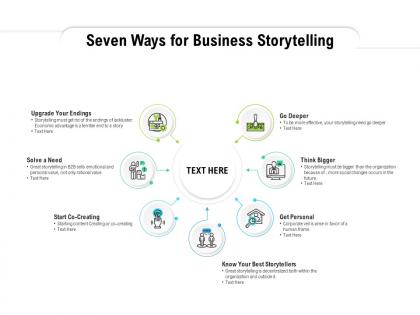
Seven ways for business storytelling




Try Before you Buy Download Free Sample Product
 Impress Your
 Audience
 100%
100% Editable
 Save Hours
 of Time


Our Seven Ways For Business Storytelling create happy customers. They help you deliver efficiently.
People who downloaded this PowerPoint presentation also viewed the following :
Seven ways for business storytelling with all 5 slides:
Broaden your consensus with our Seven Ways For Business Storytelling. They encourage convivial feelings.




FAQs for Seven ways
Compelling business stories include a relatable protagonist, clear conflict or challenge, emotional stakes, authentic details, and a meaningful resolution that demonstrates transformation. These elements work together by creating emotional connection, building credibility through specificity, and showing tangible outcomes, with many organizations finding that stories combining personal stakes with business results ultimately deliver stronger audience engagement and persuasive impact.
Storytelling enhances brand identity by creating emotional connections, establishing authentic values, and differentiating companies from competitors through memorable narratives that resonate with target audiences. These compelling stories build customer loyalty by fostering trust, encouraging engagement, and making brands more relatable, with many retail and service organizations finding that consistent storytelling significantly increases customer retention and advocacy.
Emotional engagement serves as the foundation of effective business storytelling, transforming data and facts into compelling narratives that resonate with audiences, drive decision-making, and inspire action. Through authentic emotional connections, organizations across industries like healthcare, financial services, and retail create memorable brand experiences, enhance customer loyalty, and ultimately achieve stronger market positioning and competitive advantage.
Businesses can measure storytelling effectiveness through engagement metrics, conversion rates, brand awareness surveys, customer retention data, and social media analytics. These measurement approaches enable organizations to track audience response, assess emotional connection, and evaluate business impact, with many companies finding that compelling narratives drive significantly higher customer engagement and ultimately deliver measurable competitive advantage.
Companies commonly make mistakes like creating generic narratives without differentiation, focusing solely on features rather than customer benefits, lacking authentic emotional connection, inconsistent messaging across channels, and neglecting audience-specific customization. These storytelling missteps often result in reduced brand engagement, weakened competitive positioning, and missed opportunities to build meaningful customer relationships, ultimately limiting business growth and market differentiation.
Visuals complement business stories by illustrating key data points, creating emotional connections through imagery, simplifying complex concepts, and reinforcing narrative themes throughout presentations. Through strategic charts, infographics, and compelling photography, organizations enhance audience engagement, improve information retention, and deliver more persuasive messaging, with many finding that visual storytelling accelerates decision-making processes.
Data integration in storytelling enhances credibility by transforming abstract narratives into evidence-backed presentations through statistical validation, trend analysis, and measurable outcomes. Strategic combinations of compelling visuals, relevant benchmarks, and industry-specific metrics enable organizations to deliver more persuasive pitches and stakeholder communications, ultimately strengthening trust while demonstrating tangible business impact.
Storytelling adaptation techniques include audience analysis, message customization, tone adjustment, language modification, and format optimization. These approaches enhance communication by tailoring narratives to specific demographics, cultural contexts, and professional backgrounds, with many organizations finding that customized storytelling significantly improves engagement, comprehension, and ultimately delivers stronger business outcomes across diverse stakeholder groups.
Cultural context significantly shapes business storytelling through communication styles, value systems, hierarchical norms, and audience expectations across different markets. Companies operating globally must adapt their narratives to resonate with local cultural nuances, with many finding that culturally-sensitive storytelling enhances customer engagement, builds stronger brand connections, and ultimately delivers more effective business outcomes.
Nike's "Just Do It" campaigns transform product marketing into personal empowerment narratives, while Patagonia weaves environmental activism throughout their corporate messaging, and Airbnb shares authentic host and traveler stories to build community trust. These approaches enhance brand connection by creating emotional resonance, differentiating from competitors, and building customer loyalty, with many organizations finding that authentic storytelling ultimately drives stronger engagement and business growth.
Leaders can use storytelling to inspire teams by sharing vision narratives, celebrating success stories, communicating challenges through relatable examples, and connecting individual contributions to larger organizational purposes. Through authentic storytelling, leaders create emotional engagement, build trust, and clarify strategic direction, with many organizations finding that narrative-driven leadership significantly enhances team motivation and organizational alignment.
The pyramid principle, hero's journey, problem-solution-benefit, and before-after-bridge frameworks prove most effective for business presentations, alongside situation-complication-resolution structures. These frameworks enhance audience engagement by creating logical flow, emotional connection, and clear value propositions, with many organizations finding that structured narratives increase message retention and drive stronger stakeholder buy-in.
Storytelling enables crisis management by providing transparent communication frameworks, humanizing organizational responses, and rebuilding stakeholder trust through authentic narratives. During reputation challenges, companies like Johnson & Johnson and Tylenol have leveraged strategic storytelling to acknowledge issues, demonstrate accountability, and showcase corrective actions, ultimately transforming crises into opportunities for stronger stakeholder relationships.
Authenticity significantly enhances brand story perception by building trust, emotional connection, and credibility with audiences who increasingly scrutinize corporate communications. When brands share genuine experiences, acknowledge challenges alongside successes, and maintain consistent messaging across touchpoints, they create deeper customer loyalty and differentiate themselves in competitive markets, ultimately driving stronger engagement and sustainable business relationships.
Startups can leverage storytelling by crafting compelling founder journeys, highlighting unique problem-solving approaches, showcasing customer transformation stories, and communicating their mission authentically across all touchpoints. These narrative strategies enable emerging companies to build emotional connections with investors and customers, establish brand identity in competitive sectors like fintech and healthcare, ultimately delivering memorable positioning and sustainable competitive advantage.
No Reviews