


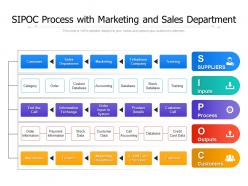
Sipoc process with marketing and sales department





Try Before you Buy Download Free Sample Product
 Impress Your
 Audience
 100%
100% Editable
 Save Hours
 of Time


Our SIPOC Process With Marketing And Sales Department focus on concerted effort. They help build a harmonious group.
People who downloaded this PowerPoint presentation also viewed the following :
Sipoc process with marketing and sales department with all 2 slides:
Avoid harrowing experiences with our SIPOC Process With Marketing And Sales Department. They help cater for any emergency.
FAQs for Sipoc process with marketing
The key components of a SIPOC diagram in marketing sales include Suppliers (data providers, lead sources), Inputs (customer data, market research), Process (lead qualification, nurturing workflows), Outputs (qualified leads, sales proposals), and Customers (prospects, existing clients). These elements streamline sales operations by mapping dependencies, identifying bottlenecks, and optimizing handoffs between marketing and sales teams, ultimately delivering improved conversion rates and enhanced customer experiences.
A SIPOC analysis helps identify marketing sales process gaps by mapping suppliers, inputs, processes, outputs, and customers to reveal missing connections, redundant steps, and resource inefficiencies. Through systematic process visualization, organizations can pinpoint where leads are lost, communication breaks down, and handoffs fail, ultimately streamlining sales funnels and enhancing customer conversion rates.
Suppliers in SIPOC marketing sales provide essential inputs like customer data, market research, content materials, advertising platforms, and lead generation tools. These suppliers, including data providers, marketing agencies, technology vendors, and research firms, enable sales teams to streamline prospecting, enhance customer targeting, and deliver more personalized campaigns, ultimately driving higher conversion rates and revenue growth.
Customer feedback enhances SIPOC marketing by identifying key customer requirements as outputs, revealing process gaps through voice-of-customer insights, and validating supplier performance against actual needs. This integration enables marketing teams to refine messaging strategies, optimize customer touchpoints, and streamline campaign processes, with many organizations finding that feedback-driven SIPOC analysis delivers more targeted campaigns and improved customer satisfaction rates.
Defining Inputs in marketing sales SIPOC presents challenges including identifying all data sources, qualifying lead parameters, resource allocation requirements, timing dependencies, and cross-departmental handoffs. These complexities arise because marketing inputs span multiple touchpoints, from initial brand awareness through lead nurturing, with many organizations finding that unclear input definitions lead to misaligned expectations and inefficient resource deployment across sales funnels.
A SIPOC diagram enhances communication among marketing and sales teams by clearly mapping suppliers, inputs, processes, outputs, and customers, creating shared understanding of workflows and interdependencies. This visual framework enables teams to identify handoff points, align on lead qualification criteria, and streamline processes from initial prospect identification through final customer delivery, ultimately reducing miscommunication and improving conversion rates.
**INPUT**: What metrics can be used to evaluate the Outputs in a SIPOC for marketing sales? **OUTPUT**: Key metrics for evaluating SIPOC marketing sales outputs include conversion rates, lead quality scores, customer acquisition costs, sales cycle length, and revenue attribution. These measurements enable organizations to streamline performance tracking, enhance pipeline efficiency, and deliver measurable ROI improvements, with many sales teams finding that systematic output evaluation ultimately drives competitive advantage. **Word count: 53 words**
A clearly defined Process in a SIPOC diagram improves lead conversion rates by mapping each touchpoint from initial contact to customer acquisition, identifying bottlenecks that cause prospect drop-off, and standardizing high-performing sales activities. This systematic approach enables sales teams to streamline follow-up sequences, reduce response times, and deliver consistent messaging, with many organizations finding conversion rates increase significantly through optimized process visibility.
Best practices for conducting SIPOC analysis in marketing campaigns include clearly defining campaign objectives, identifying all stakeholders from creative teams to customers, mapping detailed process flows, establishing measurable outputs like leads and conversions, and documenting success criteria upfront. These practices streamline campaign execution by enhancing cross-team collaboration, improving resource allocation, and enabling real-time performance tracking, with many marketing organizations finding that structured SIPOC frameworks ultimately deliver more targeted messaging and higher ROI.
Technology tools support SIPOC diagram creation and utilization through automation software, collaborative platforms, process mapping applications, data analytics dashboards, and cloud-based workflow systems. These technologies streamline diagram development by enabling real-time collaboration, automated data collection, and dynamic visualization, with many sales organizations finding that integrated platforms enhance process transparency, accelerate team alignment, and ultimately deliver improved customer conversion rates.
Marketing sales SIPOC diagrams should be revisited quarterly or when significant changes occur in processes, team structures, customer segments, or market conditions. Regular updates ensure the diagram accurately reflects current workflows, identifies new optimization opportunities, and maintains alignment between marketing and sales teams, with many organizations finding that consistent reviews enhance lead quality, streamline handoffs, and ultimately improve conversion rates.
Neglecting SIPOC in marketing sales strategies can result in misaligned processes, unclear customer requirements, inefficient resource allocation, and disconnected stakeholder communication. These gaps often lead to longer sales cycles, reduced conversion rates, and missed revenue targets, with many organizations finding that without structured process mapping, their marketing and sales teams operate in silos, ultimately diminishing competitive advantage.
Cross-functional teams can leverage SIPOC to enhance marketing sales initiatives by clearly mapping suppliers, inputs, processes, outputs, and customers across departments, eliminating communication gaps and redundant efforts. This strategic alignment enables marketing and sales teams to streamline lead generation, optimize customer handoffs, and accelerate conversion rates, with many organizations finding that shared process visibility ultimately delivers improved collaboration and measurable revenue growth.
Training resources for SIPOC analysis in marketing sales include process mapping workshops, customer journey certification programs, data analytics courses, cross-functional collaboration training, and lean methodology fundamentals. These educational approaches streamline team understanding by combining theoretical frameworks with hands-on practice, role-playing exercises, and real-world case studies, with many sales organizations finding that structured learning paths ultimately enhance pipeline visibility and customer acquisition efficiency.
Organizations use SIPOC to streamline customer journey mapping by identifying suppliers (lead sources), inputs (prospect data), processes (sales stages), outputs (qualified leads), and customers (target segments) within their sales funnel. This structured approach enables sales teams to eliminate bottlenecks, optimize touchpoints, and enhance handoffs between marketing and sales, ultimately delivering shorter cycle times and improved conversion rates.
No Reviews